Quetecsaurus
"fire lizard"
Type species Quetecsaurus rusconii
- Lived
- 94 to 90 million years ago, Late Cretaceous
- Diet
- Herbivore
- Group
- Sauropods
- Found in
- Argentina
- Named by
- González Riga and Ortiz David 2014
Where its fossils were found
The evidence
Today

90 million years ago
Habitat
A muddy floodplain with temporary pools that filled and dried out, crossed by river channels. Anabisetia, turtles, crocodiles and freshwater fish are also known from the Cerro Lisandro Formation.
Field notes
About Quetecsaurus
What it was like
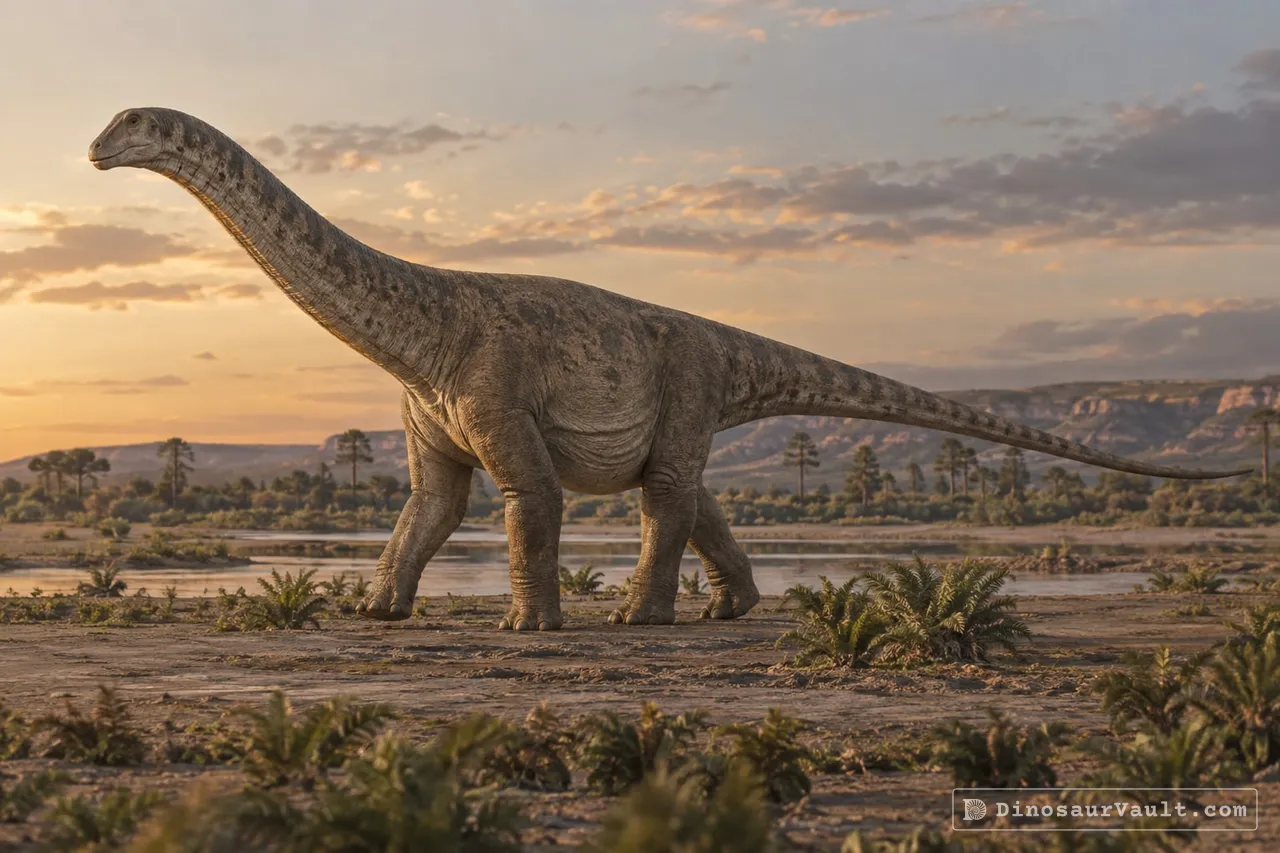
Quetecsaurus was a titanosaur, a long-necked plant eater related to Futalognkosaurus and Mendozasaurus. It is known from part of the skeleton.
Its world
It lived about 94 to 90 million years ago, in the Late Cretaceous, in what is now Argentina. It comes from the Cerro Lisandro Formation, where the small plant eater Anabisetia also lived.
How it was found
González Riga and Ortiz David named Quetecsaurus in 2014. The type species is Quetecsaurus rusconii. Its name comes from a local native word for fire, after a nearby volcano.
Field gallery
More views of Quetecsaurus
Scenes reconstructed from the available fossil evidence.
1 of 3
Lived alongside
Found in the same rock formations

A rock formation can hold fossils laid down millions of years apart, so not every animal here met Quetecsaurus.
The evidence
The science behind Quetecsaurus
Which parts of the picture come from its own bones, and which come from its relatives.
From its own fossils
- A partial skeleton of one animal preserves a bone from behind the eye, two teeth, the first and a rear neck vertebra, parts of a back vertebra and a tail vertebra, ribs, a shoulder bone, an upper arm bone, pieces of the forearm and five hand bones.
- Its rear neck vertebra has small sideways expansions at the top of its spine, and the top of its upper arm bone has a strong double curve.
- The hand bones were found partly joined in their original positions and form an upright, curved arch.
Borrowed from relatives
- The study that named it placed it next to the group formed by Mendozasaurus and Futalognkosaurus, as a preliminary result.
- Its missing face can be modeled on Tapuiasaurus, a titanosaur known from a skull.
Still unknown
- Its complete skull shape.
- Its full body length and weight.
- Whether its one tail vertebra comes from near the hips or farther back along the tail.
Discovery timeline
- 2014Named itRiga & David
- 2017Family treeCarballido et al.
- 2018Close relativeGonzàlez Riga et al.
Key papers
The research behind what we know of Quetecsaurus
Named it
Named Quetecsaurus from a partial skeleton and linked its neck anatomy to Mendozasaurus and Futalognkosaurus.
A New Titanosaur (Dinosauria, Sauropoda) from the Upper Cretaceous (Cerro Lisandro Formation) of Mendoza Province, Argentina. Ameghiniana 51: 3-25
Read the paper : A New Titanosaur (Dinosauria, Sauropoda) from the Upper Cretaceous (Cerro Lisandro Formation) of Mendoza Province, Argentina (opens in a new tab)Family tree
Named Patagotitan and tested the relationships and body-size evolution of the giant titanosaur group that includes relatives of Quetecsaurus.
A new giant titanosaur sheds light on body mass evolution among sauropod dinosaurs. Proceedings of the Royal Society B: Biological Sciences 284: 20171219
Read the paper : A new giant titanosaur sheds light on body mass evolution among sauropod dinosaurs (opens in a new tab)Close relative
Redescribed Mendozasaurus and tested relationships among its group, providing detailed comparisons for restoring the missing bones of Quetecsaurus.
Osteology of the Late Cretaceous Argentinean sauropod dinosaur Mendozasaurus neguyelap: implications for basal titanosaur relationships. Zoological Journal of the Linnean Society 184: 136-181
Read the paper : Osteology of the Late Cretaceous Argentinean sauropod dinosaur Mendozasaurus neguyelap: implications for basal titanosaur relationships (opens in a new tab)
Close relatives
Other members of Lognkosauria


Sources: Wikidata