Amazonsaurus
"Amazon lizard"
- Lived
- 120 to 106 million years ago, Early Cretaceous
- Diet
- Herbivore
- Group
- Sauropods, Rebbachisauridae
- Found in
- Brazil
- Named by
- Carvalho et al. 2003
Where its fossils were found
The evidence
Today

115 million years ago
Habitat
Rivers carried sand into a lake, building deltas in what is now northern Brazil. Turtles and mollusks were found in the same layer, and Dasosaurus is another sauropod recorded from the Itapecuru Formation.
Field notes
About Amazonsaurus
What it was like
Amazonsaurus was a rebbachisaur, a long-necked plant eater from a family related to Diplodocus. It is known from a few backbones and hip bones.
Its world
It lived in the Early Cretaceous in what is now northern Brazil. Its bones come from the Itapecuru Formation.
How it was found
Carvalho and colleagues named Amazonsaurus in 2003, from a single find. It was one of the first dinosaurs named from that part of Brazil.
Field gallery
More views of Amazonsaurus
Scenes reconstructed from the available fossil evidence.
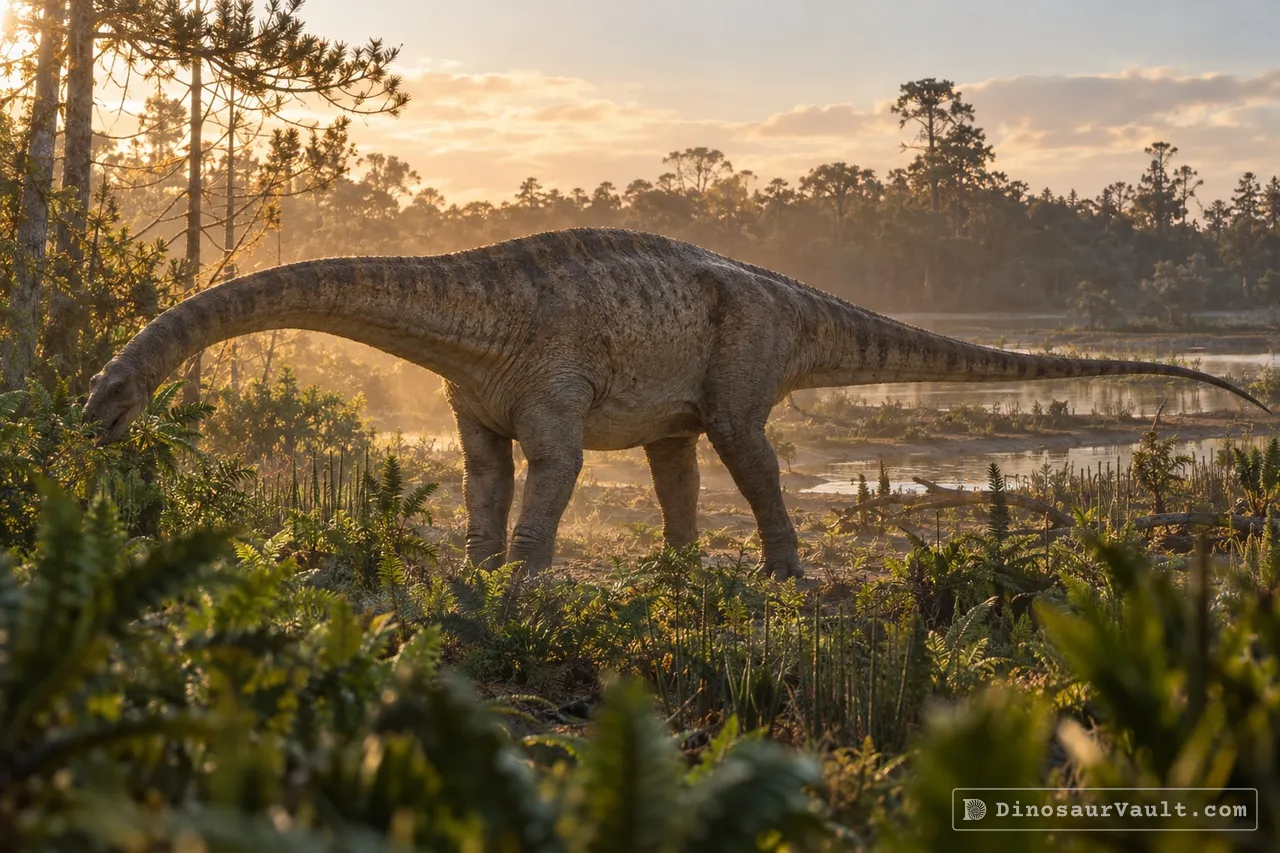
1 of 3
Lived alongside
Found in the same rock formations

A rock formation can hold fossils laid down millions of years apart, so not every animal here met Amazonsaurus.
The evidence
The science behind Amazonsaurus
Which parts of the picture come from its own bones, and which come from its relatives.
From its own fossils
- The find includes crushed back vertebrae, tail vertebrae, ribs and parts of the hips, all reported from a single animal.
- Its tail vertebrae have tall, backward-leaning spines, with thin side ridges of bone that bend forward.
- The partial hip bone is broad and tall, and may have held an air space inside.
Borrowed from relatives
- The missing head and neck are restored by comparison with Lavocatisaurus, a rebbachisaur known from much of its skull, with Nigersaurus as a guide to the top of the head and the eyes.
- The shoulders and limbs follow a general sauropod plan, using the more distant Mnyamawamtuka as a guide.
Still unknown
- The shape of its skull and teeth.
- Its complete body length and neck proportions.
- Its skin texture and color.
Discovery timeline
- 2003Named itde Souza Carvalho, dos Santos Avilla & Salgado
- 2007Close relativeSereno et al.
- 2015Family treeFanti et al.
- 2018Close relativeCanudo et al.
- 2019Close relativeLindoso et al.
Key papers
The research behind what we know of Amazonsaurus
Named it
Described the vertebrae, ribs and hip fragments of a new long-necked dinosaur from river and lake deposits in northern Brazil.
Amazonsaurus maranhensis gen. et sp. nov. (Sauropoda, Diplodocoidea) from the Lower Cretaceous (Aptian–Albian) of Brazil. Cretaceous Research 24: 697-713
Read the paper : Amazonsaurus maranhensis gen. et sp. nov. (Sauropoda, Diplodocoidea) from the Lower Cretaceous (Aptian–Albian) of Brazil (opens in a new tab)Close relative
Used scans to rebuild the skull of Nigersaurus, a rebbachisaur with an unusually broad muzzle and rows of packed teeth.
Structural Extremes in a Cretaceous Dinosaur. PLoS ONE 2: e1230
Read the paper : Structural Extremes in a Cretaceous Dinosaur (opens in a new tab)Family tree
Family-tree analyses placed Amazonsaurus among early-branching rebbachisaurs, with its exact position changing between methods.
New Information on Tataouinea hannibalis from the Early Cretaceous of Tunisia and Implications for the Tempo and Mode of Rebbachisaurid Sauropod Evolution. PLOS ONE 10: e0123475
Read the paper : New Information on Tataouinea hannibalis from the Early Cretaceous of Tunisia and Implications for the Tempo and Mode of Rebbachisaurid Sauropod Evolution (opens in a new tab)Close relative
Named Lavocatisaurus, a rebbachisaur from Argentina known from much of its skull and neck.
A new rebbachisaurid sauropod from the Aptian–Albian, Lower Cretaceous Rayoso Formation, Neuquén, Argentina. Acta Palaeontologica Polonica 63
Read the paper : A new rebbachisaurid sauropod from the Aptian–Albian, Lower Cretaceous Rayoso Formation, Neuquén, Argentina (opens in a new tab)Close relative
Named Itapeuasaurus and compared rebbachisaurs from northern Brazil, including the older Amazonsaurus.
A new rebbachisaurid (Sauropoda: Diplodocoidea) from the middle Cretaceous of northern Brazil. Cretaceous Research 104: 104191
Read the paper : A new rebbachisaurid (Sauropoda: Diplodocoidea) from the middle Cretaceous of northern Brazil (opens in a new tab)
Close relatives
Other members of Rebbachisauridae


Sources: Wikidata