Albalophosaurus
"white crest lizard"
Type species Albalophosaurus yamaguchiorum
- Lived
- 126 to 121 million years ago, Early Cretaceous
- Diet
- Herbivore
- Group
- Ceratopsians
- Found in
- Japan
- Named by
- Ohashi and Barrett 2009
Where its fossils were found
The evidence
Today

125 million years ago
Habitat
Its rocks record a humid floodplain with winding rivers, shallow lakes and swamps. Shirerpeton was a small amphibian from the same formation. Monjurosuchus was another reptile living in this river and lake region.
Field notes
About Albalophosaurus
What it was like
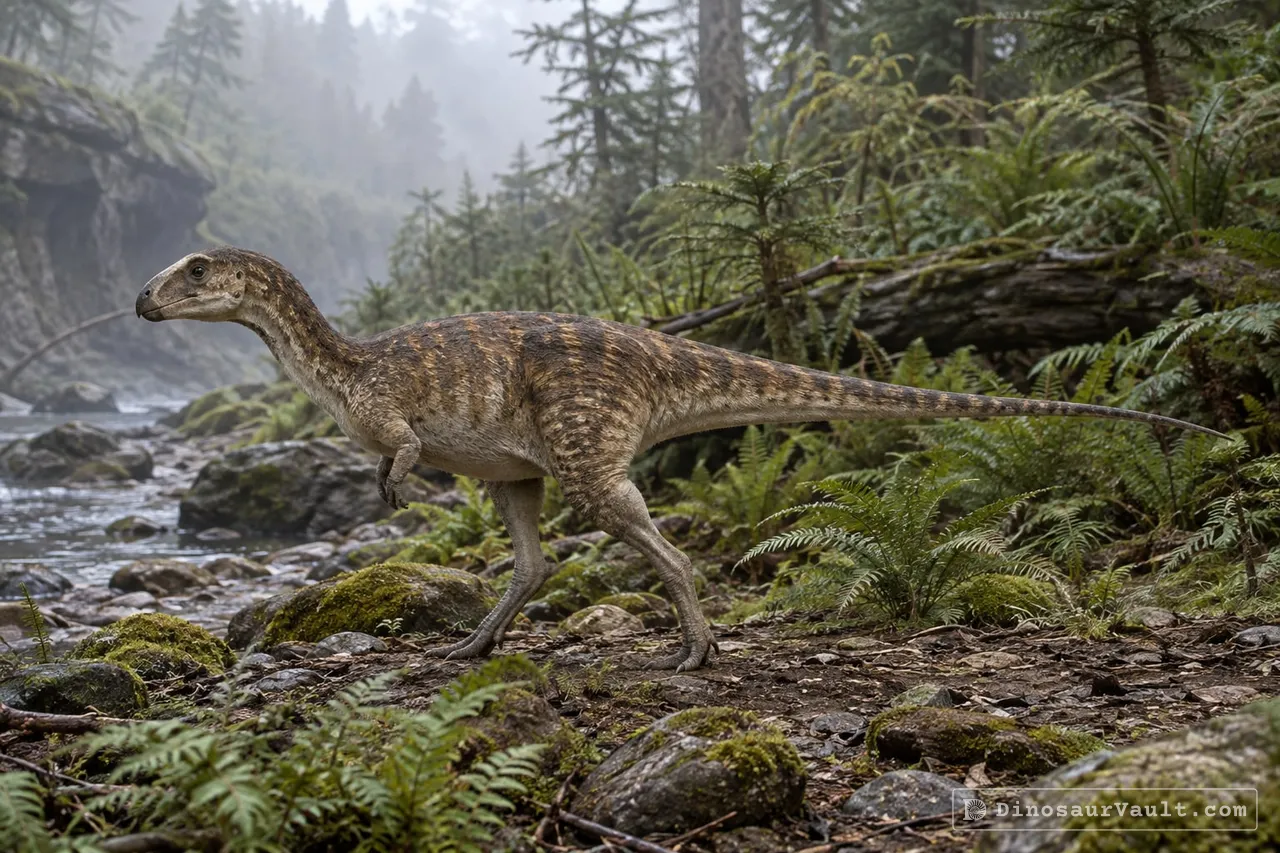
Albalophosaurus was a small plant eater known from a partial skull and some teeth. It was an early relative of the horned dinosaurs or the dome-headed dinosaurs, but its exact place is unclear.
Its world
It lived in the Early Cretaceous in what is now Japan. Its bones come from the Kuwajima Formation, rocks laid down near lakes and rivers.
How it was found
Ohashi and Barrett named Albalophosaurus in 2009, from a single find. The name refers to the white, snowy peak of the mountain near where it was found.
Field gallery
More views of Albalophosaurus
Scenes reconstructed from the available fossil evidence.
The evidence
The science behind Albalophosaurus
Which parts of the picture come from its own bones, and which come from its relatives.
From its own fossils
- Albalophosaurus is known from a partial skull and lower jaw.
- The teeth and tooth-bearing jaw bones have a distinctive combination of features that separates it from other small plant eaters.
Borrowed from relatives
- A body restored with slender legs and a balancing tail follows small plant eaters such as Hypsilophodon.
- Comparisons with early horned dinosaurs such as Psittacosaurus help explore its possible place in the family tree.
Still unknown
- Whether it belongs with the horned dinosaurs or another branch of small plant eaters.
- Its body proportions and adult size.
- Its skin covering and color.
Discovery timeline
- 2009Named itOhashi & Barrett
- 2017Its worldSano & Yabe
- 2018Same rocksMatsumoto & Evans
Key papers
The research behind what we know of Albalophosaurus
Named it
Described Albalophosaurus from a partial skull and jaw, finding a possible but weakly supported relationship with early horned dinosaurs.
A new ornithischian dinosaur from the Lower Cretaceous Kuwajima Formation of Japan. Journal of Vertebrate Paleontology 29: 748-757
Read the paper : A new ornithischian dinosaur from the Lower Cretaceous Kuwajima Formation of Japan (opens in a new tab)Its world
Reviewed animals and plants from the region, tracing changes in freshwater ecosystems and climate during the Early Cretaceous.
Fauna and flora of Early Cretaceous Tetori Group in Central Japan: The clues to revealing the evolution of Cretaceous terrestrial ecosystem in East Asia. Palaeoworld 26: 253-267
Read the paper : Fauna and flora of Early Cretaceous Tetori Group in Central Japan: The clues to revealing the evolution of Cretaceous terrestrial ecosystem in East Asia (opens in a new tab)Same rocks
Described a small amphibian from the Kuwajima Formation and detailed the humid river floodplain where its fossils were buried.
The first record of albanerpetontid amphibians (Amphibia: Albanerpetontidae) from East Asia. PLOS ONE 13: e0189767
Read the paper : The first record of albanerpetontid amphibians (Amphibia: Albanerpetontidae) from East Asia (opens in a new tab)
Close relatives
Other members of Ceratopsia


Sources: Wikidata