Adratiklit
"mountain lizard"
Type species Adratiklit boulahfa
- Lived
- 168 to 162 million years ago, Middle Jurassic
- Diet
- Herbivore
- Group
- Stegosaurs, Stegosauridae
- Found in
- Morocco
- Named by
- Maidment et al. 2020
Where its fossils were found
The evidence
Today

165 million years ago
Habitat
A muddy landscape in Middle Jurassic Morocco. The same rocks preserve the armored dinosaurs Spicomellus and Thyreosaurus.
Field notes
About Adratiklit
What it was like
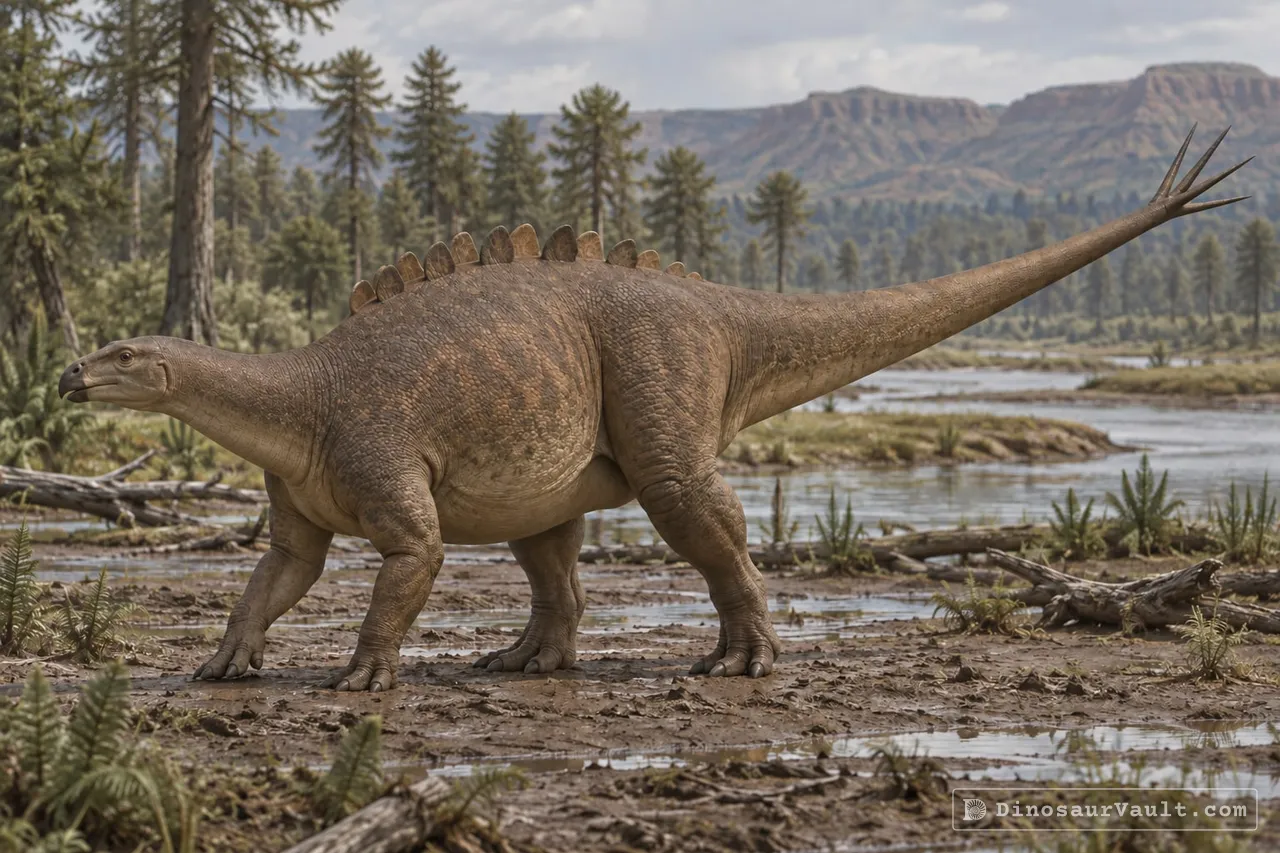
Adratiklit was a stegosaur, a plant eater with plates and spikes along its back and tail. It is known only from part of the backbone and an arm bone, so little is known about its exact shape.
Its world
It lived in the Middle Jurassic in what is now Morocco. Its bones come from the El Mers III Formation, which has also produced the spiky armored Spicomellus and Thyreosaurus.
How it was found
Maidment and colleagues named Adratiklit boulahfa in 2020, from a single find. It is one of the oldest stegosaurs known and one of very few from Africa, where fossils of these armored dinosaurs are rare.
Field gallery
More views of Adratiklit
Scenes reconstructed from the available fossil evidence.
1 of 3
Lived alongside
Found in the same rock formations


A rock formation can hold fossils laid down millions of years apart, so not every animal here met Adratiklit.
The evidence
The science behind Adratiklit
Which parts of the picture come from its own bones, and which come from its relatives.
From its own fossils
- Back vertebrae have distinctive roughened ridges near the joints where neighboring bones met.
- The back bones place it among stegosaurs related to Dacentrurus.
Borrowed from relatives
- Its small beaked head is restored from skull bones of a stegosaur closely related to Dacentrurus.
- Stegosaurus provides comparisons for the sturdy hindquarters, broad hind toes and tail spikes.
- The plates along its back are restored by comparison with other stegosaurs.
Still unknown
- The shape, number and arrangement of its plates and spikes.
- Its skull, feet and full body proportions.
- Whether the tentatively assigned neck bones and upper arm bone belong to it.
Discovery timeline
- 2009Close relativeMateus, Maidment & Christiansen
- 2015Close relativeMaidment, Brassey & Barrett
- 2020Named itMaidment et al.
Key papers
The research behind what we know of Adratiklit
Close relative
Described a long-necked relative of Dacentrurus with skull bones and plates, providing comparisons for parts missing in Adratiklit.
A new long-necked ‘sauropod-mimic’ stegosaur and the evolution of the plated dinosaurs. Proceedings of the Royal Society B: Biological Sciences 276: 1815-1821
Read the paper : A new long-necked ‘sauropod-mimic’ stegosaur and the evolution of the plated dinosaurs (opens in a new tab)Close relative
Described a nearly complete Stegosaurus skeleton, providing comparisons for the legs, feet and armor of less complete stegosaurs.
The Postcranial Skeleton of an Exceptionally Complete Individual of the Plated Dinosaur Stegosaurus stenops (Dinosauria: Thyreophora) from the Upper Jurassic Morrison Formation of Wyoming, U.S.A. PLOS ONE 10: e0138352
Read the paper : The Postcranial Skeleton of an Exceptionally Complete Individual of the Plated Dinosaur Stegosaurus stenops (Dinosauria: Thyreophora) from the Upper Jurassic Morrison Formation of Wyoming, U.S.A. (opens in a new tab)Named it
Named Adratiklit from distinctive back vertebrae and placed it closer to Dacentrurus than to Kentrosaurus.
North Africa's first stegosaur: Implications for Gondwanan thyreophoran dinosaur diversity. Gondwana Research 77: 82-97
Read the paper : North Africa's first stegosaur: Implications for Gondwanan thyreophoran dinosaur diversity (opens in a new tab)
Close relatives
Other members of Stegosauridae


Sources: Wikidata