Spicomellus
"spiked necklace"
Type species Spicomellus afer
- Lived
- 168 to 162 million years ago, Middle Jurassic
- Diet
- Herbivore
- Group
- Ankylosaurs
- Found in
- Morocco
- Named by
- Maidment et al. 2021
Where its fossils were found
The evidence
Today

165 million years ago
Habitat
It lived on land in Jurassic Morocco, in the region recorded by the El Mers III Formation. Other armored plant eaters from these rocks include Adratiklit and Thyreosaurus.
Field notes
About Spicomellus
What it was like
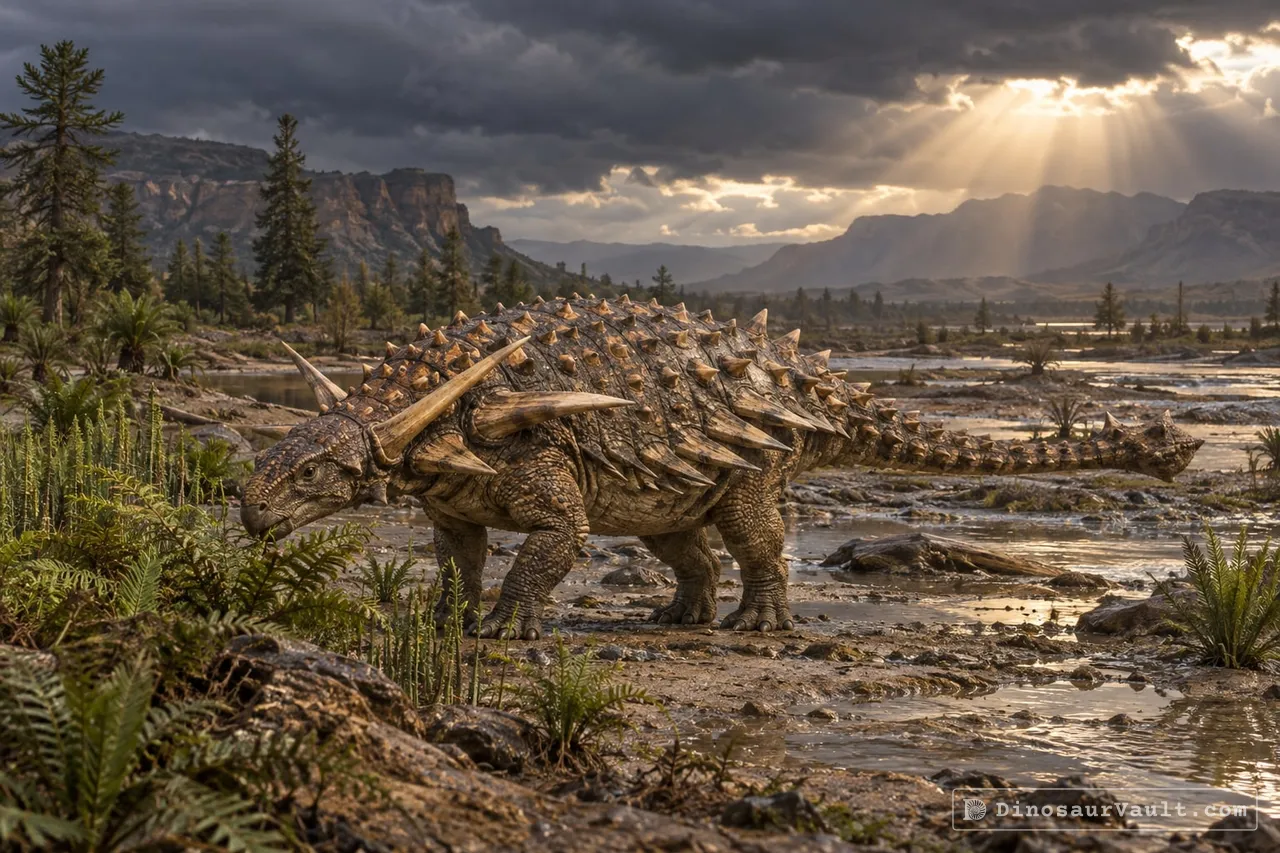
Spicomellus was an early ankylosaur covered in an unusual array of bony spines, including long spikes fused directly onto its ribs, a feature not seen in any other known dinosaur. Later finds added spikes around its neck and hips, along with a likely tail weapon, making it one of the earliest known ankylosaurs to carry this kind of defense. As a plant eater, it probably relied on this armor to protect itself from predators.
Its world
Spicomellus lived in what is now Morocco during the Middle Jurassic, about 168 million years ago. Its remains, from a single find, come from the El Mers III Formation, where it shared its habitat with the stegosaur Adratiklit and the little-known Thyreosaurus.
How it was found
Maidment and colleagues named Spicomellus in 2021, from a single rib bearing fused spikes. Later discoveries added more of the skeleton, revealing far more of its unusual armor than the first find suggested. It is among the oldest confirmed members of Ankylosauria, the armored dinosaur group that also includes Sarcolestes and Vectipelta.
Field gallery
More views of Spicomellus
Scenes reconstructed from the available fossil evidence.
1 of 4
Lived alongside
Found in the same rock formations


A rock formation can hold fossils laid down millions of years apart, so not every animal here met Spicomellus.
The evidence
The science behind Spicomellus
Which parts of the picture come from its own bones, and which come from its relatives.
From its own fossils
- The first fossil was a rib with bony spikes fused directly to its surface.
- A more complete skeleton shows a bony neck collar with long spikes projecting sideways, and large spikes over the hips.
- Stiffened tail vertebrae suggest that its tail carried a weapon.
Borrowed from relatives
- The missing skull and much of the limbs are restored from other early ankylosaurs, such as Gargoyleosaurus.
- A low body walking on all fours follows the build of other ankylosaurs.
Still unknown
- The shape of the weapon at the end of its tail.
- Its skull shape, full body size and color.
- How its armor changed as it grew.
Often drawn wrong
- Its spikes belong to distinct regions, including a neck collar and the hips, rather than an even porcupine-like coat.
- A definite rounded tail club like Ankylosaurus's is an unsupported addition.
Discovery timeline
- 2015Close relativesArbour & Currie
- 2021Named itMaidment et al.
- 2025New findMaidment et al.
Key papers
The research behind what we know of Spicomellus
Close relatives
Showed that stiffened tail bones evolved before large terminal knobs in later ankylosaurs, helping separate the parts of a tail weapon.
Ankylosaurid dinosaur tail clubs evolved through stepwise acquisition of key features. Journal of Anatomy 227: 514-523
Read the paper : Ankylosaurid dinosaur tail clubs evolved through stepwise acquisition of key features (opens in a new tab)Named it
Named an early African ankylosaur from a rib bearing spikes fused directly to the bone.
Bizarre dermal armour suggests the first African ankylosaur. Nature Ecology & Evolution 5: 1576-1581
Read the paper : Bizarre dermal armour suggests the first African ankylosaur (opens in a new tab)New find
Described a partial skeleton with a long-spiked neck collar, hip armor and tail bones suggesting an early tail weapon.
Extreme armour in the world’s oldest ankylosaur. Nature 647: 121-126
Read the paper : Extreme armour in the world’s oldest ankylosaur (opens in a new tab)
Close relatives
Other members of Ankylosauria


Sources: Wikidata