Igai
Type species Igai semkhu
- Lived
- 84 to 72 million years ago, Late Cretaceous
- Diet
- Herbivore
- Group
- Sauropods, Saltasauridae
- Found in
- Egypt
- Named by
- Gorscak et al. 2023
Where its fossils were found
The evidence
Today

80 million years ago
Habitat
The Quseir Formation records warm, wet river and lake habitats with flowering plants and ferns. Mansourasaurus also lived in this part of Egypt.
Field notes
About Igai
What it was like
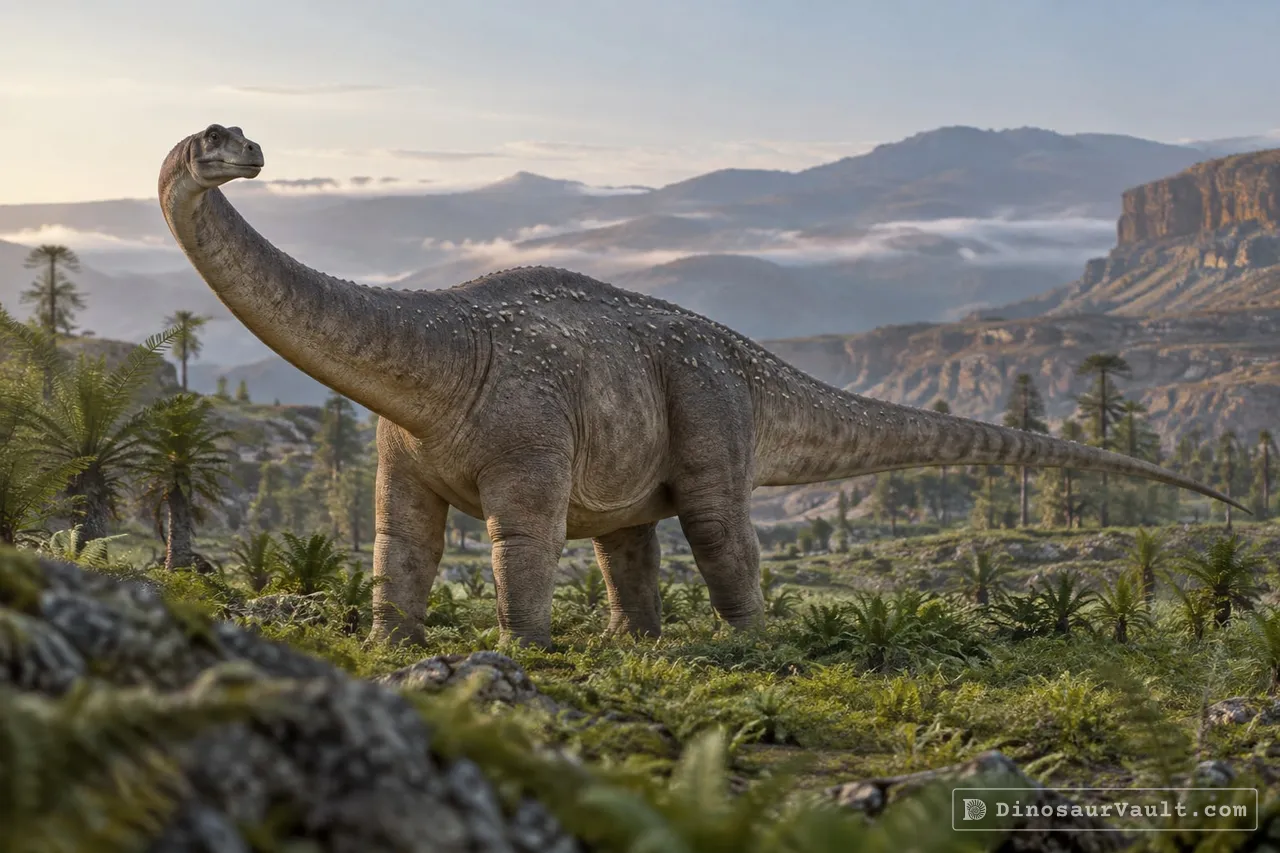
Igai was a titanosaur, a long-necked plant eater. It is known from part of the skeleton.
Its world
It lived in the Late Cretaceous, in what is now Egypt. It comes from the Quseir Formation, where the titanosaur Mansourasaurus also lived. Very few dinosaurs are known from Africa at this time.
How it was found
Gorscak and colleagues named Igai in 2023. The type species is Igai semkhu. The name comes from an ancient Egyptian god of an oasis.
Field gallery
More views of Igai
Scenes reconstructed from the available fossil evidence.
1 of 2
Lived alongside
Found in the same rock formations

A rock formation can hold fossils laid down millions of years apart, so not every animal here met Igai.
The evidence
The science behind Igai
Which parts of the picture come from its own bones, and which come from its relatives.
From its own fossils
- The partial skeleton preserves back vertebrae, a shoulder bone and parts of the arms, hands, legs and feet.
- Its limb bones are slender compared with those of many other titanosaurs.
- Small joint surfaces on the outermost hand bone may have supported finger bones.
Borrowed from relatives
- Its missing skull is compared with Tapuiasaurus, while Mendozasaurus provides a broader comparison for the neck and body.
- The missing fingers and toe tips are compared with Apatosaurus and Camarasaurus, respectively.
Still unknown
- Its complete body proportions and skull shape.
- Which titanosaurs were its closest relatives.
- Its skin covering and color.
Discovery timeline
- 2003Its worldMahmoud
- 2018Same rocksSallam et al.
- 2023Named itGorscak et al.
Key papers
The research behind what we know of Igai
Its world
Found pollen and spores showing flowering plants, ferns and aquatic vegetation in warm, wet river and lake habitats.
Palynology and palaeoenvironment of the Quseir Formation (Campanian) from central Egypt. Journal of African Earth Sciences 36: 135-148
Read the paper : Palynology and palaeoenvironment of the Quseir Formation (Campanian) from central Egypt (opens in a new tab)Same rocks
Named Mansourasaurus from the Quseir Formation and linked it with titanosaurs from Europe and Asia.
New Egyptian sauropod reveals Late Cretaceous dinosaur dispersal between Europe and Africa. Nature Ecology & Evolution 2: 445-451
Read the paper : New Egyptian sauropod reveals Late Cretaceous dinosaur dispersal between Europe and Africa (opens in a new tab)Named it
Described a slender-limbed titanosaur from Egypt and compared its relationships with other titanosaurs from Africa, Europe and Asia.
A new titanosaurian (Dinosauria: Sauropoda) from the Upper Cretaceous (Campanian) Quseir Formation of the Kharga Oasis, Egypt. Journal of Vertebrate Paleontology 42
Read the paper : A new titanosaurian (Dinosauria: Sauropoda) from the Upper Cretaceous (Campanian) Quseir Formation of the Kharga Oasis, Egypt (opens in a new tab)
Close relatives
Other members of Saltasauridae


Sources: Wikidata