Silutitan
"Silk Road titan"
Type species Silutitan sinensis
- Lived
- 137 to 133 million years ago, Early Cretaceous
- Diet
- Herbivore
- Group
- Sauropods, Euhelopodidae
- Found in
- China
- Named by
- Wang et al. 2021
Where its fossils were found
The evidence
Today

135 million years ago
Habitat
A lakeside landscape in China, with Silutitan buried in sandstone. Neighbors included Hamititan and Xiyunykus, as well as pterosaurs.
Field notes
About Silutitan
What it was like
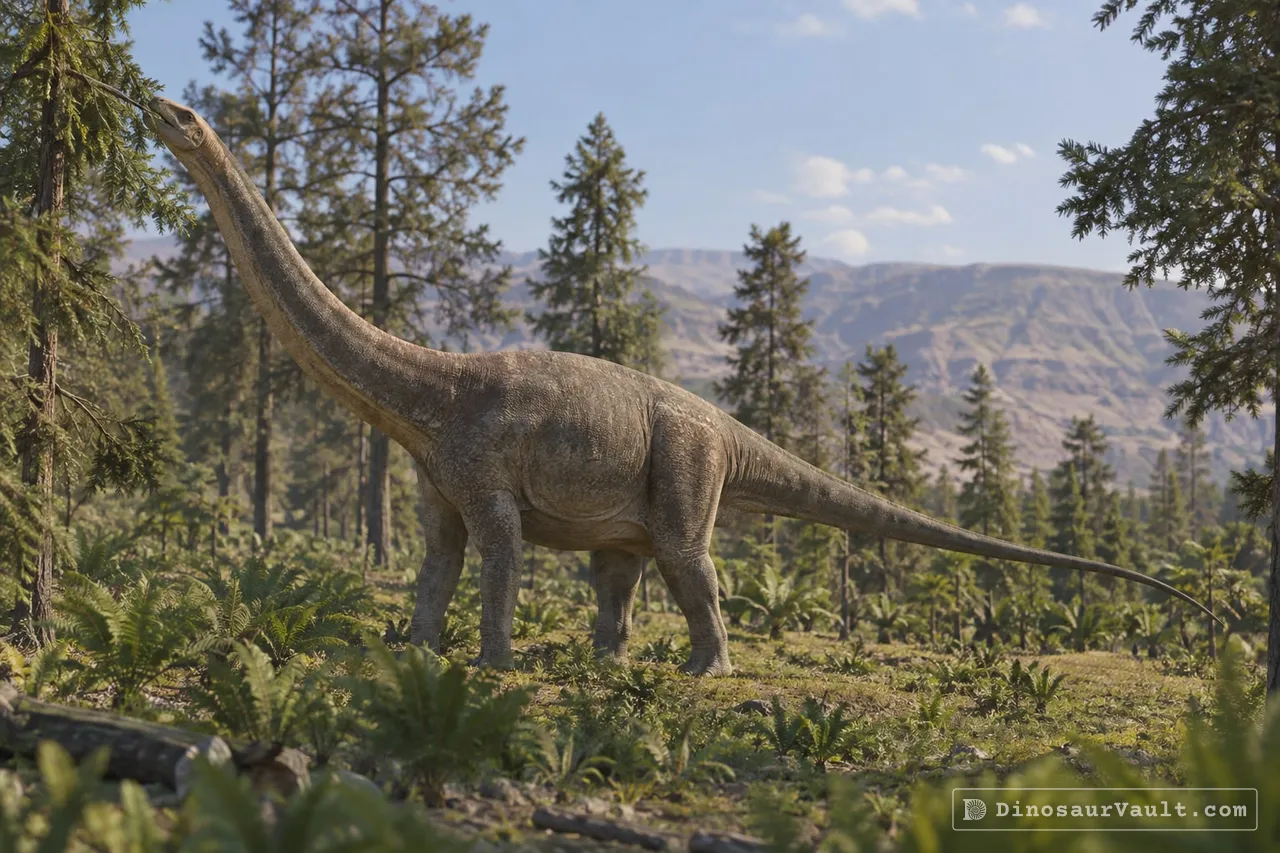
Silutitan was a long-necked, four-legged plant eater, a relative of Euhelopus, known from several neck bones.
Its world
It lived in the Early Cretaceous in what is now northwestern China. Its bones come from the Shengjinkou Formation, where it shared the land with the titanosaur Hamititan and the early alvarezsaur Xiyunykus. Its bones were found near many pterosaur fossils.
How it was found
Wang and colleagues named Silutitan in 2021, from a single find.
Field gallery
More views of Silutitan
Scenes reconstructed from the available fossil evidence.
Lived alongside
Found in the same rock formations


A rock formation can hold fossils laid down millions of years apart, so not every animal here met Silutitan.
The evidence
The science behind Silutitan
Which parts of the picture come from its own bones, and which come from its relatives.
From its own fossils
- The type specimen is a connected series of six neck vertebrae that preserves most of the accompanying neck ribs.
- Branching bony ridges, flanges on the underside and a narrowing where each rib meets its vertebra help distinguish Silutitan from other sauropods.
- The spines on top of the rearmost vertebrae in the series are low and short.
Borrowed from relatives
- The missing head and the front of the neck are compared with Euhelopus, its closest relative in the naming paper's family trees.
- The trunk, legs and tail follow the general build of Mnyamawamtuka, a better known sauropod from the same broad group.
Still unknown
- Its complete body length and proportions.
- Whether Silutitan and Hamititan could be parts of the same kind of sauropod.
- How it and Euhelopus fit among other sauropods, which is still debated.
Discovery timeline
- 2009Close relativeWilson & Upchurch
- 2013SkullPoropat & Kear
- 2017Same rocksWang et al.
- 2021Named itWang et al.
Key papers
The research behind what we know of Silutitan
Close relative
Restudied Euhelopus and placed this long-necked sauropod close to titanosaurs, making it the main comparison for Silutitan.
Redescription and reassessment of the phylogenetic affinities of euhelopus zdanskyi (Dinosauria: Sauropoda) from the early cretaceous of China. Journal of Systematic Palaeontology 7: 199-239
Read the paper : Redescription and reassessment of the phylogenetic affinities of euhelopus zdanskyi (Dinosauria: Sauropoda) from the early cretaceous of China (opens in a new tab)Skull
Photographed and digitally rebuilt the skull of Euhelopus, the closest guide to Silutitan's unknown head.
Photographic Atlas and Three-Dimensional Reconstruction of the Holotype Skull of Euhelopus zdanskyi with Description of Additional Cranial Elements. PLoS ONE 8: e79932
Read the paper : Photographic Atlas and Three-Dimensional Reconstruction of the Holotype Skull of Euhelopus zdanskyi with Description of Additional Cranial Elements (opens in a new tab)Same rocks
Described pterosaur eggs and embryos from the fossil beds that later yielded Silutitan.
Egg accumulation with 3D embryos provides insight into the life history of a pterosaur. Science 358: 1197-1201
Read the paper : Egg accumulation with 3D embryos provides insight into the life history of a pterosaur (opens in a new tab)Named it
Named Silutitan from neck bones and found it closely related to Euhelopus.
The first dinosaurs from the Early Cretaceous Hami Pterosaur Fauna, China. Scientific Reports 11
Read the paper : The first dinosaurs from the Early Cretaceous Hami Pterosaur Fauna, China (opens in a new tab)
Close relatives
Other members of Euhelopodidae


Sources: Wikidata