Vitosaura
Type species Vitosaura colozacani
- Lived
- 84 to 72 million years ago, Late Cretaceous
- Diet
- Carnivore
- Group
- Theropods, Abelisauridae
- Found in
- Argentina
- Named by
- Jiménez Velandia et al. 2025
Where its fossils were found
The evidence
Today

80 million years ago
Habitat
The Los Llanos Formation records a partly dry landscape where streams and wind spread sand across well-drained, vegetated ground. Titanosaurs nested in soils preserved in the same formation.
Field notes
About Vitosaura
What it was like
Vitosaura was an abelisaurid, a two-legged predator from the family that includes Carnotaurus. It is known from a partial skeleton. Like its relatives, it probably had a short, deep head and very small arms.
Its world
It lived in the Late Cretaceous in what is now Argentina. Its bones come from the Los Llanos Formation, in the north of the country, far from the better known dinosaur sites of the south.
How it was found
Jiménez Velandia and colleagues named it in 2025 from one find. The type species is Vitosaura colozacani.
Field gallery
More views of Vitosaura
Scenes reconstructed from the available fossil evidence.
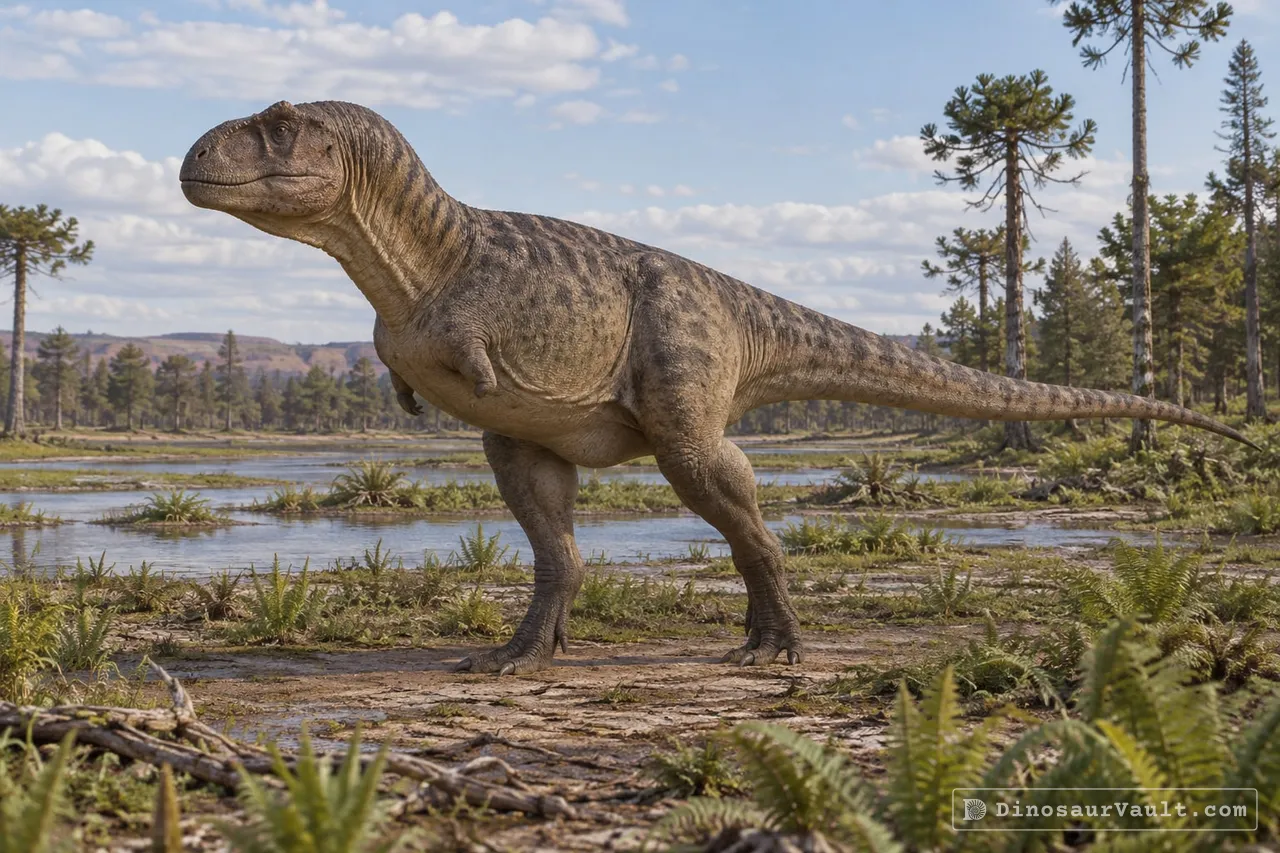
1 of 2
The evidence
The science behind Vitosaura
Which parts of the picture come from its own bones, and which come from its relatives.
From its own fossils
- The partial skeleton preserves back vertebrae, part of the backbone at the hips and bones from the left side of the pelvis.
- A groove crosses the top of a vertebral spine, and a pelvic bone has an unusually tapering shaft.
Borrowed from relatives
- The missing head and neck are modeled on Majungasaurus, suggesting a deep skull and muscular neck.
- Majungasaurus also guides the probably short arms, reduced hands and sturdy feet.
Still unknown
- The shape of its head and any horns or other ornaments.
- Its full body proportions and closest relatives within the abelisaurids.
- Its skin covering and color.
Often drawn wrong
- The groove in its vertebral spine is an internal skeletal feature, rather than an exposed notch in its back.
Discovery timeline
- 2017Close relativeBurch
- 2017Its worldBasilici et al.
- 2025Named itVelandia et al.
Key papers
The research behind what we know of Vitosaura
Close relative
Reconstructed muscles in the short arms of Majungasaurus, a useful comparison for the missing forelimbs of Vitosaura.
Myology of the forelimb of Majungasaurus crenatissimus (Theropoda, Abelisauridae) and the morphological consequences of extreme limb reduction. Journal of Anatomy 231: 515-531
Read the paper : Myology of the forelimb of Majungasaurus crenatissimus (Theropoda, Abelisauridae) and the morphological consequences of extreme limb reduction (opens in a new tab)Its world
Showed how slowly accumulating sandy soils in a semiarid landscape buried and preserved titanosaur egg clutches in the Los Llanos Formation.
Preservation of titanosaur egg clutches in Upper Cretaceous cumulative palaeosols (Los Llanos Formation, La Rioja, Argentina). Palaeogeography, Palaeoclimatology, Palaeoecology 482: 83-102
Read the paper : Preservation of titanosaur egg clutches in Upper Cretaceous cumulative palaeosols (Los Llanos Formation, La Rioja, Argentina) (opens in a new tab)Named it
Named an abelisaurid from back and pelvic bones with an unusual combination of skeletal features.
A New Late Cretaceous Abelisaurid Species from La Rioja Province, Northwestern Argentina. Ameghiniana 62: 505-527
Read the paper : A New Late Cretaceous Abelisaurid Species from La Rioja Province, Northwestern Argentina (opens in a new tab)
Close relatives
Other members of Abelisauridae


Sources: Wikidata