Transylvanosaurus
"lizard from beyond the forest"
- Lived
- 72 to 66 million years ago, Late Cretaceous
- Diet
- Herbivore
- Group
- Ornithopods
- Found in
- Romania
- Named by
- Augustin et al. 2022
Where its fossils were found
The evidence
Today

Habitat
It lived on an island with winding rivers and floodplains that were dry for part of the year. Zalmoxes, Telmatosaurus and Magyarosaurus also lived in this region of what is now Romania.
Field notes
About Transylvanosaurus
What it was like
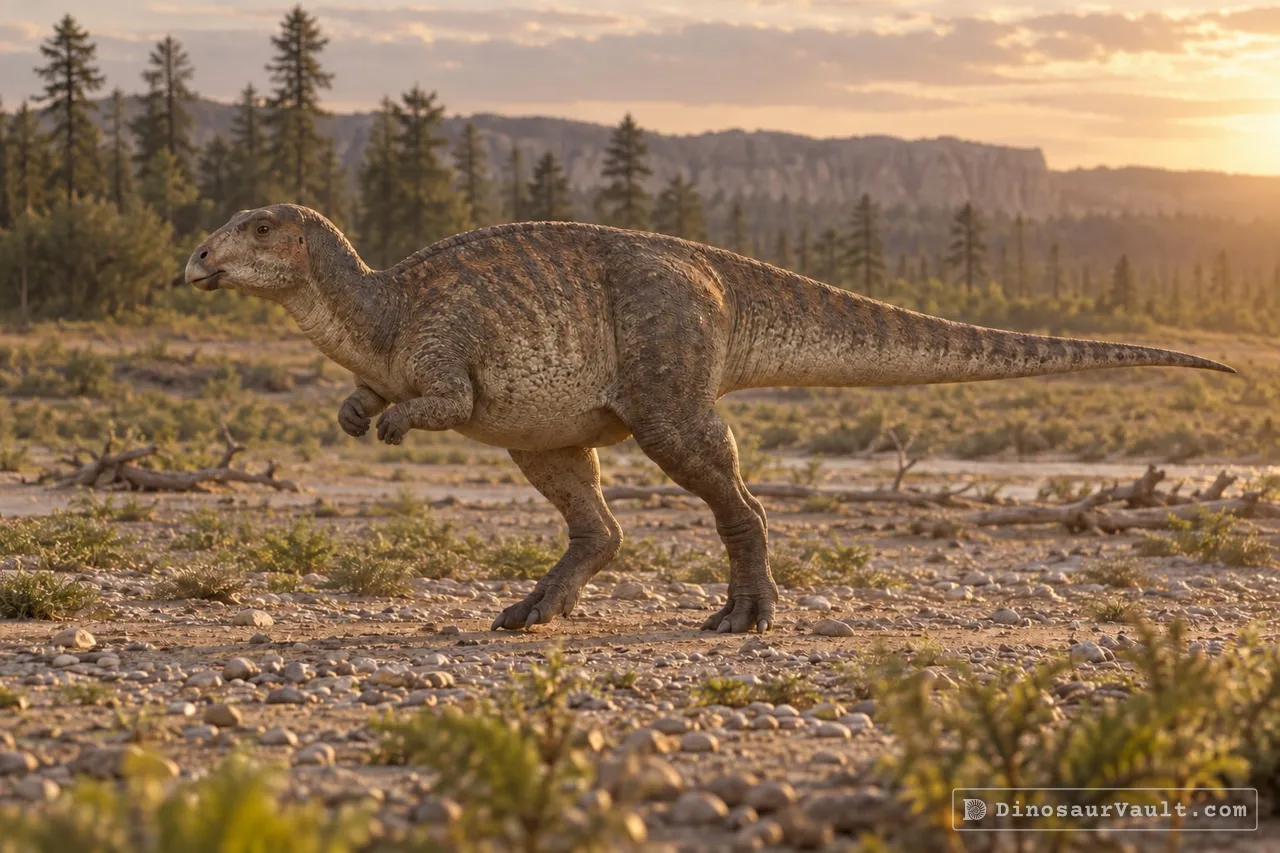
Transylvanosaurus was a small plant eater related to Rhabdodon. It is known from part of a skull.
Its world
It lived about 72 to 66 million years ago, near the end of the Cretaceous, in what is now Romania. It shared an island world with the small plant eater Zalmoxes, the duckbill relative Telmatosaurus and the dwarf sauropod Magyarosaurus. Its skull looks more like those of French relatives than local ones.
How it was found
Augustin and colleagues named Transylvanosaurus in 2022.
Field gallery
More views of Transylvanosaurus
Scenes reconstructed from the available fossil evidence.
1 of 3
Lived alongside
Found in the same rock formations


A rock formation can hold fossils laid down millions of years apart, so not every animal here met Transylvanosaurus.
The evidence
The science behind Transylvanosaurus
Which parts of the picture come from its own bones, and which come from its relatives.
From its own fossils
- The type specimen consists of the braincase and paired bones from the roof of the skull.
- The skull-roof bones are unusually wide and carry a ridge across their front.
- A conference report by the authors assigned another partial skull to Transylvanosaurus because of its broad frontal with a front ridge. It includes that skull-roof bone, a toothless part of the upper jaw and part of the lower jaw with teeth.
Borrowed from relatives
- The missing front of the snout and body are inferred from broader iguanodontian comparisons such as Iani.
- The naming study compared its braincase with Rhabdodon from France and found closer similarities than with the local Zalmoxes.
- Fona supplies a broader comparison for the missing hands and feet.
Still unknown
- The complete shape of its jaws, limbs and tail.
- Its full-grown size, skin texture and color.
- Its exact closest relatives.
Discovery timeline
- 2003Same rocksWeishampel et al.
- 2012Its worldŐsi et al.
- 2022Named itAugustin et al.
- 2023Full descriptionZanno et al.
- 2024Full descriptionAvrahami et al.
Key papers
The research behind what we know of Transylvanosaurus
Same rocks
Described the skeleton of Zalmoxes, a plant eater from the same rocks, and its resemblance to Rhabdodon.
Osteology and phylogeny of Zalmoxes (n. g.), an unusual Euornithopod dinosaur from the latest Cretaceous of Romania. Journal of Systematic Palaeontology 1: 65-123
Read the paper : Osteology and phylogeny of Zalmoxes (n. g.), an unusual Euornithopod dinosaur from the latest Cretaceous of Romania (opens in a new tab)Its world
Compared growth and size in Mochlodon, Zalmoxes and Rhabdodon.
Phylogeny, Histology and Inferred Body Size Evolution in a New Rhabdodontid Dinosaur from the Late Cretaceous of Hungary. PLoS ONE 7: e44318
Read the paper : Phylogeny, Histology and Inferred Body Size Evolution in a New Rhabdodontid Dinosaur from the Late Cretaceous of Hungary (opens in a new tab)Named it
Named Transylvanosaurus from a broad partial skull and proposed a close relationship with Rhabdodon from France.
A new ornithopod dinosaur, Transylvanosaurus platycephalus gen. et sp. nov. (Dinosauria: Ornithischia), from the Upper Cretaceous of the Haţeg Basin, Romania. Journal of Vertebrate Paleontology 42
Read the paper : A new ornithopod dinosaur, Transylvanosaurus platycephalus gen. et sp. nov. (Dinosauria: Ornithischia), from the Upper Cretaceous of the Haţeg Basin, Romania (opens in a new tab)Full description
Described Iani from skull and body bones, providing broader iguanodontian comparisons for the missing snout and body of Transylvanosaurus.
An early-diverging iguanodontian (Dinosauria: Rhabdodontomorpha) from the Late Cretaceous of North America. PLOS ONE 18: e0286042
Read the paper : An early-diverging iguanodontian (Dinosauria: Rhabdodontomorpha) from the Late Cretaceous of North America (opens in a new tab)Full description
Described hand and foot bones of Fona that provide broader comparisons for the missing hands and feet of Transylvanosaurus.
A new semi‐fossorial thescelosaurine dinosaur from the Cenomanian‐age Mussentuchit Member of the Cedar Mountain Formation, Utah. The Anatomical Record 307: 3717-3781
Read the paper : A new semi‐fossorial thescelosaurine dinosaur from the Cenomanian‐age Mussentuchit Member of the Cedar Mountain Formation, Utah (opens in a new tab)
Close relatives
Other members of Rhabdodontomorpha


Sources: Wikidata