Tralkasaurus
"thunder lizard"
Type species Tralkasaurus cuyi
- Lived
- Early Cretaceous
- Diet
- Carnivore
- Group
- Theropods, Abelisauridae
- Found in
- Argentina
- Named by
- Cerroni et al. 2020
Where its fossils were found
The evidence
Today

Habitat
It probably hunted on river plains in what is now Argentina. The Huincul Formation also preserves Ilokelesia, Skorpiovenator and Taurovenator.
Field notes
About Tralkasaurus
What it was like
Tralkasaurus was a medium-sized abelisaur, a two-legged hunter with a short head and tiny arms. It is known from part of a skeleton, including a piece of the upper jaw.
It was smaller than most of its relatives, and may have hunted smaller prey than the giant hunters it lived with.
Its world
It lived in the Cretaceous in what is now Argentina. Its bones come from the Huincul Formation, where it shared the land with the giant Argentinosaurus and the big hunters Mapusaurus and Meraxes.
How it was found
Cerroni and colleagues named Tralkasaurus in 2020, from a single find.
Field gallery
More views of Tralkasaurus
Scenes reconstructed from the available fossil evidence.
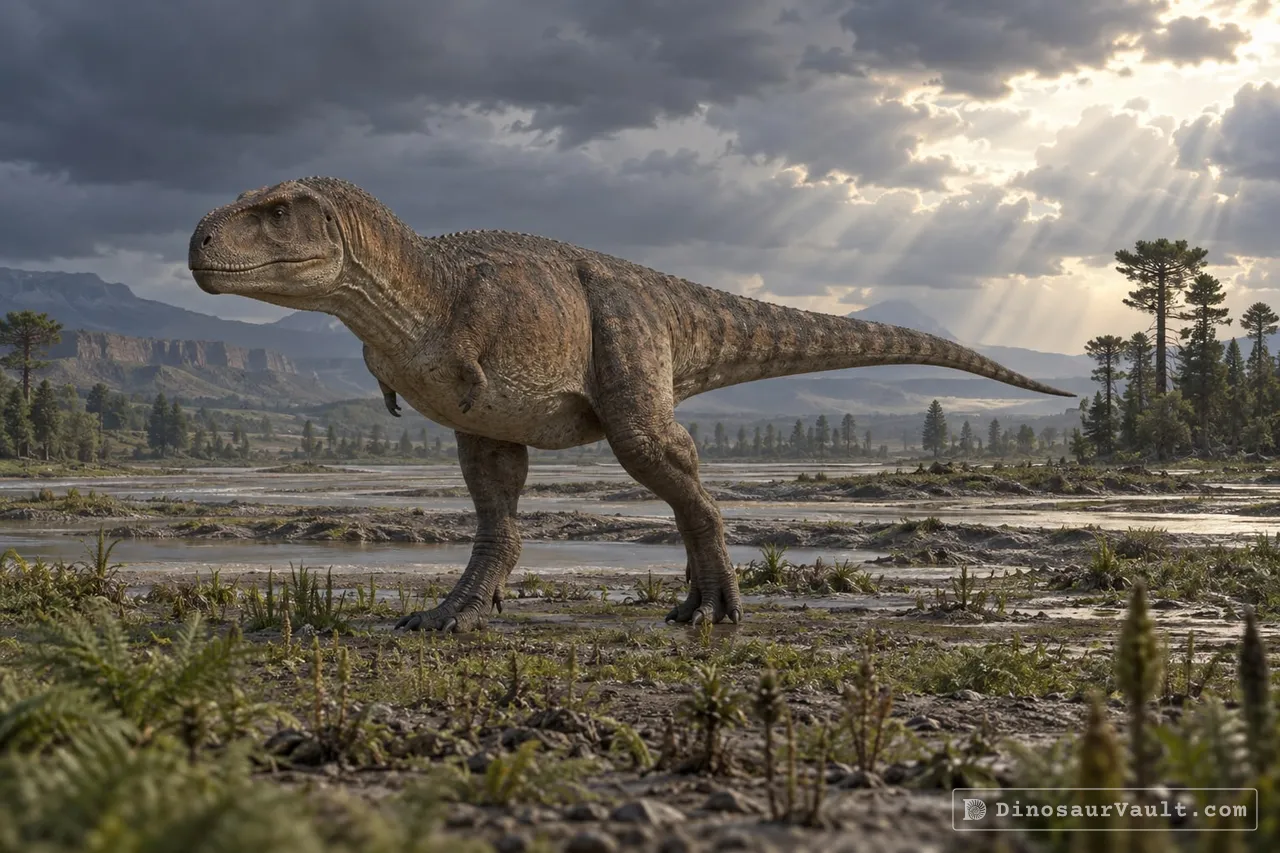
The evidence
The science behind Tralkasaurus
Which parts of the picture come from its own bones, and which come from its relatives.
From its own fossils
- The incomplete type skeleton includes part of the upper jaw, backbone, neck ribs and a hip bone.
- The preserved back vertebra and its bony side projections contain small internal air chambers connected to its breathing system.
- The preserved upper jaw is deep, with rough areas and small openings for nerves and blood vessels.
Borrowed from relatives
- Majungasaurus provides comparisons for the missing parts of the skull, the shortened forearms and reduced hands, and the feet.
Still unknown
- The complete shape of its skull.
- Which animals it hunted.
- Its skin color.
Discovery timeline
- 2008Same rocksCanale et al.
- 2017Full descriptionBurch
- 2020Named itCerroni et al.
- 2025Inside the bonesZurriagus & Cerroni
Key papers
The research behind what we know of Tralkasaurus
Same rocks
Described Skorpiovenator, an abelisaurid from the same formation, and examined relationships within the family.
New carnivorous dinosaur from the Late Cretaceous of NW Patagonia and the evolution of abelisaurid theropods. Naturwissenschaften 96: 409-414
Read the paper : New carnivorous dinosaur from the Late Cretaceous of NW Patagonia and the evolution of abelisaurid theropods (opens in a new tab)Full description
Studied the very short forearm and reduced hand of Majungasaurus, an abelisaurid used as a comparison for the missing arms.
Myology of the forelimb of Majungasaurus crenatissimus (Theropoda, Abelisauridae) and the morphological consequences of extreme limb reduction. Journal of Anatomy 231: 515-531
Read the paper : Myology of the forelimb of Majungasaurus crenatissimus (Theropoda, Abelisauridae) and the morphological consequences of extreme limb reduction (opens in a new tab)Named it
Described a medium-sized abelisaurid whose smaller build suggests a different hunting role from its larger relatives.
A new abelisaurid from the Huincul Formation (Cenomanian-Turonian; Upper Cretaceous) of Río Negro province, Argentina. Journal of South American Earth Sciences 98: 102445
Read the paper : A new abelisaurid from the Huincul Formation (Cenomanian-Turonian; Upper Cretaceous) of Río Negro province, Argentina (opens in a new tab)Inside the bones
Documented small internal air chambers in a back vertebra and its bony side projections in Tralkasaurus, comparing them with other abelisaurids.
POSTCRANIAL PNEUMATICITY IN ABELISAURIDS (DINOSAURIA: THEROPODA): THE CASES OF TRALKASAURUS CUYI, SKORPIOVENATOR BUSTINGORRYI AND CARNOTAURUS SASTREI. Ameghiniana
Read the paper : POSTCRANIAL PNEUMATICITY IN ABELISAURIDS (DINOSAURIA: THEROPODA): THE CASES OF TRALKASAURUS CUYI, SKORPIOVENATOR BUSTINGORRYI AND CARNOTAURUS SASTREI (opens in a new tab)
Close relatives
Other members of Abelisauridae


Sources: Wikidata