Tototlmimus
"bird mimic"
Type species Tototlmimus packardensis
- Lived
- 84 to 72 million years ago, Late Cretaceous
- Diet
- Omnivore
- Group
- Theropods, Ornithomimidae
- Found in
- Mexico
- Named by
- Serrano-Brañas et al. 2016
Where its fossils were found
The evidence
Today

80 million years ago
Habitat
Rivers, lakes and low ground in what is now Mexico formed the landscape around the Packard Shale.
Field notes
About Tototlmimus
What it was like
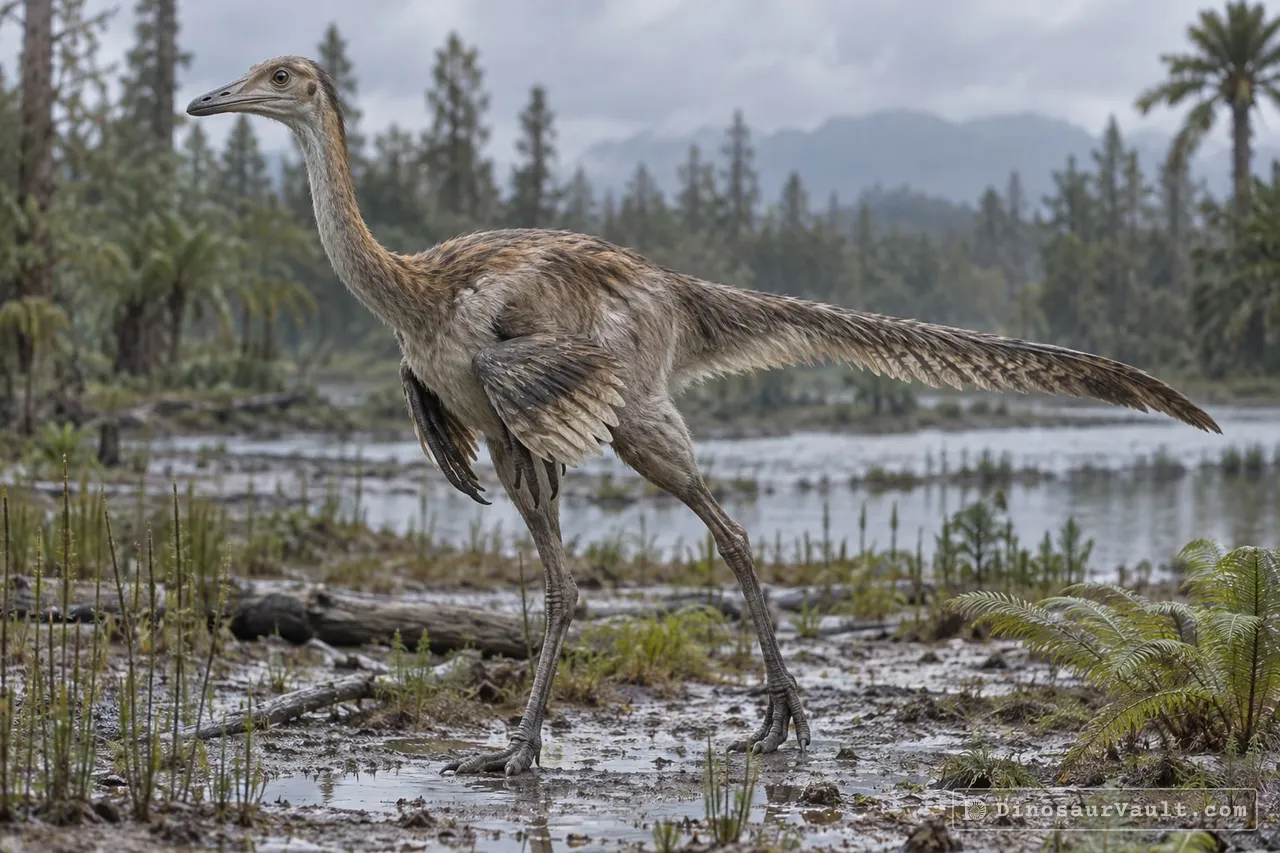
Tototlmimus was an ostrich-like dinosaur known from bones of the hands and feet.
Its world
It lived in the Late Cretaceous in what is now Mexico. Its bones come from the Packard Shale.
How it was found
Serrano-Brañas and colleagues named it in 2016. The type species is Tototlmimus packardensis. It was the first ostrich-like dinosaur named from Mexico, and its name comes from an old language of Mexico.
Field gallery
More views of Tototlmimus
Scenes reconstructed from the available fossil evidence.
1 of 2
The evidence
The science behind Tototlmimus
Which parts of the picture come from its own bones, and which come from its relatives.
From its own fossils
- The type specimen is a partial skeleton preserving finger and foot bones.
- The ends of its long foot bones fit closely against one another.
- Its claw is narrow and asymmetrical, with a nearly straight underside.
Borrowed from relatives
- Ornithomimus supplies a comparison for the missing head, while Gallimimus helps restore the missing neck, trunk, legs and tail.
- A feathered covering is inferred from feather fossils of Ornithomimus.
- The missing parts of its hands are compared with Sinornithomimus, which had slender arms and narrow, weakly curved finger claws.
Still unknown
- Its full size and body proportions.
- Its feather colors and patterns.
- Exactly what it ate.
Discovery timeline
- 2012Close relativeZelenitsky et al.
- 2016Named itSerrano-Brañas et al.
- 2016Close relativevan der Reest, Wolfe & Currie
- 2017Close relativeChinzorig et al.
Key papers
The research behind what we know of Tototlmimus
Close relative
Found feathers in Ornithomimus, with wing-like forelimb feathers in adults and a simpler covering in a young animal.
Feathered Non-Avian Dinosaurs from North America Provide Insight into Wing Origins. Science 338: 510-514
Read the paper : Feathered Non-Avian Dinosaurs from North America Provide Insight into Wing Origins (opens in a new tab)Named it
Named Tototlmimus from hand and foot bones with distinctive joints and toe claws, establishing an ornithomimid in Mexico.
A new ornithomimid dinosaur from the Upper Cretaceous Packard Shale formation (Cabullona Group) Sonora, México. Cretaceous Research 58: 49-62
Read the paper : A new ornithomimid dinosaur from the Upper Cretaceous Packard Shale formation (Cabullona Group) Sonora, México (opens in a new tab)Close relative
Described an Ornithomimus with dense body and tail feathers and bare lower legs.
A densely feathered ornithomimid (Dinosauria: Theropoda) from the Upper Cretaceous Dinosaur Park Formation, Alberta, Canada. Cretaceous Research 58: 108-117
Read the paper : A densely feathered ornithomimid (Dinosauria: Theropoda) from the Upper Cretaceous Dinosaur Park Formation, Alberta, Canada (opens in a new tab)Close relative
Compared claw bones and described a nearly straight underside in Tototlmimus, against a slightly curved one in Aepyornithomimus.
First Ornithomimid (Theropoda, Ornithomimosauria) from the Upper Cretaceous Djadokhta Formation of Tögrögiin Shiree, Mongolia. Scientific Reports 7
Read the paper : First Ornithomimid (Theropoda, Ornithomimosauria) from the Upper Cretaceous Djadokhta Formation of Tögrögiin Shiree, Mongolia (opens in a new tab)
Close relatives
Other members of Ornithomimidae


Sources: Wikidata