Texasetes
"Texas dweller"
Type species Texasetes pleurohalio
- Lived
- 106 to 101 million years ago, Early Cretaceous
- Diet
- Herbivore
- Group
- Ankylosaurs, Nodosauridae
- Found in
- United States
- Named by
- Coombs 1995
Where its fossils were found
The evidence
Today

105 million years ago
Habitat
Its bones were buried in coastal sediments of the Pawpaw Formation in what is now Texas. Pawpawsaurus comes from the same formation.
Field notes
About Texasetes
What it was like
Texasetes was an armored plant eater, probably a nodosaur. It is known from a few bones and pieces of armor.
Its world
It lived in the Early Cretaceous in what is now Texas. Its bones come from the Pawpaw Formation, which also held the nodosaur Pawpawsaurus.
How it was found
Coombs named Texasetes in 1995. The type species is Texasetes pleurohalio.
Field gallery
More views of Texasetes
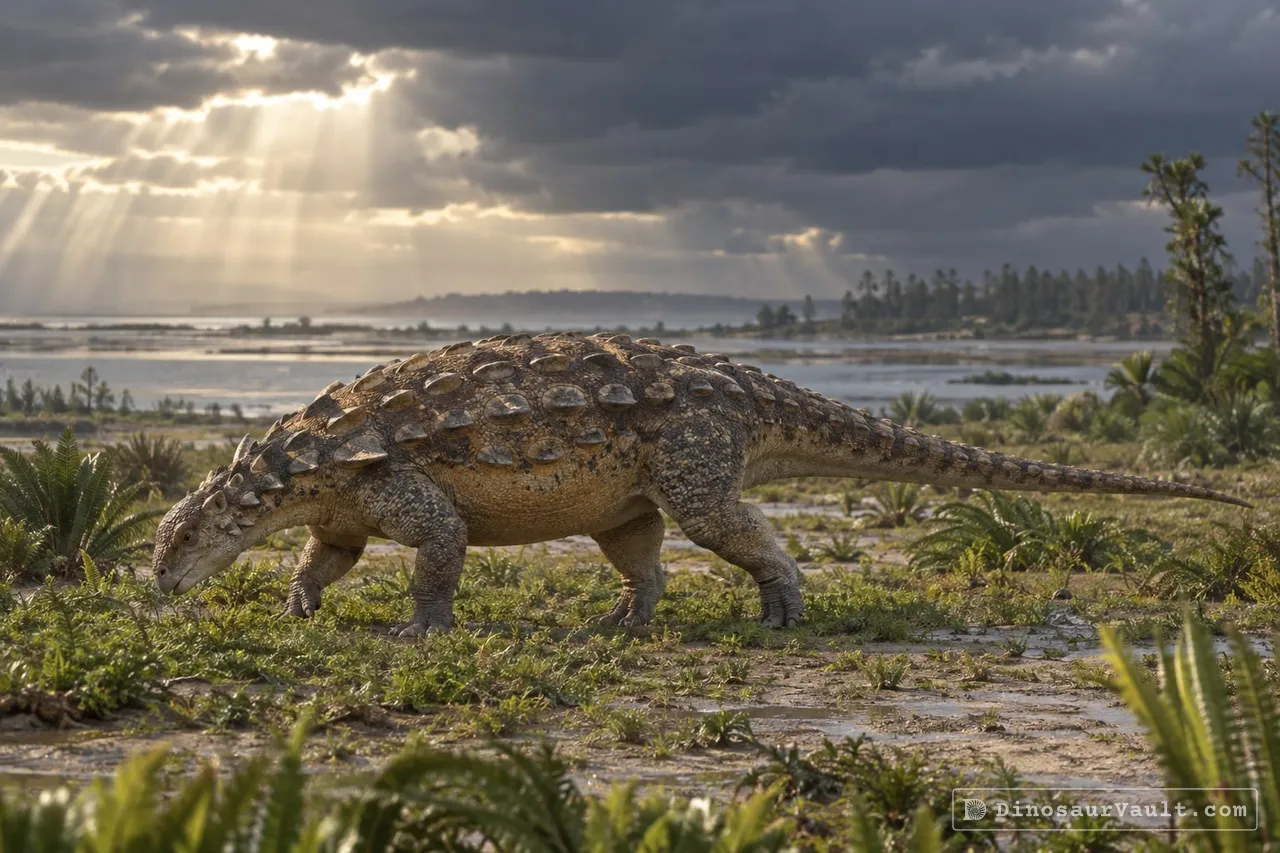
Scenes reconstructed from the available fossil evidence.
The evidence
The science behind Texasetes
Which parts of the picture come from its own bones, and which come from its relatives.
From its own fossils
- The type material includes skull fragments, limb and shoulder bones, vertebrae and pieces of armor.
- The naming description distinguished Texasetes by a prong-shaped shoulder-blade ridge and a splintlike ridge on the thighbone.
Borrowed from relatives
- The missing body is restored from other armored dinosaurs; no specific relative is established.
Still unknown
- The full shape of its skull and its skin color.
- The arrangement of its armor plates and spikes.
- The exact family placement of Texasetes.
Discovery timeline
- 1995Named itCoombs
- 1996Same rocksLee
- 2016Its worldArbour, Zanno & Gates
- 2018Its worldBrownstein
- 2023Family treeRaven et al.
Key papers
The research behind what we know of Texasetes
Named it
Named Texasetes from a partial armored dinosaur skeleton with distinctive shoulder and thigh bones.
A Nodosaurid Ankylosaur (Dinosauria: Ornithischia) from the Lower Cretaceous of Texas. Journal of Vertebrate Paleontology 15: 298-312
Read the paper : A Nodosaurid Ankylosaur (Dinosauria: Ornithischia) from the Lower Cretaceous of Texas (opens in a new tab)Same rocks
Named Pawpawsaurus from a skull and described other armored dinosaur remains, including a baby, from the same formation.
A new nodosaurid ankylosaur (Dinosauria: Ornithischia) from the Paw Paw Formation (Late Albian) of Texas. Journal of Vertebrate Paleontology 16: 232-245
Read the paper : A new nodosaurid ankylosaur (Dinosauria: Ornithischia) from the Paw Paw Formation (Late Albian) of Texas (opens in a new tab)Its world
Linked the frequent burial of armored dinosaurs in marine sediments to changing sea levels and regional extinctions.
Ankylosaurian dinosaur palaeoenvironmental associations were influenced by extirpation, sea-level fluctuation, and geodispersal. Palaeogeography, Palaeoclimatology, Palaeoecology 449: 289-299
Read the paper : Ankylosaurian dinosaur palaeoenvironmental associations were influenced by extirpation, sea-level fluctuation, and geodispersal (opens in a new tab)Its world
Discussed possible synonymy between Texasetes and Pawpawsaurus alongside analyses that treated them as separate animals.
The biogeography and ecology of the Cretaceous non-avian dinosaurs of Appalachia. Palaeontologia Electronica: 1-56
Read the paper : The biogeography and ecology of the Cretaceous non-avian dinosaurs of Appalachia (opens in a new tab)Family tree
One family-tree analysis placed Texasetes and Pawpawsaurus in different armored dinosaur families.
The phylogenetic relationships and evolutionary history of the armoured dinosaurs (Ornithischia: Thyreophora). Journal of Systematic Palaeontology 21
Read the paper : The phylogenetic relationships and evolutionary history of the armoured dinosaurs (Ornithischia: Thyreophora) (opens in a new tab)
Close relatives
Other members of Nodosauridae


Sources: Wikidata