Tengrisaurus
"Tengri lizard"
Type species Tengrisaurus starkovi
- Lived
- 137 to 133 million years ago, Early Cretaceous
- Diet
- Herbivore
- Group
- Sauropods
- Found in
- Russia
- Named by
- Averianov and Skutschas 2017
Where its fossils were found
The evidence
Today

135 million years ago
Habitat
It lived in inland Early Cretaceous environments in what is now Russia. Richardoestesia and other small meat eaters are recorded from the Murtoi Formation.
Field notes
About Tengrisaurus
What it was like
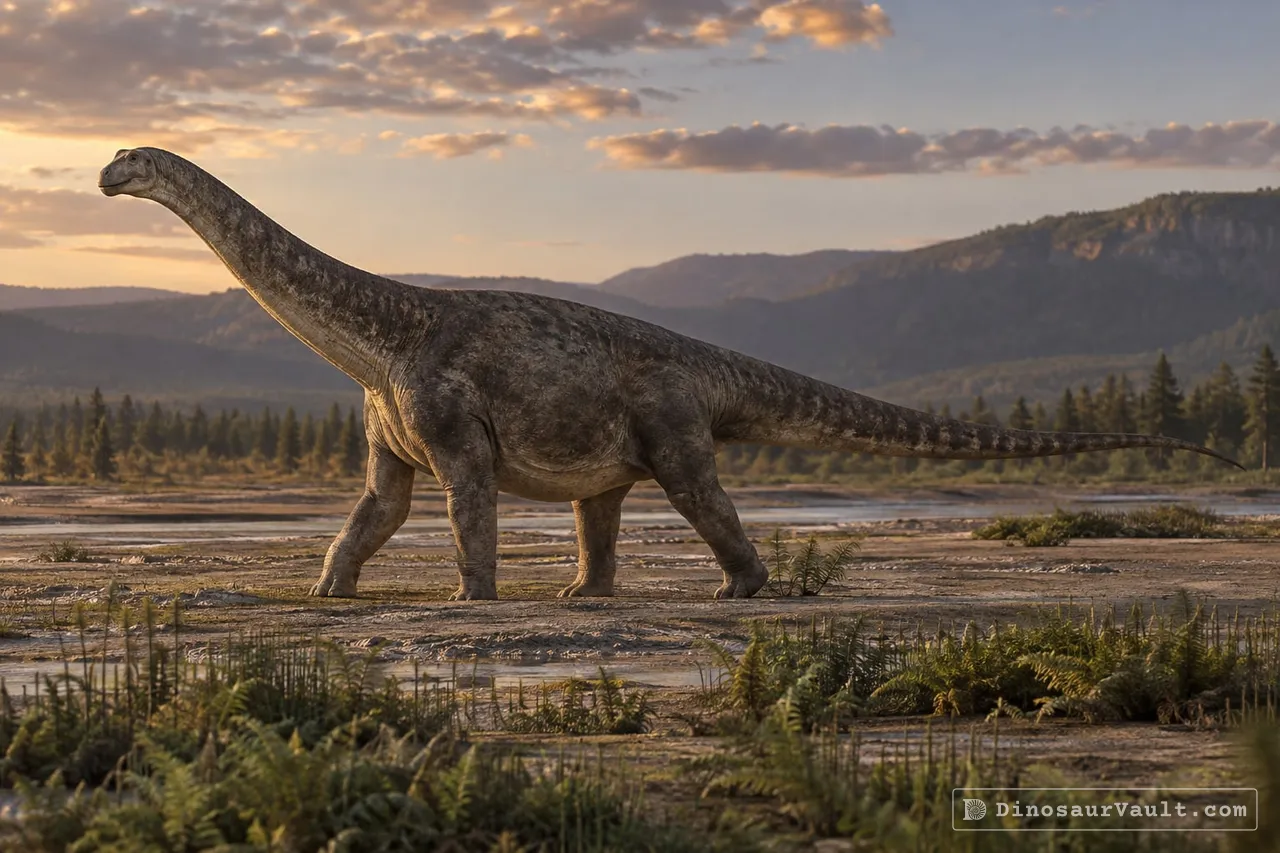
Tengrisaurus was a titanosaur, a long-necked plant eater. It was named from tail bones, and a neck vertebra has since been assigned to it.
Its world
It lived in the Early Cretaceous, in what is now Russia. It comes from the Murtoi Formation. It is one of the oldest titanosaurs known from Asia.
How it was found
Averianov and Skutschas named Tengrisaurus in 2017. The type species is Tengrisaurus starkovi. Its name comes from a sky god of the region.
Field gallery
More views of Tengrisaurus
Scenes reconstructed from the available fossil evidence.
1 of 3
The evidence
The science behind Tengrisaurus
Which parts of the picture come from its own bones, and which come from its relatives.
From its own fossils
- Tengrisaurus was first named from isolated tail vertebrae found close together, with deep sockets at the front and rounded ends at the back.
- A later tail bone has a prominent ridge around its rounded joint surface.
- A neck vertebra, probably the last one in the neck, has also been assigned to Tengrisaurus. It is very short, and its neck ribs are fused to it.
Borrowed from relatives
- Dongbeititan provides a comparison for joining the isolated neck and tail bones into a single body plan.
- Its head is restored by comparison with Tapuiasaurus, and its neck, shoulders and legs with Mnyamawamtuka.
Still unknown
- Its total length and weight.
- The shape of its skull.
- Where titanosaurs first arose. Its describers see it as a sign of an Asian origin, while others say the fossil record is too patchy to tell.
Discovery timeline
- 2017Named itAverianov & Skutschas
- 2021New findAverianov, Sizov & Skutschas
- 2026New findAverianov et al.
Key papers
The research behind what we know of Tengrisaurus
Named it
Named Tengrisaurus from tail vertebrae and identified it as an early titanosaur.
A new lithostrotian titanosaur (Dinosauria, Sauropoda) from the Early Cretaceous of Transbaikalia, Russia. Biological Communications 62: 6-18
No link available
New find
Described another tail vertebra and linked Tengrisaurus to a group of titanosaurs later widespread across the southern continents.
Gondwanan affinities of Tengrisaurus, Early Cretaceous titanosaur from Transbaikalia, Russia (Dinosauria, Sauropoda). Cretaceous Research 122: 104731
Read the paper : Gondwanan affinities of Tengrisaurus, Early Cretaceous titanosaur from Transbaikalia, Russia (Dinosauria, Sauropoda) (opens in a new tab)New find
Assigned a neck vertebra to Tengrisaurus and placed it within a group of giant titanosaurs, supporting an early Asian origin for the group.
A sauropod Tengrisaurus starkovi from the Lower Cretaceous of Transbaikalia, Russia, and Asiatic origin of Titanosauria. Cretaceous Research 181: 106271
Read the paper : A sauropod Tengrisaurus starkovi from the Lower Cretaceous of Transbaikalia, Russia, and Asiatic origin of Titanosauria (opens in a new tab)
Close relatives
Other members of Eutitanosauria


Sources: Wikidata