Taohelong
"Tao River dragon"
- Lived
- 126 to 113 million years ago, Early Cretaceous
- Diet
- Herbivore
- Group
- Ankylosaurs, Nodosauridae
- Found in
- China
- Named by
- Yang et al. 2013
Where its fossils were found
The evidence
Fossil record
Hekou Group, Gansu, China
Early Cretaceous
The naming paper places the skeleton in the Hekou Group. A numbered subdivision is not a formation name.
Today

120 million years ago
Habitat
It lived in an inland basin with lakes and deltas in Early Cretaceous China. Yongjinglong, Daxiatitan and Huanghetitan are known from the same regional rocks.
Field notes
About Taohelong
What it was like
Taohelong was an armored plant eater whose closest relatives remain uncertain. Its describers linked it to Polacanthus, but later studies have suggested a different placement. It is known from a tail bone, ribs, part of the hip and pieces of armor.
Its world
It lived in the Early Cretaceous in what is now northern China. The sauropod Yongjinglong lived in the same region.
How it was found
Yang and colleagues named it in 2013. They described it as the first polacanthine armored dinosaur found in Asia, though that grouping is now uncertain.
Field gallery
More views of Taohelong
Scenes reconstructed from the available fossil evidence.
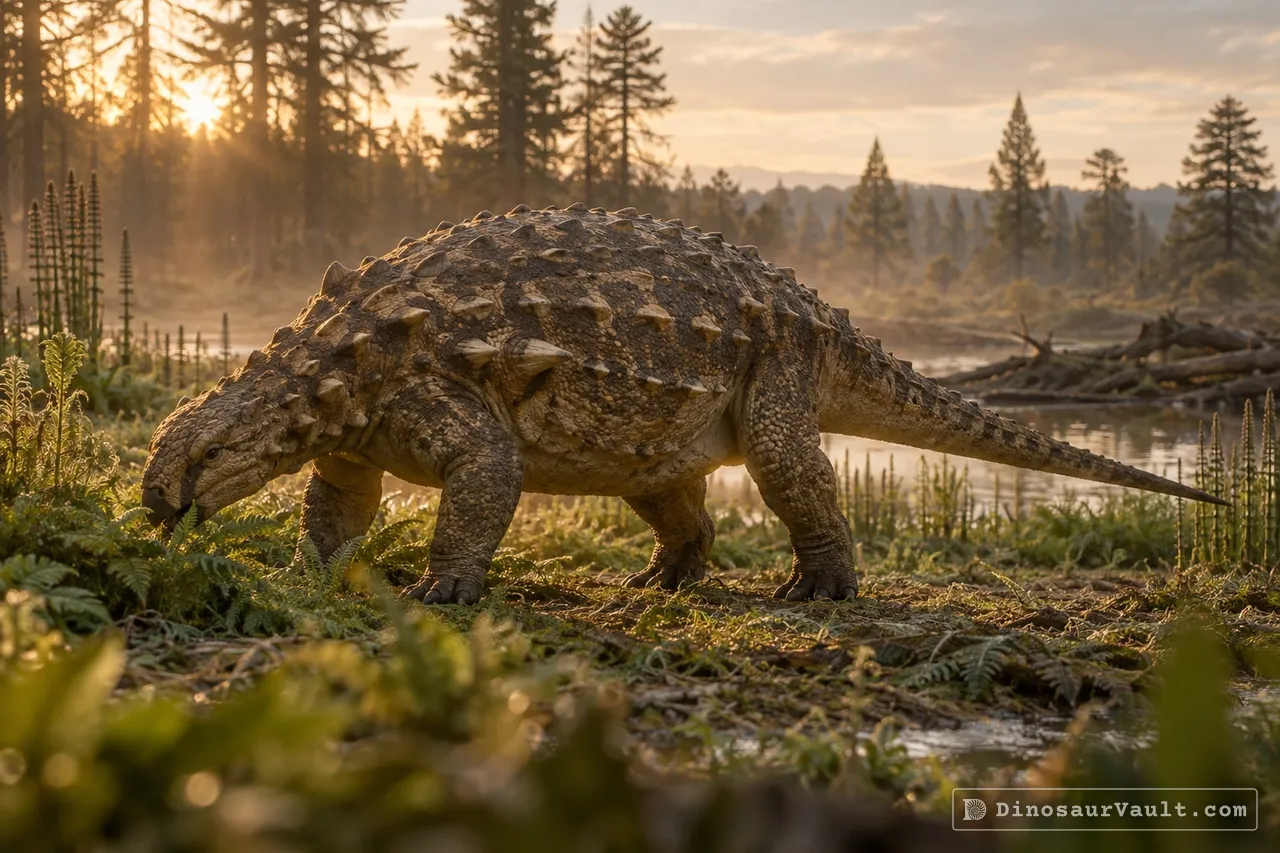
1 of 3
The evidence
The science behind Taohelong
Which parts of the picture come from its own bones, and which come from its relatives.
From its own fossils
- Its remains include a tail vertebra, ribs, a nearly complete left hip bone and pieces of bony armor.
- Armor pieces of different sizes form part of an irregular shield over the hips.
- The outer edge of the hip bone curves in an unusual S shape when viewed from above.
Borrowed from relatives
- The missing head and neck are restored by comparison with Europelta, an early nodosaurid from Spain.
Still unknown
- The shape of its skull and neck.
- The arrangement of armor across the rest of its body.
- Its closest relatives. The first study placed it next to Polacanthus, while a later analysis grouped it with Silvisaurus.
Discovery timeline
- 2013Named itYang et al.
- 2013Close relativeKirkland et al.
- 2014Same rocksLi et al.
- 2020Close relativeRaven et al.
- 2025Family treeTreiber et al.
Key papers
The research behind what we know of Taohelong
Named it
Named Taohelong from hip, rib, tail and armor fossils and identified Polacanthus as its closest relative in the analysis.
[First discovery of polacanthine ankylosaur dinosaur in Asia]. Vertebrata PalAsiatica 51: 265-277
No link available
Close relative
Described Europelta, an early nodosaurid from Spain with a crushed skull, neck bones and low-profile armor, a comparison for the parts of Taohelong still missing.
The Basal Nodosaurid Ankylosaur Europelta carbonensis n. gen., n. sp. from the Lower Cretaceous (Lower Albian) Escucha Formation of Northeastern Spain. PLoS ONE 8: e80405
Read the paper : The Basal Nodosaurid Ankylosaur Europelta carbonensis n. gen., n. sp. from the Lower Cretaceous (Lower Albian) Escucha Formation of Northeastern Spain (opens in a new tab)Same rocks
Described Yongjinglong and documented a regional sauropod fauna that also included Daxiatitan and Huanghetitan.
A New Titanosaurian Sauropod from the Hekou Group (Lower Cretaceous) of the Lanzhou-Minhe Basin, Gansu Province, China. PLoS ONE 9: e85979
Read the paper : A New Titanosaurian Sauropod from the Hekou Group (Lower Cretaceous) of the Lanzhou-Minhe Basin, Gansu Province, China (opens in a new tab)Close relative
Redescribed Polacanthus, an important comparison for Taohelong, and restricted reliably identified Polacanthus fossils to its original specimen.
Osteology and Taxonomy of British Wealden Supergroup (Berriasian–aptian) Ankylosaurs (Ornithischia, Ankylosauria). Journal of Vertebrate Paleontology 40: e1826956
Read the paper : Osteology and Taxonomy of British Wealden Supergroup (Berriasian–aptian) Ankylosaurs (Ornithischia, Ankylosauria) (opens in a new tab)Family tree
Reviewed armored dinosaurs from Romania and discussed an earlier analysis that grouped Taohelong with Silvisaurus, noting how much missing data affects that result.
New report of Late Cretaceous struthiosaurids from the Haţeg Basin, with an overview of the Transylvanian ankylosaur fossil record. Palaeobiodiversity and Palaeoenvironments 105: 517-543
Read the paper : New report of Late Cretaceous struthiosaurids from the Haţeg Basin, with an overview of the Transylvanian ankylosaur fossil record (opens in a new tab)
Close relatives
Other members of Nodosauridae


Sources: Wikidata