Soumyasaurus
"Soumya's lizard"
- Lived
- 227 to 206 million years ago, Late Triassic
- Diet
- Herbivore
- Group
- Early ornithischians, Silesauridae
- Found in
- United States
- Named by
- Sarigul et al. 2018
Where its fossils were found
The evidence
Today

220 million years ago
Habitat
A floodplain in what is now Texas, where seasonal floods buried scattered bones. Coelophysis and Technosaurus are also recorded from the Cooper Canyon Formation.
Field notes
About Soumyasaurus
What it was like
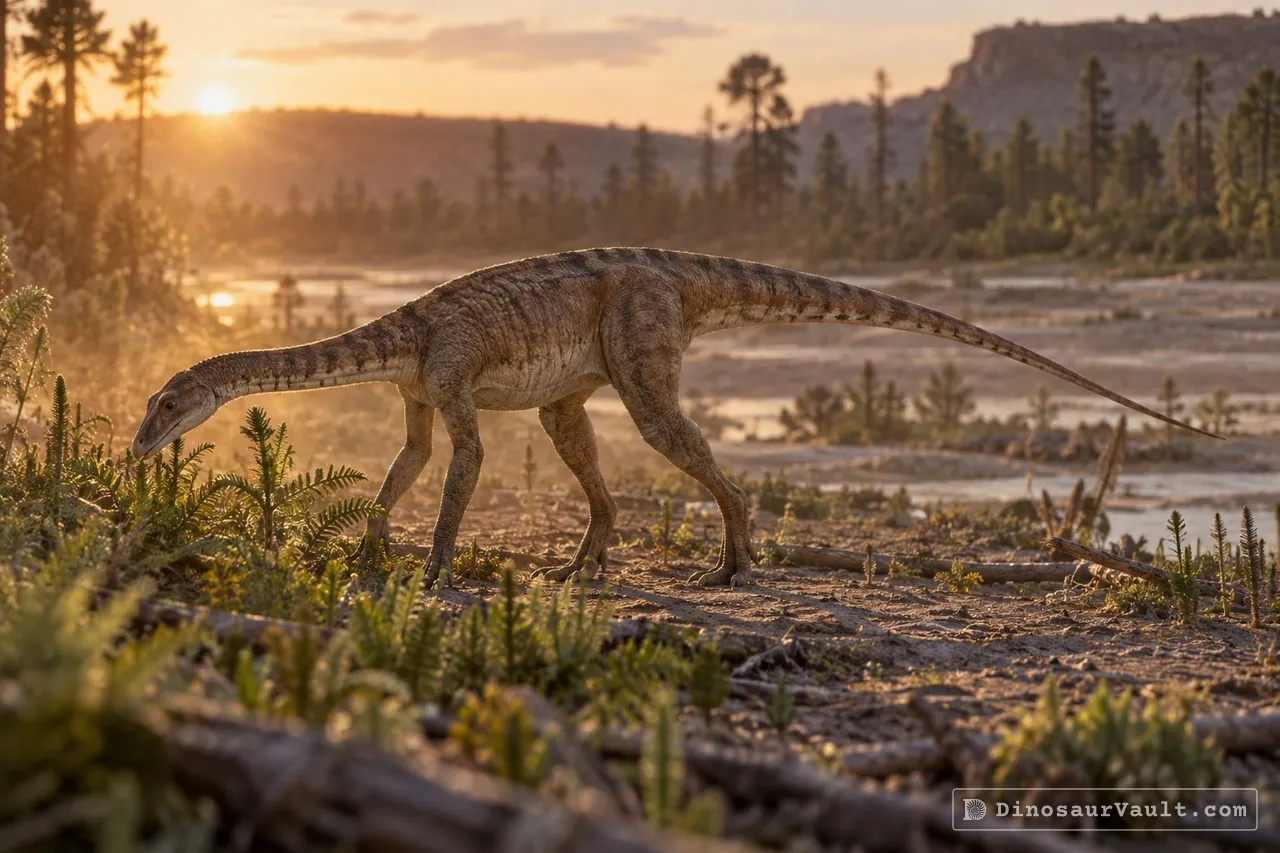
Soumyasaurus was a small silesaur, a slender animal. It is known only from part of a lower jaw.
Silesaurs had beak-like jaw tips and probably ate plants. Scientists still debate whether they were early dinosaurs or their close cousins.
Its world
It lived in the Late Triassic in what is now Texas, in the United States. Its bones come from the Cooper Canyon Formation, which has also produced Coelophysis.
How it was found
Sarigul and colleagues named Soumyasaurus in 2018, from a single find.
Field gallery
More views of Soumyasaurus
Scenes reconstructed from the available fossil evidence.
1 of 3
Lived alongside
Found in the same rock formations


A rock formation can hold fossils laid down millions of years apart, so not every animal here met Soumyasaurus.
The evidence
The science behind Soumyasaurus
Which parts of the picture come from its own bones, and which come from its relatives.
From its own fossils
- The only fossil is part of a left lower jaw. It is very slender, angles downward toward the front, and its front tip is missing.
- Its small teeth are cone-shaped, unlike the triangular teeth of Technosaurus, and are fused at their bases to the jaw, a feature shared with other silesaurs.
- Other bones from the same quarry belong to other animals or cannot be identified.
Borrowed from relatives
- The rest of the head, the neck, chest and arms are restored from Silesaurus.
Still unknown
- The shape of its snout tip and whether it carried a beak.
- Whether it is a distinct animal. One study suggested the jaw might belong to a young silesaur, possibly Technosaurus.
- Whether silesaurs were early ornithischian dinosaurs or close relatives outside Dinosauria.
Discovery timeline
- 2018Named itSarigul, Agnolin & Chatterjee
- 2020Family treeMüller & Garcia
- 2022Family treeNorman et al.
Key papers
The research behind what we know of Soumyasaurus
Named it
Named a small silesaur from a partial lower jaw and described other animals in the same bone assemblage.
Description of a multitaxic bone assemblage from the Upper Triassic Post Quarry of Texas (Dockum Group), including a new small basal dinosauriform taxon. Historia Natural 8: 5-24
No link available
Family tree
Proposed that silesaurs represent successive branches leading to the main ornithischian dinosaur groups.
A paraphyletic ‘Silesauridae' as an alternative hypothesis for the initial radiation of ornithischian dinosaurs. Biology Letters 16: 20200417
Read the paper : A paraphyletic ‘Silesauridae' as an alternative hypothesis for the initial radiation of ornithischian dinosaurs (opens in a new tab)Family tree
An expanded family tree placed Soumyasaurus near the beginning of the ornithischian lineage.
Taxonomic, palaeobiological and evolutionary implications of a phylogenetic hypothesis for Ornithischia (Archosauria: Dinosauria). Zoological Journal of the Linnean Society 196: 1273-1309
Read the paper : Taxonomic, palaeobiological and evolutionary implications of a phylogenetic hypothesis for Ornithischia (Archosauria: Dinosauria) (opens in a new tab)
Close relatives
Other members of Silesauridae


Sources: Wikidata