Lewisuchus
"Lewis's crocodile"
- Lived
- 237 to 233 million years ago, Late Triassic
- Diet
- Herbivore
- Group
- Early ornithischians, Silesauridae
- Found in
- Argentina
- Named by
- Romer 1972
Where its fossils were found
The evidence
Today

240 million years ago
Habitat
Rivers, floodplains and lakes in a landscape affected by volcanic eruptions. Mammal relatives called cynodonts and crocodile-line reptiles also lived there.
Field notes
About Lewisuchus
What it was like
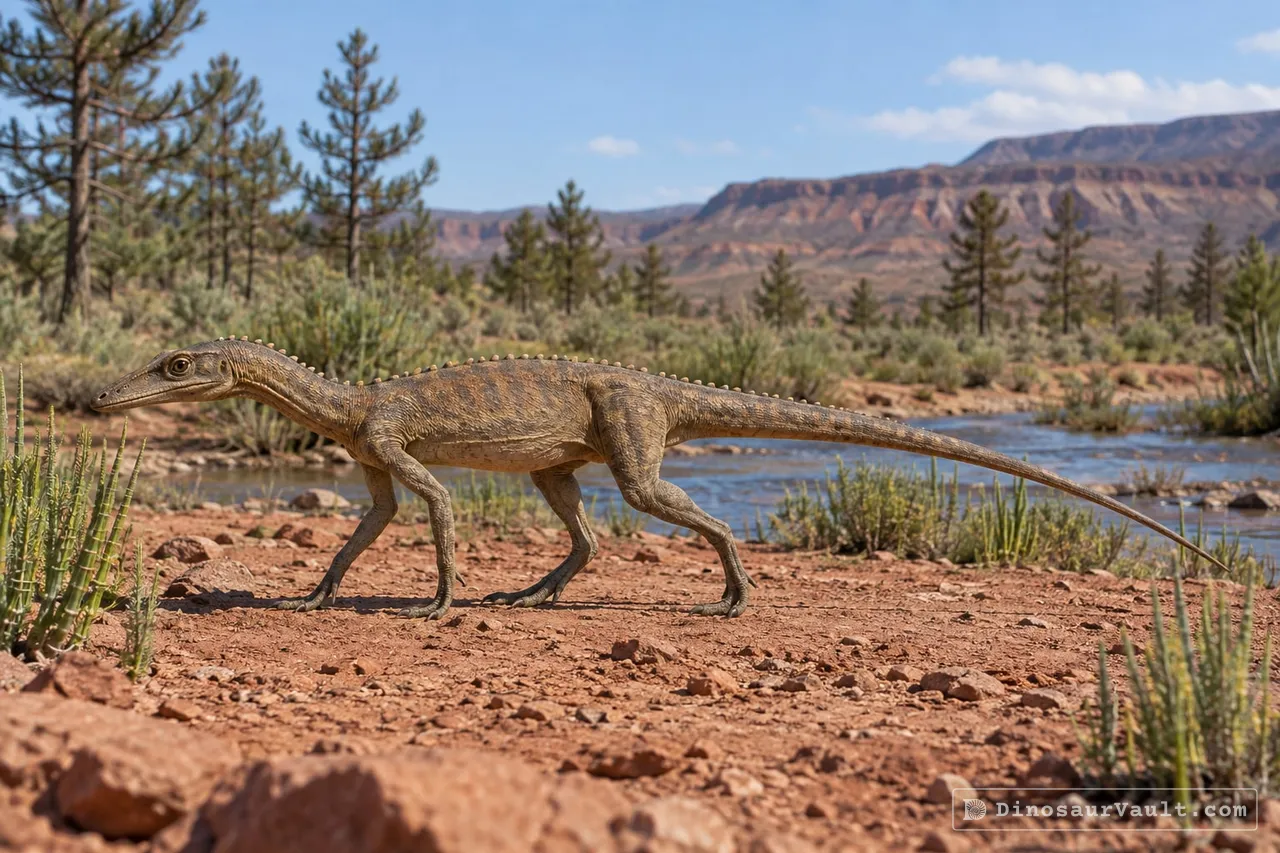
Lewisuchus was a small, slender reptile about the size of a large lizard, one of the closest known relatives of the dinosaurs. It belongs to the silesaurids, a group that some scientists place among the earliest dinosaurs and others place just outside them.
Its world
It lived in the Triassic in what is now Argentina. Its bones come from the Chañares Formation, which holds many early relatives of dinosaurs.
How it was found
Romer named Lewisuchus in 1972. Despite its name, it was not a crocodile.
Field gallery
More views of Lewisuchus
Scenes reconstructed from the available fossil evidence.
1 of 3
The evidence
The science behind Lewisuchus
Which parts of the picture come from its own bones, and which come from its relatives.
From its own fossils
- Skull and jaw bones show a narrow, rounded snout with teeth at the front and a shallow, upward-curving lower jaw.
- A single row of long, low bony plates ran along the back of the neck and the front of the back.
- Shoulder, arm, hip and leg bones show a slender animal with well-developed forelimbs.
Borrowed from relatives
- Asilisaurus provides a comparison for the missing skull roof, hand bones and toe tips.
- Eoraptor provides a broader comparison for the missing fingers and their claws.
Still unknown
- Whether it usually walked on two legs or four.
- The complete shape of its hands, feet and tail.
- Its skin covering and color.
Often drawn wrong
- A toothless beak borrowed from Silesaurus replaces its own toothed snout.
- Tall back spikes exaggerate its low, elongated bony plates.
Discovery timeline
- 1972Named itRomer
- 2019New findEzcurra et al.
- 2021Full descriptionAgnolín et al.
Key papers
The research behind what we know of Lewisuchus
Named it
Named Lewisuchus from a partial skeleton found in Argentina.
The Chañares (Argentina) Triassic reptile fauna; XIV, Lewisuchus admixtus, gen. et sp. nov., a further thecodont from the Chañares beds. Breviora 390: 1-13
No link available
New find
Described a new skeleton that confirmed the identity of its curved lower jaw and united bones previously assigned to separate genera.
New Specimen Sheds Light on the Anatomy and Taxonomy of the Early Late Triassic Dinosauriforms from the Chañares Formation, NW Argentina. The Anatomical Record 303: 1393-1438
Read the paper : New Specimen Sheds Light on the Anatomy and Taxonomy of the Early Late Triassic Dinosauriforms from the Chañares Formation, NW Argentina (opens in a new tab)Full description
Additional specimens revealed more of the skull, hips and backbone, including the row of low bony plates.
New specimens provide insights into the anatomy of the dinosauriform Lewisuchus admixtus Romer, 1972 from the upper Triassic levels of the Chañares Formation, NW Argentina. The Anatomical Record 305: 1119-1146
Read the paper : New specimens provide insights into the anatomy of the dinosauriform Lewisuchus admixtus Romer, 1972 from the upper Triassic levels of the Chañares Formation, NW Argentina (opens in a new tab)
Close relatives
Other members of Silesauridae


Sources: Wikidata