Amanasaurus
"rain lizard"
- Lived
- 237 to 227 million years ago, Late Triassic
- Diet
- Herbivore
- Group
- Early ornithischians, Silesauridae
- Found in
- Brazil
- Named by
- Müller and Garcia 2023
Where its fossils were found
The evidence
Today

230 million years ago
Habitat
It lived in southern Brazil among early dinosaurs, their close relatives and stocky plant-eating rhynchosaurs. The surrounding region supported early long-necked dinosaur relatives and herrerasaurid predators.
Field notes
About Amanasaurus
What it was like
Amanasaurus was a silesaurid, a small, slender relative of the dinosaurs. It is known from two partial thigh bones.
Its world
It lived in the Late Triassic in what is now Brazil.
How it was found
Müller and Garcia named it in 2023. Its name comes from a native word for rain.
Field gallery
More views of Amanasaurus
Scenes reconstructed from the available fossil evidence.
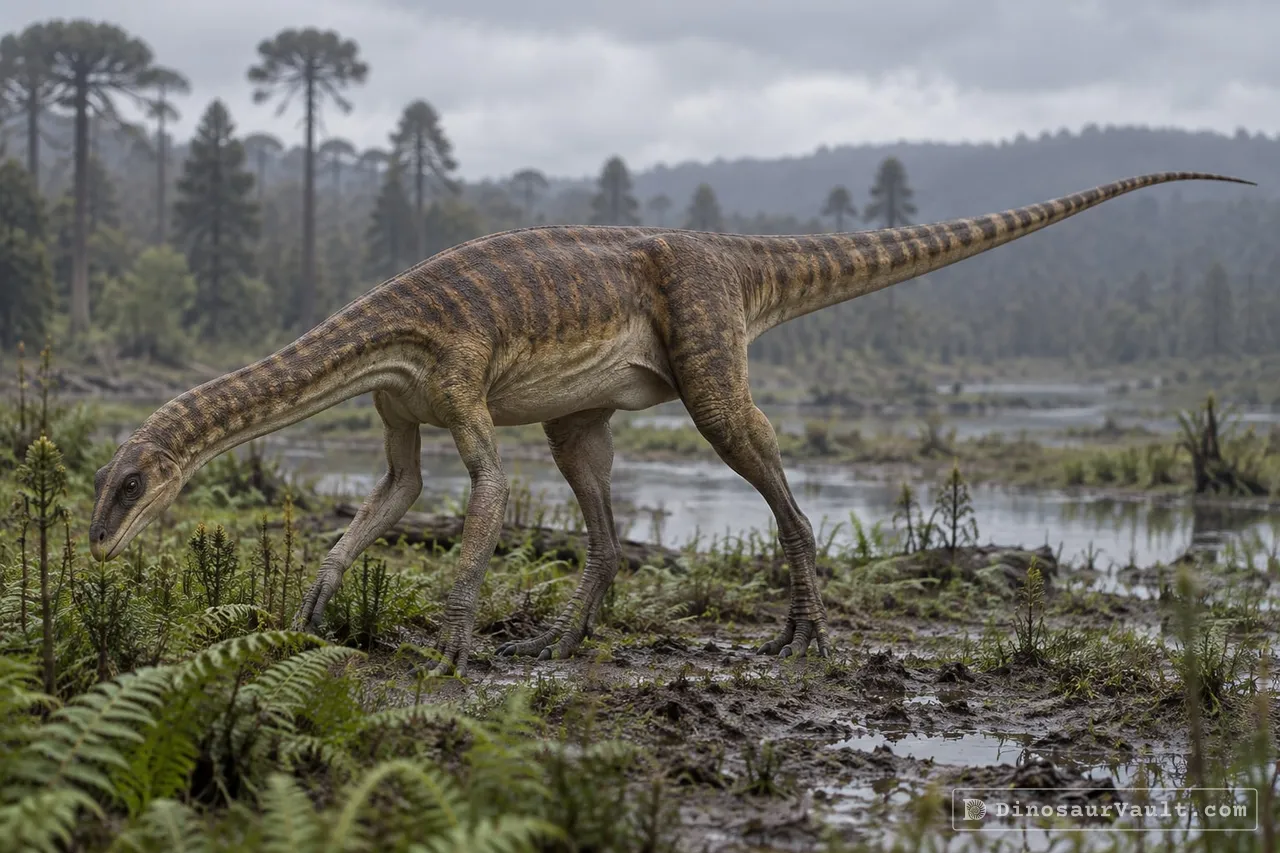
1 of 2
The evidence
The science behind Amanasaurus
Which parts of the picture come from its own bones, and which come from its relatives.
From its own fossils
- The type specimen is the upper end of a right thigh bone. The lower end of a left thigh bone from a separate animal is provisionally referred to Amanasaurus; the two bones do not overlap.
- The type thigh bone has a distinctive scar and a cleft beside a muscle attachment.
Borrowed from relatives
- Its head, neck and trunk can be compared with the better-known silesaurid Silesaurus.
- A slender trunk is borrowed from Silesaurus.
Still unknown
- The shape of its skull and teeth.
- Its full adult size and skin covering.
- Whether silesaurids belong inside the dinosaur family tree or just outside it.
Discovery timeline
- 2023Named itMüller & Garcia
- 2024RedescriptionMüller & Garcia
- 2025Family treeLovegrove et al.
Key papers
The research behind what we know of Amanasaurus
Named it
Described partial thigh bones with a distinctive combination of features and placed Amanasaurus among silesaurids.
A new silesaurid from Carnian beds of Brazil fills a gap in the radiation of avian line archosaurs. Scientific Reports 13
Read the paper : A new silesaurid from Carnian beds of Brazil fills a gap in the radiation of avian line archosaurs (opens in a new tab)Redescription
Added the formal registration details needed to establish the genus and species names.
Author Correction: A new silesaurid from Carnian beds of Brazil fills a gap in the radiation of avian line archosaurs. Scientific Reports 14
Read the paper : Author Correction: A new silesaurid from Carnian beds of Brazil fills a gap in the radiation of avian line archosaurs (opens in a new tab)Family tree
Compared a large silesaur thigh bone with Amanasaurus and other relatives, showing that some silesaurs grew larger than previously assumed.
A new large ‘silesaur’ specimen from the ?Late Triassic of Zambia; taxonomic, ecological and evolutionary implications. Royal Society Open Science 12
Read the paper : A new large ‘silesaur’ specimen from the ?Late Triassic of Zambia; taxonomic, ecological and evolutionary implications (opens in a new tab)
Close relatives
Other members of Silesauridae


Sources: Wikidata