Silesaurus
"Silesia lizard"
- Lived
- Late Triassic
- Diet
- Herbivore
- Group
- Early ornithischians, Silesauridae
- Found in
- Poland
- Named by
- Dzik 2003
Where its fossils were found
The evidence
Today

Habitat
A landscape of meandering rivers, lakes and conifers in Poland, with wet and dry seasons. Stagonolepis was an armored land-dwelling neighbor. Metoposaurus was a large amphibian in the lakes.
Field notes
About Silesaurus
What it was like
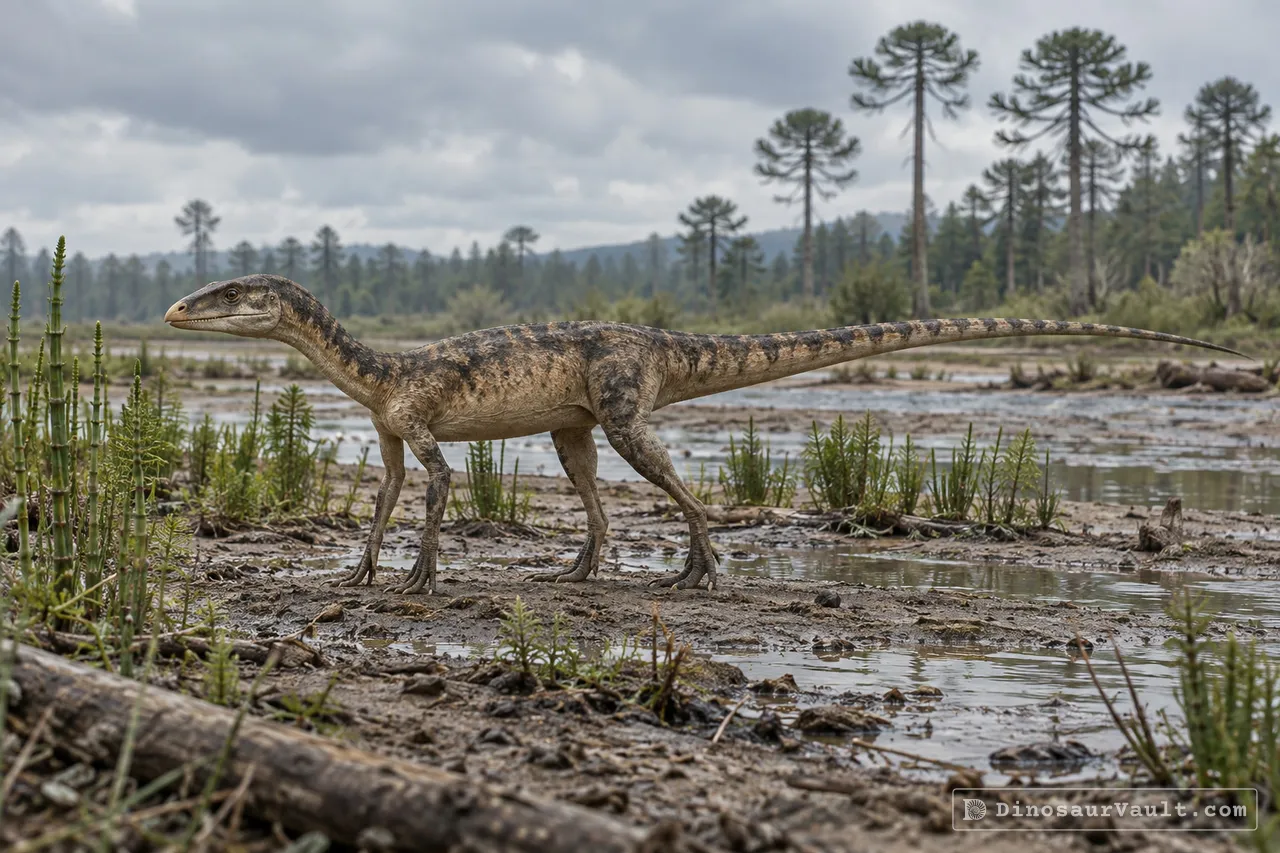
Silesaurus was a slender four-legged animal about the size of a large dog, with long thin legs and a small head. Its jaws ended in a toothless tip that may have held a beak, and it probably ate plants or insects.
Its world
It lived in the Late Triassic, in what is now Poland. Many bones were found together in the Drawno Beds, so it may have been common.
How it was found
Dzik named Silesaurus in 2003. It belongs to the silesaurids, and scientists still argue about where they fit: they may be close cousins of the dinosaurs, or the earliest ornithischians.
Field gallery
More views of Silesaurus
Scenes reconstructed from the available fossil evidence.
1 of 3
The evidence
The science behind Silesaurus
Which parts of the picture come from its own bones, and which come from its relatives.
From its own fossils
- Several partial skeletons and many separate bones show a slender animal with a small head and long limbs.
- The lower jaw ends in a toothless tip that probably carried a beak.
- Long neck ribs ran backward alongside the neck vertebrae.
Borrowed from relatives
- Much of its body is known from its own bones; comparisons with other silesaurids such as Asilisaurus help restore missing details.
Still unknown
- Whether silesaurids belong inside Ornithischia or just outside the dinosaurs.
- Its skin covering and color.
- The balance of plants and insects in its diet.
Discovery timeline
- 2003Named itDzik
- 2010Full descriptionPiechowski & Dzik
- 2010Growing upFostowicz-Frelik & Sulej
- 2014Growing upPiechowski, Tałanda & Dzik
Key papers
The research behind what we know of Silesaurus
Named it
Described numerous bones of a slender, beaked animal with features close to the origin of dinosaurs.
A beaked herbivorous archosaur with dinosaur affinities from the early Late Triassic of Poland. Journal of Vertebrate Paleontology 23: 556-574
Read the paper : A beaked herbivorous archosaur with dinosaur affinities from the early Late Triassic of Poland (opens in a new tab)Full description
Described the backbone and ribs, including long neck ribs that ran backward beside the neck.
The axial skeleton ofSilesaurus opolensis. Journal of Vertebrate Paleontology 30: 1127-1141
Read the paper : The axial skeleton ofSilesaurus opolensis (opens in a new tab)Growing up
Microscopic bone structure showed rapid growth, with more slowly formed bone in older individuals and few growth interruptions.
Bone histology of Silesaurus opolensis from the Late Triassic of Poland. Lethaia 43: 137-148
Read the paper : Bone histology of Silesaurus opolensis from the Late Triassic of Poland (opens in a new tab)Growing up
Compared thigh and hip bones and found that many differences between individuals reflected growth, especially changes in muscle attachments.
Skeletal variation and ontogeny of the Late Triassic DinosauriformSilesaurus opolensis. Journal of Vertebrate Paleontology 34: 1383-1393
Read the paper : Skeletal variation and ontogeny of the Late Triassic DinosauriformSilesaurus opolensis (opens in a new tab)
Close relatives
Other members of Silesauridae


Sources: Wikidata