Sidersaura
"star lizard"
Type species Sidersaura marae
- Lived
- Early Cretaceous
- Diet
- Herbivore
- Group
- Sauropods, Rebbachisauridae
- Found in
- Argentina
- Named by
- Lerzo et al. 2024
Where its fossils were found
The evidence
Today

Habitat
A river floodplain in what is now Argentina. The Huincul Formation also contains Argentinosaurus, Mapusaurus and Meraxes.
Field notes
About Sidersaura
What it was like
Sidersaura was a rebbachisaur, a long-necked plant eater from a family related to Diplodocus. It is known from the bones of several animals.
It was one of the largest members of its family, and its tail bones carry star-shaped ridges, which gave it its name.
Its world
It lived in the Cretaceous in what is now Argentina. Its bones come from the Huincul Formation, where it shared the land with the giant Argentinosaurus and the hunters Mapusaurus and Meraxes.
How it was found
Lerzo and colleagues named Sidersaura in 2024.
Field gallery
More views of Sidersaura
Scenes reconstructed from the available fossil evidence.
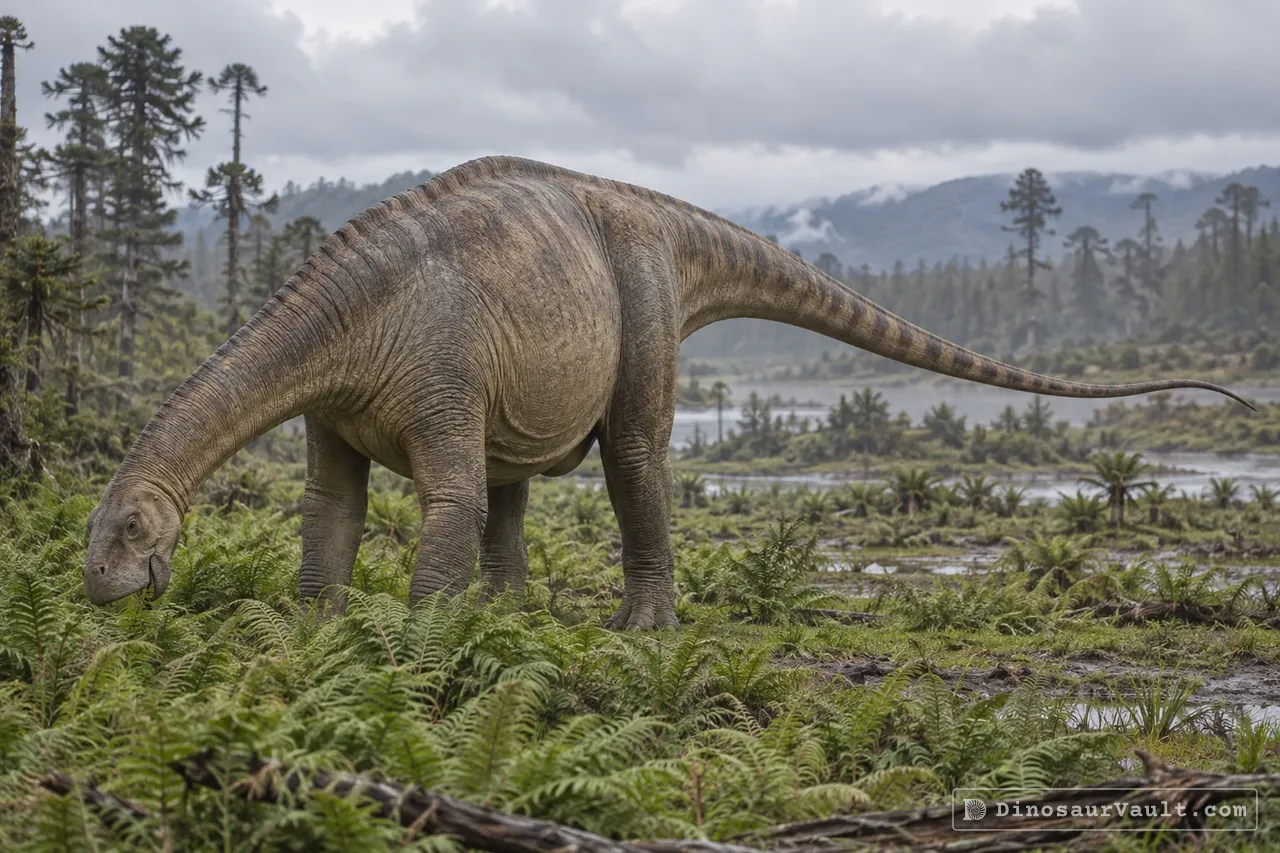
1 of 3
The evidence
The science behind Sidersaura
Which parts of the picture come from its own bones, and which come from its relatives.
From its own fossils
- The type specimen preserves part of the braincase, back and tail bones, and hind limb bones. A second skeleton assigned to it adds hip, thigh and shin bones and two incomplete hand bones.
- Bones beneath the tail have star-shaped projections.
- The skull roof has an opening between its front and rear bones.
Borrowed from relatives
- Lavocatisaurus provides a comparison for the missing snout and neck.
- Limaysaurus provides comparisons for missing parts of the trunk, front limbs and tail.
Still unknown
- Its skin covering and color.
- The full shape of its snout.
- The complete arrangement of its finger and toe bones.
Discovery timeline
- 2018Family treeCanudo et al.
- 2022Same rocksCanale et al.
- 2024Named itLerzo et al.
- 2024Family treeLerzo et al.
Key papers
The research behind what we know of Sidersaura
Family tree
Described Lavocatisaurus, whose skull and neck provide a comparison for the missing snout and neck of Sidersaura.
A new rebbachisaurid sauropod from the Aptian–Albian, Lower Cretaceous Rayoso Formation, Neuquén, Argentina. Acta Palaeontologica Polonica 63
Read the paper : A new rebbachisaurid sauropod from the Aptian–Albian, Lower Cretaceous Rayoso Formation, Neuquén, Argentina (opens in a new tab)Same rocks
Described Meraxes from the Huincul Formation and showed that its short arms evolved independently of those of tyrannosaurs.
New giant carnivorous dinosaur reveals convergent evolutionary trends in theropod arm reduction. Current Biology 32: 3195-3202.e5
Read the paper : New giant carnivorous dinosaur reveals convergent evolutionary trends in theropod arm reduction (opens in a new tab)Named it
Named Sidersaura from partial skeletons with star-shaped bones beneath the tail and an unusual opening in the skull roof.
The last of the oldies: a basal rebbachisaurid (Sauropoda, Diplodocoidea) from the early Late Cretaceous (Cenomanian–Turonian) of Patagonia, Argentina. Historical Biology 37: 208-233
Read the paper : The last of the oldies: a basal rebbachisaurid (Sauropoda, Diplodocoidea) from the early Late Cretaceous (Cenomanian–Turonian) of Patagonia, Argentina (opens in a new tab)Family tree
Named Campananeyen and, in one analysis, grouped it with Sidersaura among early rebbachisaurids.
They all floated in the cretaceous: new rebbachisaurid (Sauropoda, Diplodocoidea) with a highly pneumatized skeleton from the Upper Cretaceous (lower Cenomanian) of Patagonia, Argentina. Historical Biology 37: 1795-1808
Read the paper : They all floated in the cretaceous: new rebbachisaurid (Sauropoda, Diplodocoidea) with a highly pneumatized skeleton from the Upper Cretaceous (lower Cenomanian) of Patagonia, Argentina (opens in a new tab)
Close relatives
Other members of Rebbachisauridae


Sources: Wikidata