Sauroplites
"lizard hoplite"
Type species Sauroplites scutiger
- Lived
- 121 to 113 million years ago, Early Cretaceous
- Diet
- Herbivore
- Group
- Ankylosaurs, Nodosauridae
- Found in
- China
- Named by
- Bohlin 1953
Where its fossils were found
The evidence
Today

115 million years ago
Field notes
About Sauroplites
What it was like
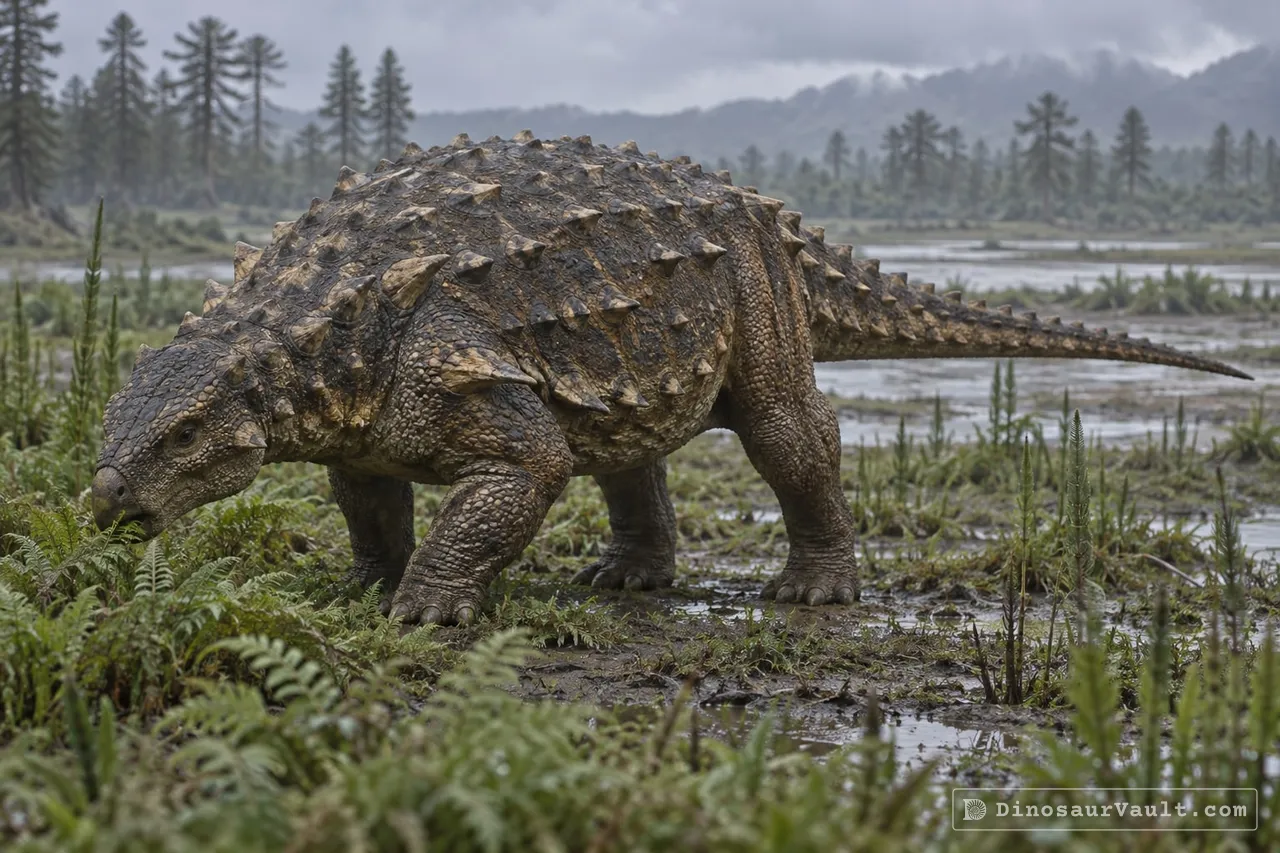
Sauroplites was an armored plant eater known from armor plates, ribs and part of the hips. Its validity has been questioned, but later work on its armor treats it as valid but poorly known. Its exact place among armored dinosaurs remains uncertain.
Its world
It lived in the Early Cretaceous, in what is now China.
How it was found
Bohlin named Sauroplites in 1953. The type species is Sauroplites scutiger.
Field gallery
More views of Sauroplites
Scenes reconstructed from the available fossil evidence.
1 of 3
The evidence
The science behind Sauroplites
Which parts of the picture come from its own bones, and which come from its relatives.
From its own fossils
- Armor plates preserve part of a bony shield over the hips. This hip armor differs from that of Taohelong and Dongyangopelta, two other early armored dinosaurs from China.
- The whereabouts of the original fossils are unknown, but casts of them survive.
Borrowed from relatives
- Its low, broad body and four-legged stance are restored from other armored dinosaurs, including nodosaurids such as Sauropelta.
- Its head, neck and shoulders can be modeled on Europelta, an early nodosaurid known from a more complete skeleton.
Still unknown
- The shape of its skull, limbs and tail.
- Its exact place among armored dinosaurs. Some family-tree studies have left it out because its position kept shifting and blurred the results.
- Its local landscape and which animals lived alongside it.
Discovery timeline
- 1953Named itBohlin
- 2015Family treeArbour & Currie
- 2018Family treeRivera-Sylva et al.
Key papers
The research behind what we know of Sauroplites
Named it
Named Sauroplites from fragmentary remains dominated by bony armor, including plates that formed a shield over the hips.
VI. Vertebrate Palaeontology 6. Fossil reptiles from Mongolia and Kansu. Reports from the Scientific Expedition to the North-western Provinces of China under Leadership of Dr. Sven Hedin. The Sino-Swedish Expedition Publication 37: 1-113
No link available
Family tree
Reassessed armored dinosaur relationships and recognized early nodosaurids in Asia, providing context for the placement of Sauroplites.
Systematics, phylogeny and palaeobiogeography of the ankylosaurid dinosaurs. Journal of Systematic Palaeontology 14: 385-444
Read the paper : Systematics, phylogeny and palaeobiogeography of the ankylosaurid dinosaurs (opens in a new tab)Family tree
Placed Sauroplites with Dongyangopelta and Mymoorapelta in an unresolved group among early branches of the nodosaurid family tree.
Paleodiversity of Late Cretaceous Ankylosauria from Mexico and their phylogenetic significance. Swiss Journal of Palaeontology 137: 83-93
Read the paper : Paleodiversity of Late Cretaceous Ankylosauria from Mexico and their phylogenetic significance (opens in a new tab)
Close relatives
Other members of Nodosauridae


Sources: Wikidata