Sarahsaurus
"Sarah's lizard"
Type species Sarahsaurus aurifontanalis
- Lived
- 200 to 184 million years ago, Early Jurassic
- Group
- Early sauropodomorphs, Massospondylidae
- Found in
- United States
- Named by
- Rowe et al. 2011
Where its fossils were found
The evidence
Today

190 million years ago
Habitat
Rivers crossed a landscape bordered by desert dunes. Dilophosaurus and Scutellosaurus lived in the Kayenta Formation alongside Sarahsaurus.
Field notes
About Sarahsaurus
What it was like
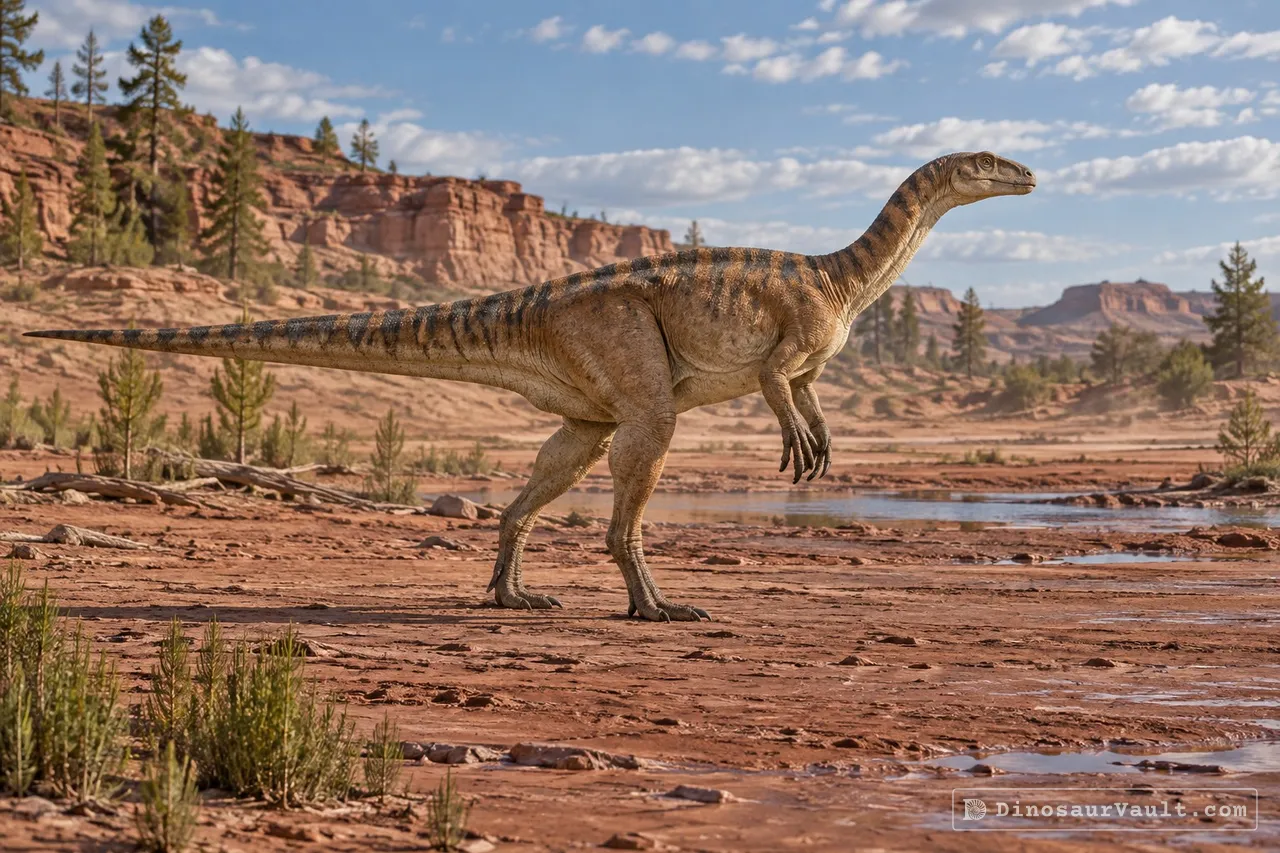
Sarahsaurus was an early relative of the giant sauropods, a medium-sized plant eater with a long neck and a long tail. Its hands were strong, with large claws on the thumbs, which it may have used for grabbing plants or for defense.
Its world
It lived about 200 to 184 million years ago, in the Early Jurassic, in what is now Arizona. Its bones come from the Kayenta Formation, where it shared the land with the crested predator Dilophosaurus and the small armored Scutellosaurus.
How it was found
Rowe and colleagues named Sarahsaurus in 2011. The type species is Sarahsaurus aurifontanalis. Its closest relatives include Massospondylus from southern Africa, which suggests that animals of this kind spread widely across the joined continents of the time.
Field gallery
More views of Sarahsaurus
Scenes reconstructed from the available fossil evidence.
1 of 2
Lived alongside
Found in the same rock formations


A rock formation can hold fossils laid down millions of years apart, so not every animal here met Sarahsaurus.
The evidence
The science behind Sarahsaurus
Which parts of the picture come from its own bones, and which come from its relatives.
From its own fossils
- Much of the skeleton preserves a long neck, strong limbs and a long tail, along with fragments of the skull.
- The hand has a huge curved thumb claw, a smaller claw beside it and short outer fingers.
- The feet carry claws on the main toes, with a reduced outer toe.
Borrowed from relatives
- Most of the body is known from its own bones; Massospondylus helps fill in the missing shape of the face.
Still unknown
- Whether a separate, more complete skull assigned to Sarahsaurus really belongs to it.
- Its skin covering and color.
- Whether its large thumb claws mainly served to gather food or defend itself.
Often drawn wrong
- Its fingers should not all end in equally large hooks: the thumb claw dwarfed the outer fingertips.
Discovery timeline
- 2011Named itRowe, Sues & Reisz
- 2018Full descriptionMarsh & Rowe
- 2018Close relativeChapelle & Choiniere
Key papers
The research behind what we know of Sarahsaurus
Named it
Named an early sauropod relative from Arizona with powerful hands and large thumb claws.
Dispersal and diversity in the earliest North American sauropodomorph dinosaurs, with a description of a new taxon. Proceedings of the Royal Society B 278: 1044-1053
No link available
Full description
Described the skeleton in detail and tested whether a separately found skull belongs to Sarahsaurus.
Anatomy and systematics of the sauropodomorph Sarahsaurus aurifontanalis from the Early Jurassic Kayenta Formation. PLOS ONE 13: e0204007
Read the paper : Anatomy and systematics of the sauropodomorph Sarahsaurus aurifontanalis from the Early Jurassic Kayenta Formation (opens in a new tab)Close relative
Scanned a well-preserved Massospondylus skull, providing a comparison for the missing parts of the Sarahsaurus face.
A revised cranial description ofMassospondylus carinatusOwen (Dinosauria: Sauropodomorpha) based on computed tomographic scans and a review of cranial characters for basal Sauropodomorpha. PeerJ 6: e4224
Read the paper : A revised cranial description ofMassospondylus carinatusOwen (Dinosauria: Sauropodomorpha) based on computed tomographic scans and a review of cranial characters for basal Sauropodomorpha (opens in a new tab)
Close relatives
Other members of Massospondylidae


Sources: Wikidata