Scutellosaurus
skoo-TEL-oh-SORE-us
"little shield lizard"
- Lived
- 201 to 184 million years ago, Early Jurassic
- Diet
- Herbivore
- Length
- about 1.2 m (4 ft)
- Found in
- United States
- Named by
- Colbert 1981
Size comparison
To scale

Scale in metersOutline: typical early armored dinosaur shape
Where its fossils were found
The evidence
Today

195 million years ago
Habitat
Rivers crossed a landscape with nearby dunes in the Kayenta Formation of Arizona. Dilophosaurus and Sarahsaurus lived there too.
Field notes
About Scutellosaurus
What it was like
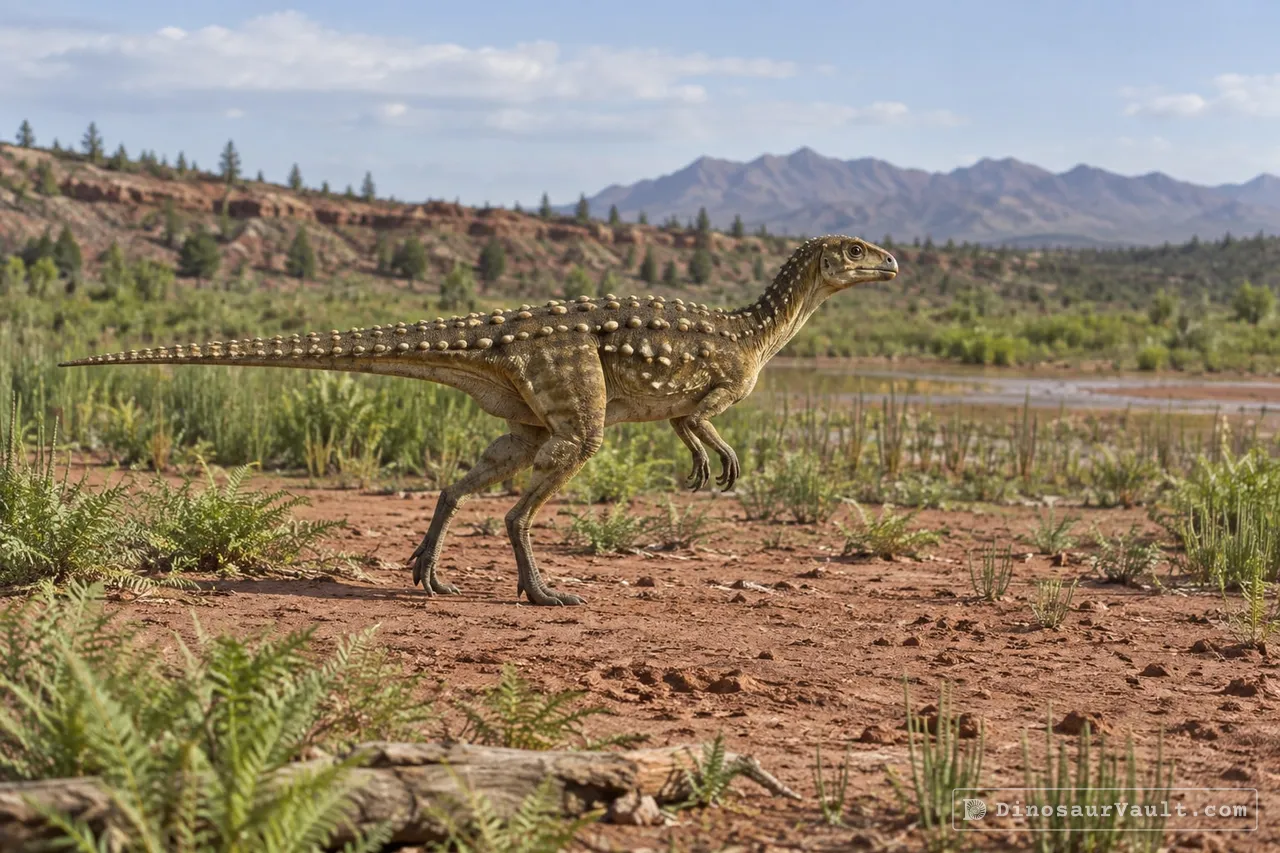
Scutellosaurus was a small plant eater about 1.2 meters (4 feet) long, one of the earliest armored dinosaurs. Hundreds of small bony studs ran along its back, sides and tail.
Unlike its big armored relatives, it was light enough to run on its hind legs. Its very long tail helped balance its body.
Its world
It lived in the Early Jurassic, about 201 to 184 million years ago, in what is now Arizona. Its fossils come from the Kayenta Formation, a land of rivers and dunes.
It shared that land with the crested hunter Dilophosaurus, the smaller Megapnosaurus and the long-necked Sarahsaurus. Its armor would have helped protect it from those predators.
How it was found
Colbert named Scutellosaurus in 1981. About 17 finds are known.
Field gallery
More views of Scutellosaurus
Scenes reconstructed from the available fossil evidence.
1 of 3
Lived alongside
Found in the same rock formations


A rock formation can hold fossils laid down millions of years apart, so not every animal here met Scutellosaurus.
The evidence
The science behind Scutellosaurus
Which parts of the picture come from its own bones, and which come from its relatives.
From its own fossils
- Many partial skeletons preserve much of the body, including pieces of the skull and a very long tail.
- Hundreds of small armor bones include flat plates and pieces with raised ridges.
- Its hind legs were much longer than its arms, supporting movement on its hind feet.
Borrowed from relatives
- Most of its body proportions come from its own bones.
- Missing details of the hands and feet are compared with early relatives such as Lesothosaurus.
Still unknown
- The full arrangement of its armor on the living animal.
- Its color.
- How often it used its front legs while feeding.
Discovery timeline
- 1981Named itColbert
- 2020New findBreeden & Rowe
- 2021Full descriptionBreeden et al.
- 2023PostureAnderson et al.
Key papers
The research behind what we know of Scutellosaurus
Named it
Described a small plant eater with numerous bony armor pieces and named it for these little shields.
A primitive ornithischian dinosaur from the Kayenta Formation of Arizona. Museum of Northern Arizona Bulletin 53: 1-61
No link available
New find
Described additional skeletons that filled gaps in its skull and body anatomy and clarified its place among early armored dinosaurs.
New Specimens ofScutellosaurus LawleriColbert, 1981, from the Lower Jurassic Kayenta Formation in Arizona Elucidate the Early Evolution of Thyreophoran Dinosaurs. Journal of Vertebrate Paleontology 40: e1791894
Read the paper : New Specimens ofScutellosaurus LawleriColbert, 1981, from the Lower Jurassic Kayenta Formation in Arizona Elucidate the Early Evolution of Thyreophoran Dinosaurs (opens in a new tab)Full description
Detailed its skeleton and armor and found that its limb bones record slow growth throughout life.
The anatomy and palaeobiology of the early armoured dinosaur Scutellosaurus lawleri (Ornithischia: Thyreophora) from the Kayenta Formation (Lower Jurassic) of Arizona. Royal Society Open Science 8
Read the paper : The anatomy and palaeobiology of the early armoured dinosaur Scutellosaurus lawleri (Ornithischia: Thyreophora) from the Kayenta Formation (Lower Jurassic) of Arizona (opens in a new tab)Posture
Walking simulations favored movement on the hind legs, although using all its feet was physically possible and may have helped during feeding.
Investigating the quadrupedal abilities of Scutellosaurus lawleri and its implications for locomotor behavior evolution among dinosaurs. The Anatomical Record 306: 2514-2536
Read the paper : Investigating the quadrupedal abilities of Scutellosaurus lawleri and its implications for locomotor behavior evolution among dinosaurs (opens in a new tab)
Close relatives
Other members of Thyreophora


Sources: Wikidata