Glacialisaurus
"frozen lizard"
Type species Glacialisaurus hammeri
- Lived
- 200 to 184 million years ago, Early Jurassic
- Group
- Early sauropodomorphs, Massospondylidae
- Found in
- Antarctica
- Named by
- Smith and Pol 2007
Where its fossils were found
The evidence
Today

190 million years ago
Habitat
A much warmer Antarctica, in a valley shaped by volcanic activity as Gondwana broke apart. Its neighbors included Cryolophosaurus, a flying reptile and a small mammal relative.
Field notes
About Glacialisaurus
What it was like
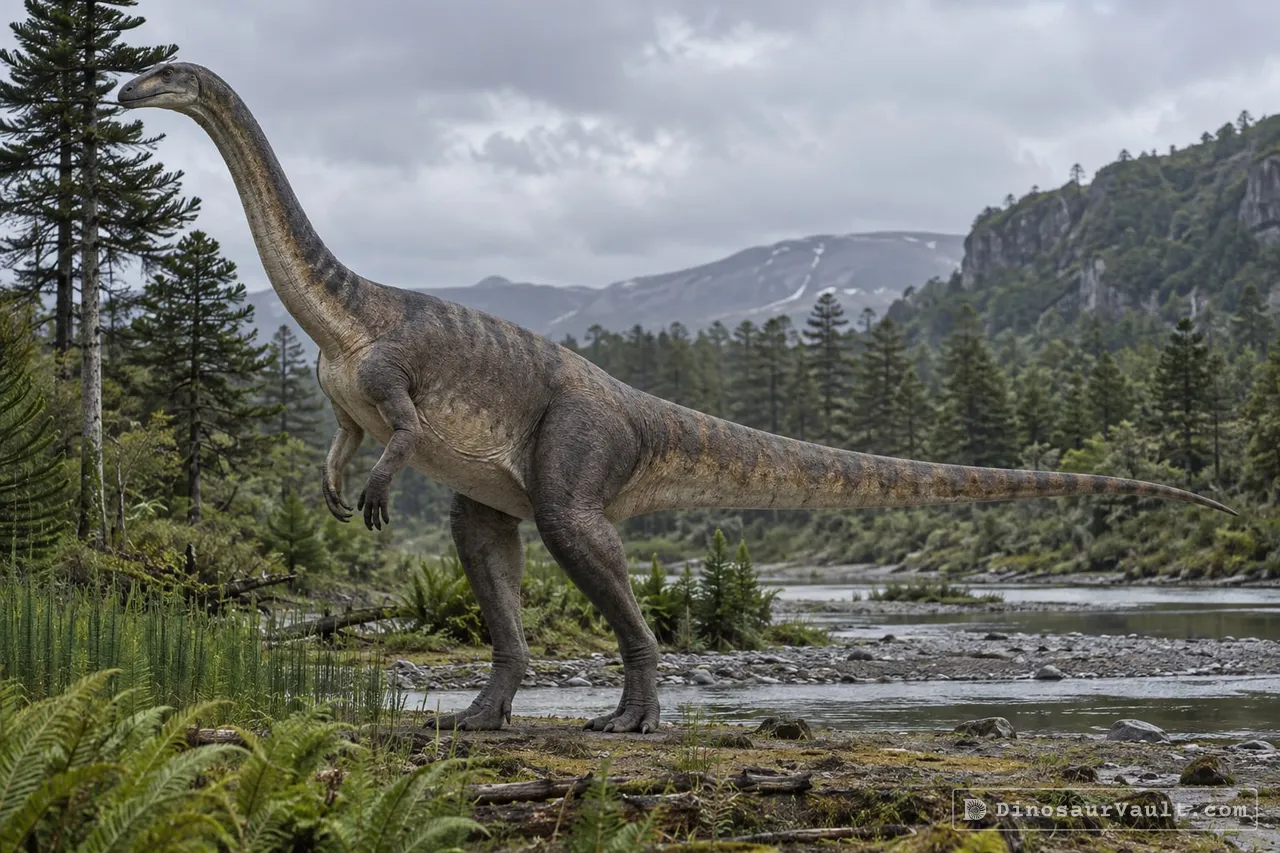
Glacialisaurus was an early relative of the giant sauropods, a plant eater with a long neck. It is known only from parts of a foot and a thigh bone. Its closest relatives include Massospondylus and Lufengosaurus.
Its world
It lived about 200 to 184 million years ago, in the Early Jurassic, in Antarctica. The land was much warmer then. Its bones come from the Hanson Formation, which also held the crested predator Cryolophosaurus.
How it was found
Smith and Pol named Glacialisaurus in 2007. The type species is Glacialisaurus hammeri.
Field gallery
More views of Glacialisaurus
Scenes reconstructed from the available fossil evidence.
1 of 3
Lived alongside
Found in the same rock formations

A rock formation can hold fossils laid down millions of years apart, so not every animal here met Glacialisaurus.
The evidence
The science behind Glacialisaurus
Which parts of the picture come from its own bones, and which come from its relatives.
From its own fossils
- The type specimen preserves parts of a right ankle and foot, including stout bones along the inner side of the foot.
- A separate lower end of a left thigh bone was provisionally referred to Glacialisaurus.
- Ridges on the lower end of the referred thigh bone and the shape of the type ankle bones were used to tell it apart from other early sauropodomorphs.
Borrowed from relatives
- Its missing head is restored by comparison with Massospondylus, and its neck, trunk, arms and tail by comparison with Sarahsaurus.
Still unknown
- The shape of its skull and teeth. Its toe bones and claws are unknown.
- Its skin covering and color.
- How often it walked on all fours.
Discovery timeline
- 2007Named itSmith & Pol
- 2007Same rocksSmith et al.
- 2018Family treeMarsh & Rowe
Key papers
The research behind what we know of Glacialisaurus
Named it
Described the type ankle and foot, referred a separate thigh bone to Glacialisaurus, and found similarities to Lufengosaurus.
Anatomy of a basal sauropodomorph dinosaur from the Early Jurassic Hanson Formation of Antarctica. Acta Palaeontologica Polonica 52: 657-674
No link available
Same rocks
Compared the early sauropodomorph and Cryolophosaurus from the Hanson Formation with dinosaurs from other continents.
The dinosaurs of the Early Jurassic Hanson Formation of the Central Transantarctic Mountains: phylogenetic review and synthesis. Open-File Report
Read the paper : The dinosaurs of the Early Jurassic Hanson Formation of the Central Transantarctic Mountains: phylogenetic review and synthesis (opens in a new tab)Family tree
A family-tree analysis grouped Glacialisaurus with Lufengosaurus and Coloradisaurus.
Anatomy and systematics of the sauropodomorph Sarahsaurus aurifontanalis from the Early Jurassic Kayenta Formation. PLOS ONE 13: e0204007
Read the paper : Anatomy and systematics of the sauropodomorph Sarahsaurus aurifontanalis from the Early Jurassic Kayenta Formation (opens in a new tab)
Close relatives
Other members of Massospondylidae


Sources: Wikidata