Leyesaurus
"Leyes lizard"
- Lived
- 201 to 175 million years ago, Early Jurassic
- Group
- Early sauropodomorphs, Massospondylidae
- Found in
- Argentina
- Named by
- Apaldetti et al. 2011
Where its fossils were found
The evidence
Today

190 million years ago
Habitat
It lived in northwestern Argentina, where streams spread sand and gravel into broad fans of sediment.
Field notes
About Leyesaurus
What it was like
Leyesaurus was a plant eater from the long-necked line that later produced the giant sauropods, a relative of Massospondylus. It is known from a skull, neck bones and parts of the limbs.
Its world
It lived in what is now northwestern Argentina. Its fossils come from the Balde de Leyes Formation, whose age is tentatively placed in the Early Jurassic rather than firmly established.
How it was found
Apaldetti and colleagues named Leyesaurus in 2011, from a single find. Its name honors the family who found it.
Field gallery
More views of Leyesaurus
Scenes reconstructed from the available fossil evidence.
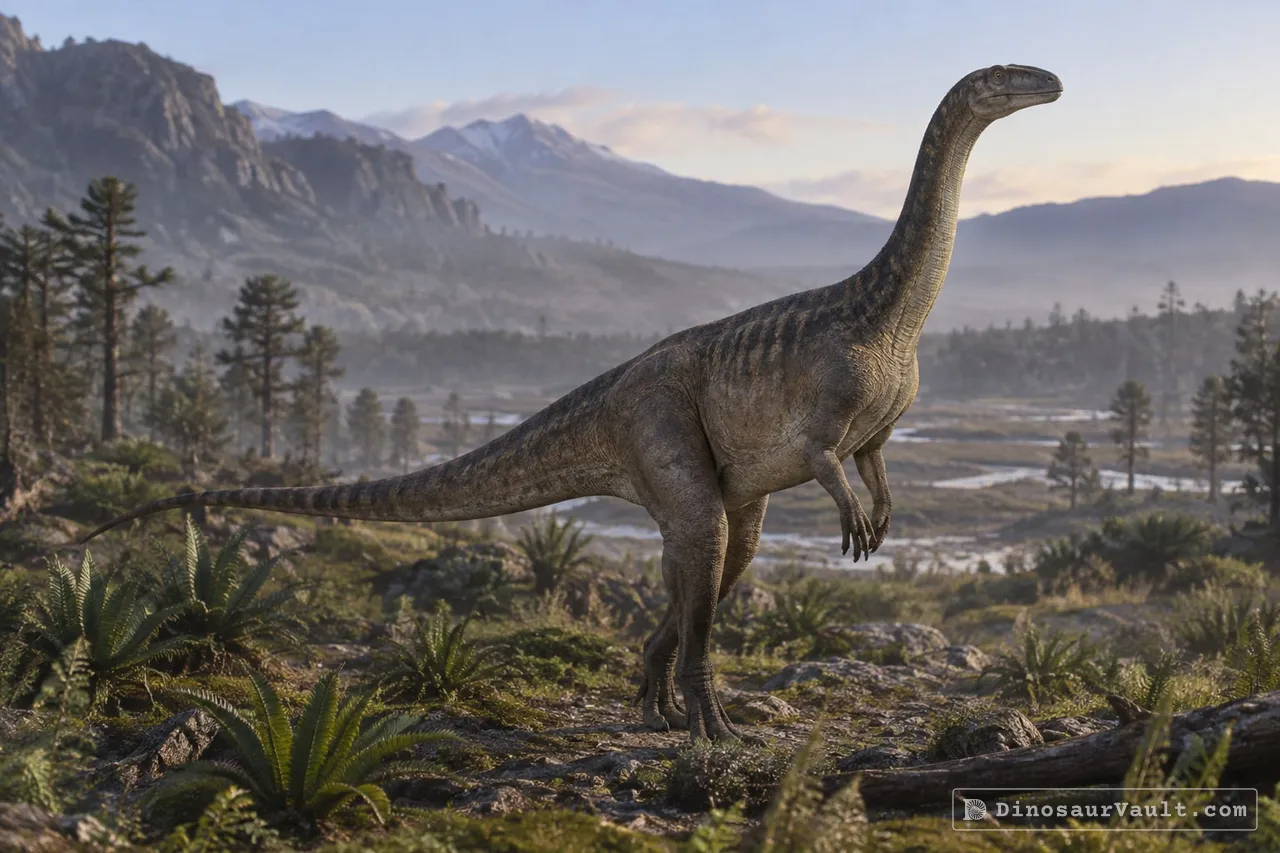
1 of 3
The evidence
The science behind Leyesaurus
Which parts of the picture come from its own bones, and which come from its relatives.
From its own fossils
- A partial skeleton preserves the skull and jaws, neck vertebrae, two tail vertebrae, damaged parts of the shoulder and upper arm, parts of the hips, the lower end of a fibula and part of the left foot.
- Its neck vertebrae are especially long, and the outer faces of its upper teeth bulge outward.
- The skull is short and low. The bones were found scattered, and are treated as one animal because they lay close together, none is repeated and they match in size.
Borrowed from relatives
- Missing parts of the body, limbs and tail are restored by comparison with its close relative Adeopapposaurus.
Still unknown
- The shape and size of its nostrils. The bones over the top of the snout are missing.
- Exactly which foot bones it preserved. A bone once described as a distinctive foot bone was later identified as the lower end of the fibula, a slender bone of the lower leg.
- Its skin covering, its color and how its body changed as it grew.
Discovery timeline
- 2009Close relativeMartínez
- 2011Named itApaldetti et al.
- 2018Family treeMarsh & Rowe
- 2025RedescriptionPeyre de Fabrègues et al.
Key papers
The research behind what we know of Leyesaurus
Close relative
Described the long-necked Adeopapposaurus, a close relative that helps fill gaps in the skeleton of Leyesaurus.
Adeopapposaurus mognai, gen. et sp. nov. (Dinosauria: Sauropodomorpha), with comments on adaptations of basal Sauropodomorpha. Journal of Vertebrate Paleontology 29: 142-164
Read the paper : Adeopapposaurus mognai, gen. et sp. nov. (Dinosauria: Sauropodomorpha), with comments on adaptations of basal Sauropodomorpha (opens in a new tab)Named it
Described the skull and partial skeleton of Leyesaurus and found it closely related to Adeopapposaurus.
A New Basal Sauropodomorph (Dinosauria: Saurischia) from Quebrada del Barro Formation (Marayes-El Carrizal Basin), Northwestern Argentina. PLoS ONE 6: e26964
Read the paper : A New Basal Sauropodomorph (Dinosauria: Saurischia) from Quebrada del Barro Formation (Marayes-El Carrizal Basin), Northwestern Argentina (opens in a new tab)Family tree
Placed Sarahsaurus within the same family as Leyesaurus and tested how these early long-necked dinosaurs spread between continents.
Anatomy and systematics of the sauropodomorph Sarahsaurus aurifontanalis from the Early Jurassic Kayenta Formation. PLOS ONE 13: e0204007
Read the paper : Anatomy and systematics of the sauropodomorph Sarahsaurus aurifontanalis from the Early Jurassic Kayenta Formation (opens in a new tab)Redescription
Reidentified a supposed foot bone as part of the lower leg, described additional bones and interpreted the type skeleton as a juvenile.
Leyesaurus marayensis (Dinosauria, Sauropodomorpha) from Northwestern Argentina: An Update. Ameghiniana 62: 217-227
Read the paper : Leyesaurus marayensis (Dinosauria, Sauropodomorpha) from Northwestern Argentina: An Update (opens in a new tab)
Close relatives
Other members of Massospondylidae


Sources: Wikidata