Udelartitan
Type species Udelartitan celeste
- Lived
- 101 to 84 million years ago, Late Cretaceous
- Diet
- Herbivore
- Group
- Sauropods
- Found in
- Uruguay
- Named by
- Soto et al. 2024
Where its fossils were found
The evidence
Today

90 million years ago
Habitat
Branching river channels crossed a warm landscape with dry spells in what is now Uruguay. Mesetasaurus is another titanosaur known from the Guichón Formation.
Field notes
About Udelartitan
What it was like
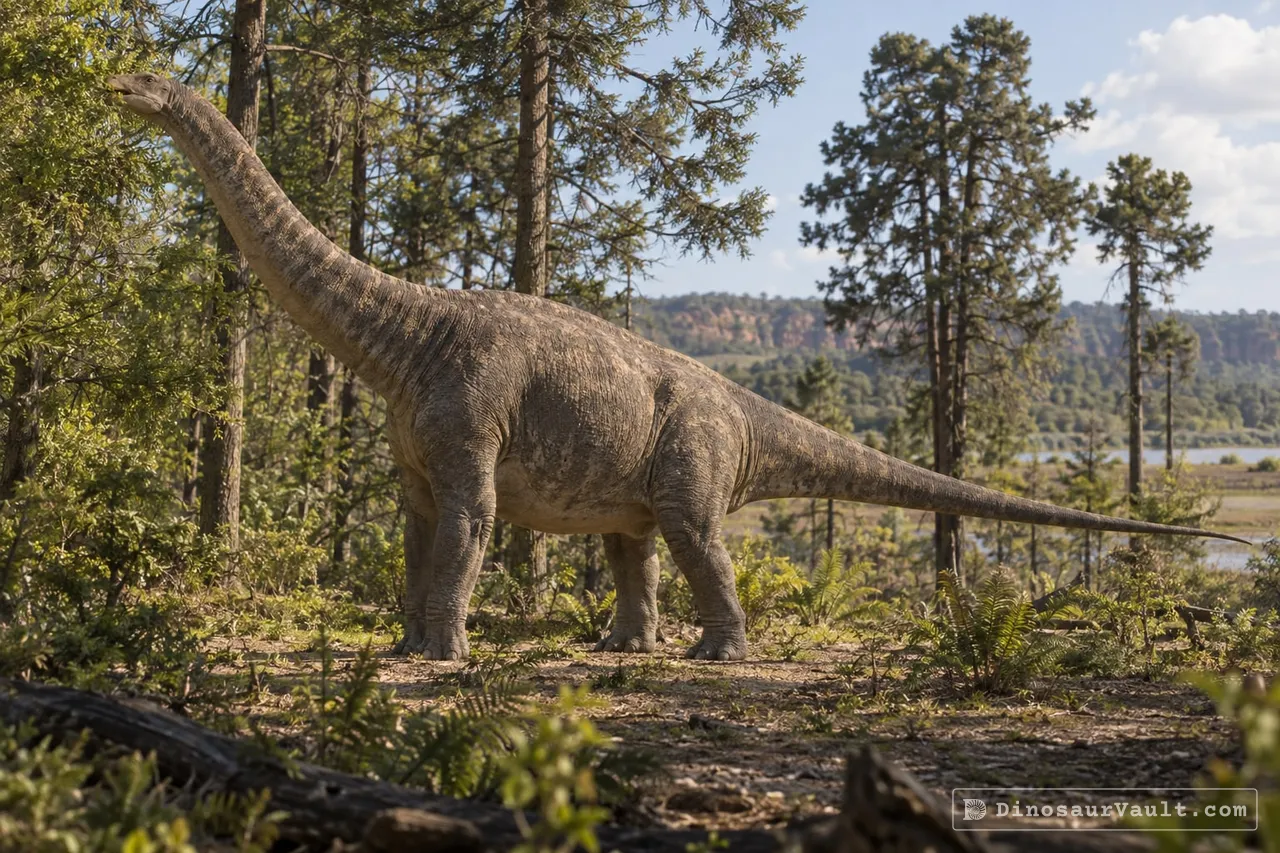
Udelartitan was a titanosaur, a long-necked plant eater. It is known from part of the skeleton.
Its world
It lived in the Late Cretaceous, in what is now Uruguay. It comes from the Guichón Formation, where the titanosaur Mesetasaurus has also been found.
How it was found
Soto and colleagues named Udelartitan in 2024. The type species is Udelartitan celeste. It was the first dinosaur named from Uruguay.
Field gallery
More views of Udelartitan
Scenes reconstructed from the available fossil evidence.
1 of 3
Lived alongside
Found in the same rock formations

A rock formation can hold fossils laid down millions of years apart, so not every animal here met Udelartitan.
The evidence
The science behind Udelartitan
Which parts of the picture come from its own bones, and which come from its relatives.
From its own fossils
- The type specimen is the first three tail vertebrae, found nearly in a row. Dozens more tail bones, part of a shoulder bone and pieces of the lower legs, ankles and feet are referred to it, from at least two individuals.
- The first tail vertebra has a rounded joint surface at each end; the following ones have a socket in front and a rounded end behind. The joint faces of the middle tail vertebrae have a six-sided outline.
- Some tail bones of the type specimen bear marks probably made by insects after the animal died.
Borrowed from relatives
- The missing head is restored after Tapuiasaurus, a titanosaur known from a skull.
- The neck, body, hips and toe claws follow Mnyamawamtuka, and the hands follow Camarasaurus and Apatosaurus.
Still unknown
- Its skull shape and neck length.
- Whether it had bony armor. Lumps once thought to be armor turned out to be mineral concretions, not bone.
- Its exact place among titanosaurs. In the naming study, different ways of weighting the anatomy put it either among the saltasaurines or in a wider group outside the saltasaurid family.
Discovery timeline
- 2012Full descriptionSoto, Perea & Cambiaso
- 2024Named itSoto et al.
- 2025Fossil sitesPerea et al.
Key papers
The research behind what we know of Udelartitan
Full description
Described the tail and limb bones before they were named Udelartitan, and compared them with Alamosaurus, Baurutitan and Pellegrinisaurus.
First sauropod (Dinosauria: Saurischia) remains from the Guichón Formation, Late Cretaceous of Uruguay. Journal of South American Earth Sciences 33: 68-79
Read the paper : First sauropod (Dinosauria: Saurischia) remains from the Guichón Formation, Late Cretaceous of Uruguay (opens in a new tab)Named it
Named Udelartitan from tail and limb bones and placed it within a branch of titanosaurs that includes Saltasaurus.
Phylogenetic relationships of a new titanosaur (Dinosauria, Sauropoda) from the Upper Cretaceous of Uruguay. Cretaceous Research 160: 105894
Read the paper : Phylogenetic relationships of a new titanosaur (Dinosauria, Sauropoda) from the Upper Cretaceous of Uruguay (opens in a new tab)Fossil sites
Identified probable insect traces on Udelartitan bones, suggesting that the bones lay exposed before burial.
Bioerosion Structures on Dinosaur Bones Probably Made by Multituberculate Mammals and Dermestid Beetles (Guichón Formation, Late Cretaceous of Uruguay). Fossil Studies 3: 2
Read the paper : Bioerosion Structures on Dinosaur Bones Probably Made by Multituberculate Mammals and Dermestid Beetles (Guichón Formation, Late Cretaceous of Uruguay) (opens in a new tab)
Close relatives
Other members of Saltasauroidea


Sources: Wikidata