Propanoplosaurus
"before Panoplosaurus"
Type species Propanoplosaurus marylandicus
- Lived
- 120 to 113 million years ago, Early Cretaceous
- Diet
- Herbivore
- Group
- Ankylosaurs, Nodosauridae
- Found in
- United States
- Named by
- Stanford et al. 2011
Where its fossils were found
The evidence
Today

115 million years ago
Habitat
It lived around muddy wetlands in the Patuxent Formation. Footprints record small meat-eating dinosaurs, sauropods, pterosaurs and mammals moving across these wet surfaces.
Field notes
About Propanoplosaurus
What it was like
Propanoplosaurus is known from the natural cast of a baby nodosaur, a young armored plant eater only a little longer than a human hand. It was found as an impression in rock, with the shape of its skull and body.
Its world
It lived in the Early Cretaceous, in what is now Maryland. It comes from the Patuxent Formation, which also preserves many dinosaur footprints.
How it was found
Stanford and colleagues named Propanoplosaurus in 2011. The type species is Propanoplosaurus marylandicus. It is one of the youngest nodosaurs ever found.
Field gallery
More views of Propanoplosaurus
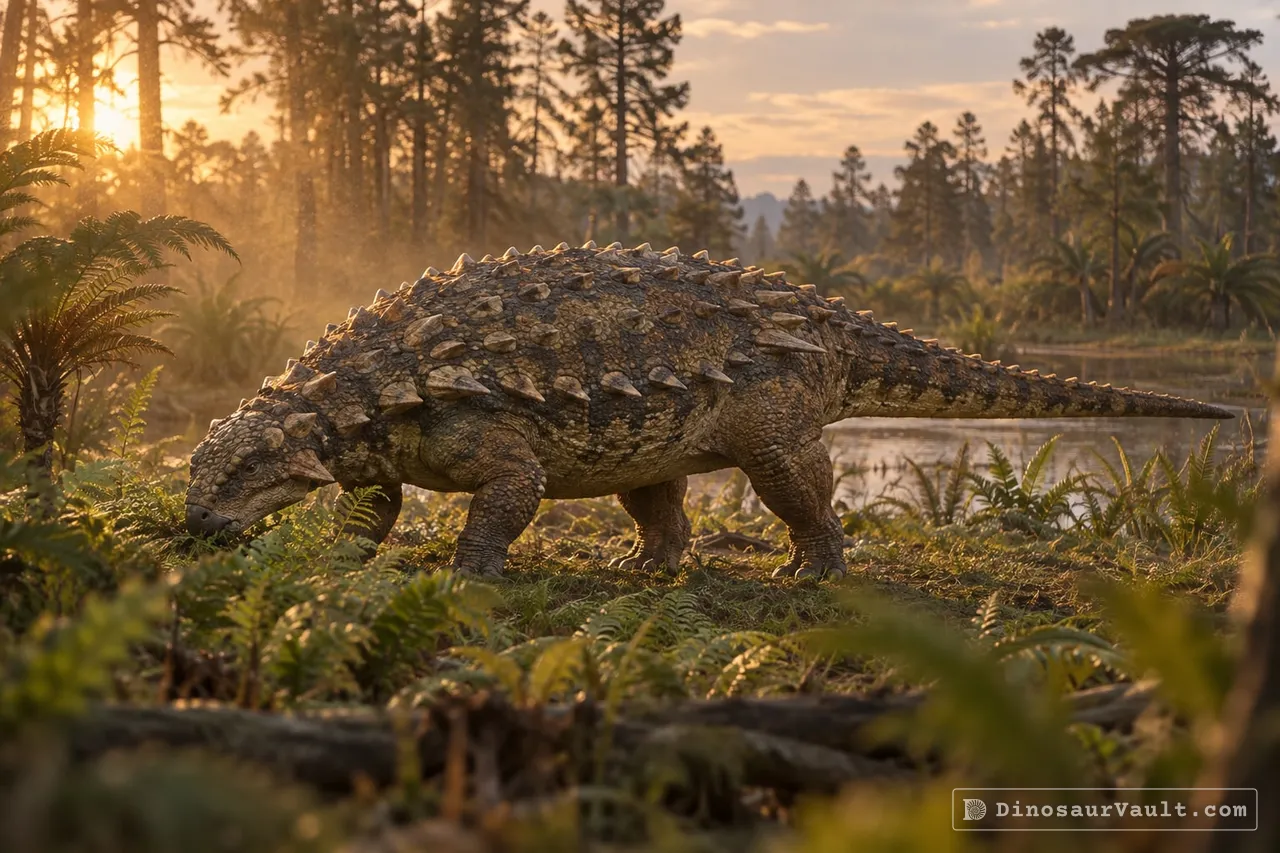
Scenes reconstructed from the available fossil evidence.
The evidence
The science behind Propanoplosaurus
Which parts of the picture come from its own bones, and which come from its relatives.
From its own fossils
- A tiny hatchling left natural molds and casts of its body in rock.
- The impression preserves body shape and bone structure, with some bones still in their original positions.
Borrowed from relatives
- An adult restoration draws its low, broad body and armored covering from other nodosaurids, such as Borealopelta.
Still unknown
- Its adult size and proportions.
- The arrangement of armor on an adult.
- Its color and whether its parents cared for hatchlings.
Discovery timeline
- 2011Named itStanford, Weishampel & Deleon
- 2017Close relativeBrown et al.
- 2018Same rocksStanford et al.
Key papers
The research behind what we know of Propanoplosaurus
Named it
Identified a tiny body impression as a hatchling nodosaur and named Propanoplosaurus.
The First Hatchling Dinosaur Reported from the Eastern United States: Propanoplosaurus marylandicus (Dinosauria: Ankylosauria) from the Early Cretaceous of Maryland, U.S.A. Journal of Paleontology 85: 916-924
Read the paper : The First Hatchling Dinosaur Reported from the Eastern United States: Propanoplosaurus marylandicus (Dinosauria: Ankylosauria) from the Early Cretaceous of Maryland, U.S.A. (opens in a new tab)Close relative
Borealopelta preserves armor, scales and horn coverings, showing how the outer covering of an adult nodosaur was built.
An Exceptionally Preserved Three-Dimensional Armored Dinosaur Reveals Insights into Coloration and Cretaceous Predator-Prey Dynamics. Current Biology 27: 2514-2521.e3
Read the paper : An Exceptionally Preserved Three-Dimensional Armored Dinosaur Reveals Insights into Coloration and Cretaceous Predator-Prey Dynamics (opens in a new tab)Same rocks
Described wetland footprints from the Patuxent Formation, including mammals, dinosaurs and pterosaurs.
A diverse mammal-dominated, footprint assemblage from wetland deposits in the Lower Cretaceous of Maryland. Scientific Reports 8
Read the paper : A diverse mammal-dominated, footprint assemblage from wetland deposits in the Lower Cretaceous of Maryland (opens in a new tab)
Close relatives
Other members of Nodosauridae


Sources: Wikidata