Pawpawsaurus
"Paw Paw lizard"
Type species Pawpawsaurus campbelli
- Lived
- 106 to 101 million years ago, Early Cretaceous
- Diet
- Herbivore
- Group
- Ankylosaurs, Nodosauridae
- Found in
- United States
- Named by
- Lee 1996
Where its fossils were found
The evidence
Today

105 million years ago
Habitat
Its skull was buried in coastal deposits beside a shallow sea in what is now Texas. Texasetes is another armored dinosaur known from the same rocks.
Field notes
About Pawpawsaurus
What it was like
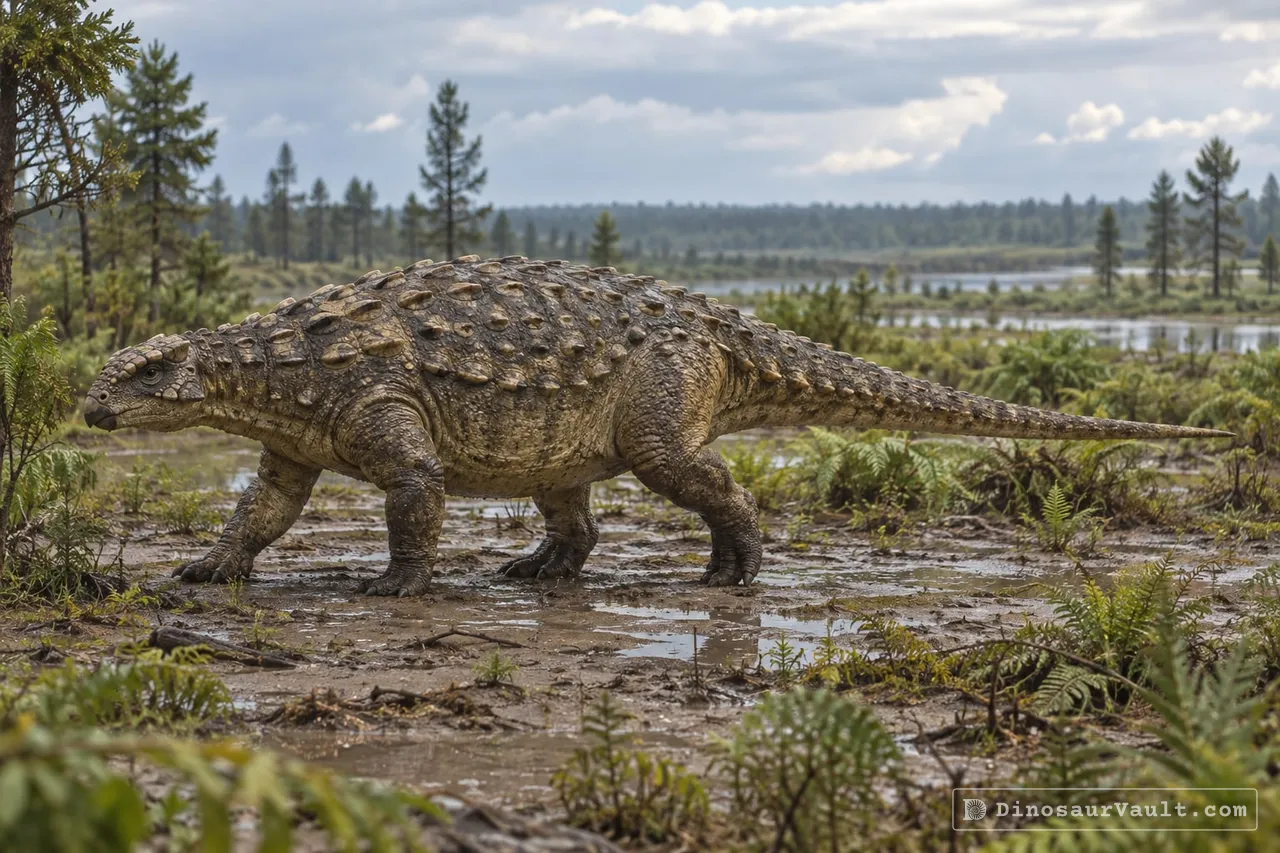
Pawpawsaurus was a nodosaur, an armored plant eater without a tail club. It is known from a complete skull, which shows bony plates over its head and even over its eyes.
Its world
It lived in the Early Cretaceous in what is now Texas. Its skull comes from the Paw Paw Formation, which formed near the coast of a shallow sea.
How it was found
Lee named it in 1996 from one find. The type species is Pawpawsaurus campbelli.
Field gallery
More views of Pawpawsaurus
Scenes reconstructed from the available fossil evidence.
1 of 3
The evidence
The science behind Pawpawsaurus
Which parts of the picture come from its own bones, and which come from its relatives.
From its own fossils
- A well-preserved skull shows a low, armored head with teeth at the front of the upper jaw.
- Bony eyelids were found with the skull.
- Scans reveal the brain cavity, inner ear and curved air passages inside its nose.
Borrowed from relatives
- Its body is restored from nodosaurs such as Sauropelta and Edmontonia, with a broad trunk, short legs and armor along the back.
- A tapering tail without a club follows other nodosaurs.
Still unknown
- The arrangement of armor and spikes along its body.
- Its full length and weight.
- Its skin color.
Discovery timeline
- 1995Same rocksCoombs
- 1996Named itLee
- 2016SkullPaulina-Carabajal, Lee & Jacobs
- 2018Close relativesBourke, Porter & Witmer
Key papers
The research behind what we know of Pawpawsaurus
Same rocks
Described Texasetes from coastal deposits, adding another armored dinosaur to the fauna of the Paw Paw Formation.
A Nodosaurid Ankylosaur (Dinosauria: Ornithischia) from the Lower Cretaceous of Texas. Journal of Vertebrate Paleontology 15: 298-312
Read the paper : A Nodosaurid Ankylosaur (Dinosauria: Ornithischia) from the Lower Cretaceous of Texas (opens in a new tab)Named it
Named Pawpawsaurus from a skull with bony eyelids and compared it with other early nodosaurs.
A new nodosaurid ankylosaur (Dinosauria: Ornithischia) from the Paw Paw Formation (Late Albian) of Texas. Journal of Vertebrate Paleontology 16: 232-245
Read the paper : A new nodosaurid ankylosaur (Dinosauria: Ornithischia) from the Paw Paw Formation (Late Albian) of Texas (opens in a new tab)Skull
Used scans to reconstruct the brain cavity, inner ear and nasal passages inside the skull.
Endocranial Morphology of the Primitive Nodosaurid Dinosaur Pawpawsaurus campbelli from the Early Cretaceous of North America. PLOS ONE 11: e0150845
Read the paper : Endocranial Morphology of the Primitive Nodosaurid Dinosaur Pawpawsaurus campbelli from the Early Cretaceous of North America (opens in a new tab)Close relatives
Modeled airflow in Panoplosaurus and Euoplocephalus, showing how their looping nasal passages could warm air and conserve heat and water.
Convoluted nasal passages function as efficient heat exchangers in ankylosaurs (Dinosauria: Ornithischia: Thyreophora). PLOS ONE 13: e0207381
Read the paper : Convoluted nasal passages function as efficient heat exchangers in ankylosaurs (Dinosauria: Ornithischia: Thyreophora) (opens in a new tab)
Close relatives
Other members of Nodosauridae


Sources: Wikidata