Paralitherizinosaurus
Type species Paralitherizinosaurus japonicus
- Lived
- 84 to 72 million years ago, Late Cretaceous
- Diet
- Herbivore
- Group
- Theropods, Therizinosauridae
- Found in
- Japan
- Named by
- Kobayashi et al. 2022
Where its fossils were found
The evidence
Today

80 million years ago
Habitat
Its bones were buried in marine mud off what is now Japan. It probably lived on nearby land, and its body drifted out to sea.
Field notes
About Paralitherizinosaurus
What it was like
Paralitherizinosaurus was a therizinosaur, a feathered plant eater with long claws on its hands. It is known from part of a hand and a neck bone.
Its world
It lived in the Late Cretaceous in what is now Japan. Its bones come from the Osoushinai Formation, which formed in the sea, so its body probably drifted out from the coast.
How it was found
Kobayashi and colleagues named it in 2022. The type species is Paralitherizinosaurus japonicus. Its name refers to the coast.
Field gallery
More views of Paralitherizinosaurus
Scenes reconstructed from the available fossil evidence.
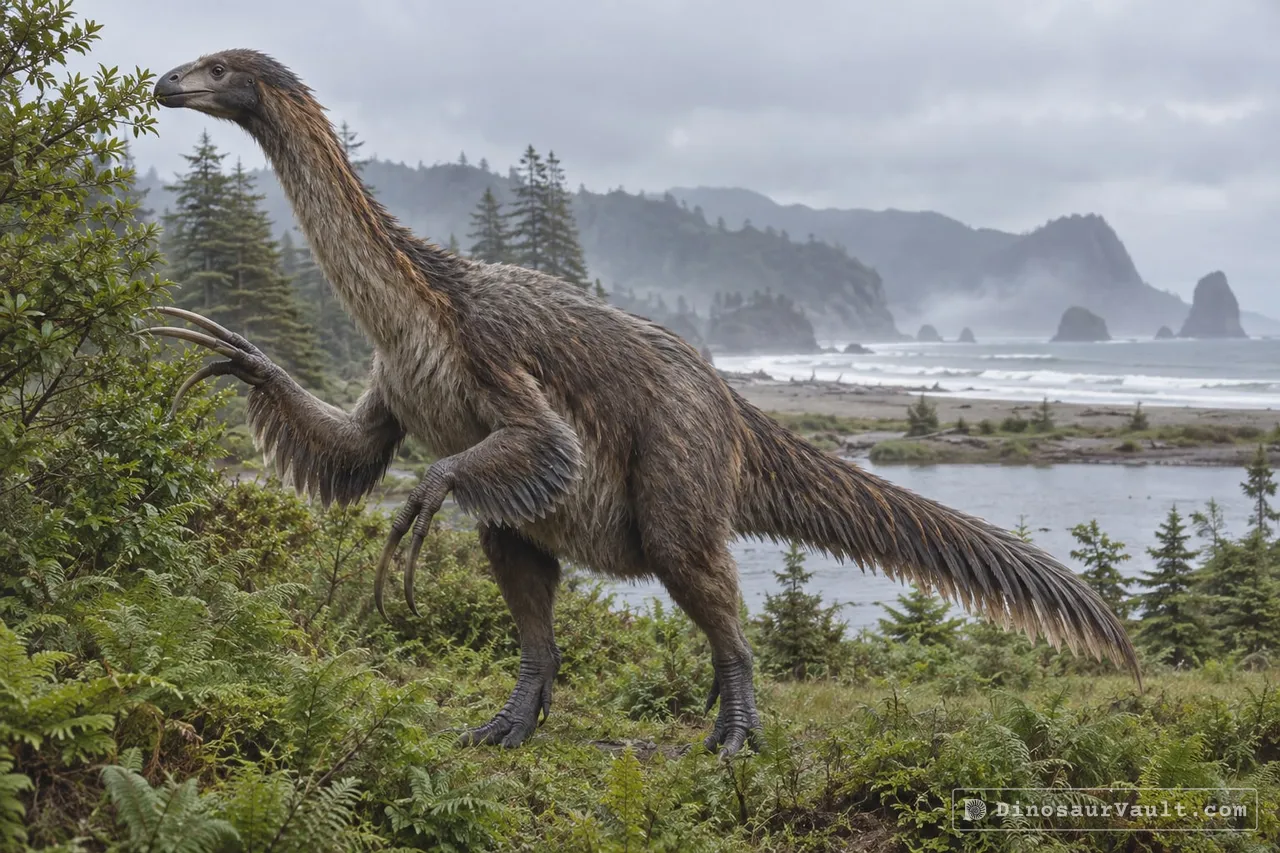
1 of 3
The evidence
The science behind Paralitherizinosaurus
Which parts of the picture come from its own bones, and which come from its relatives.
From its own fossils
- A partial hand preserves the bases of several claws and a nearly complete, slender claw with a strong curve.
- The claw bones have small attachment bumps for the muscles that bent the fingers.
Borrowed from relatives
- Nothronychus supplies a model for the missing body: a broad trunk, strong arms, long neck and short tail.
- Erlikosaurus guides the shape of the missing head, while feathered Beipiaosaurus supports a probable coat of filaments.
Still unknown
- Its skull shape and body proportions.
- The full lengths of its claws and their outer coverings.
- Whether it regularly fed near the coast.
Discovery timeline
- 2009Close relativeXu, Zheng & You
- 2015Close relativeHedrick et al.
- 2022Named itKobayashi et al.
Key papers
The research behind what we know of Paralitherizinosaurus
Close relative
Reported simple filaments and longer stiff feathers in Beipiaosaurus, supporting feathered restorations of other therizinosaurs.
A new feather type in a nonavian theropod and the early evolution of feathers. Proceedings of the National Academy of Sciences 106: 832-834
Read the paper : A new feather type in a nonavian theropod and the early evolution of feathers (opens in a new tab)Close relative
Described Nothronychus skeletons, providing a comparison for the body and limbs missing in Paralitherizinosaurus.
The Slothful Claw: Osteology and Taphonomy of Nothronychus mckinleyi and N. graffami (Dinosauria: Theropoda) and Anatomical Considerations for Derived Therizinosaurids. PLOS ONE 10: e0129449
Read the paper : The Slothful Claw: Osteology and Taphonomy of Nothronychus mckinleyi and N. graffami (Dinosauria: Theropoda) and Anatomical Considerations for Derived Therizinosaurids (opens in a new tab)Named it
Named the dinosaur from a partial hand and neck fragment, and proposed that its curved claws hooked and pulled vegetation.
New therizinosaurid dinosaur from the marine Osoushinai Formation (Upper Cretaceous, Japan) provides insight for function and evolution of therizinosaur claws. Scientific Reports 12
Read the paper : New therizinosaurid dinosaur from the marine Osoushinai Formation (Upper Cretaceous, Japan) provides insight for function and evolution of therizinosaur claws (opens in a new tab)
Close relatives
Other members of Therizinosauridae


Sources: Wikidata