Becklespinax
"Beckles's spine"
- Lived
- 139 to 133 million years ago, Early Cretaceous
- Diet
- Carnivore
- Length
- about 5 m (16 ft)
- Group
- Theropods
- Named by
- Olshevsky 1991
Size comparison
To scale


Scale in metersOutline: typical theropod shape
Where its fossils were found
The evidence
No finds with map coordinates are recorded yet.
Habitat
It lived in the Early Cretaceous in what is now southern England.
Field notes
About Becklespinax
What it was like
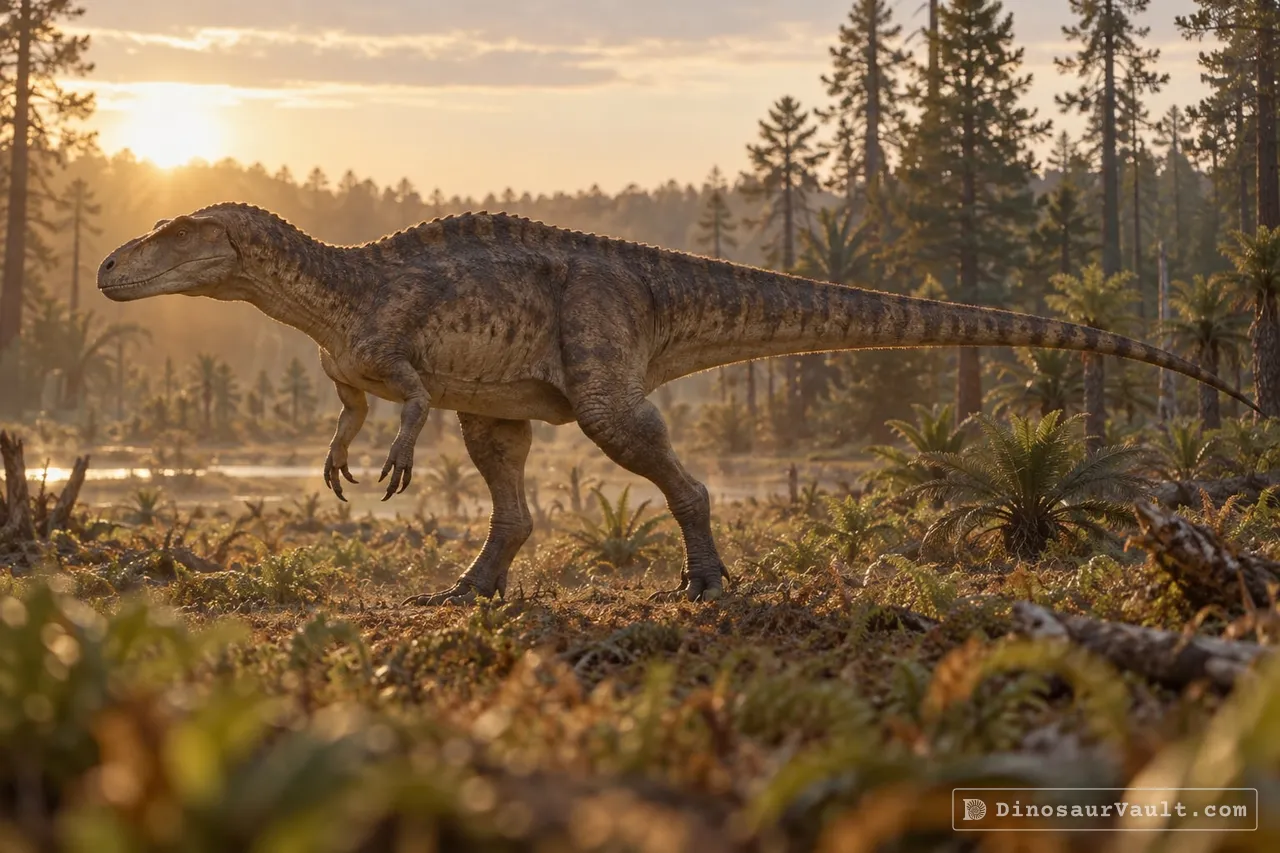
Becklespinax was a large meat eater, about 5 meters (16 feet) long, known only from three backbones. The spines on those backbones were very tall, so it may have had a ridge or low sail along its back.
Its world
It lived in the Early Cretaceous in what is now southern England.
How it was found
Its backbones were found long ago and were first placed in other genera. Olshevsky gave them a new name in 1991, honoring the collector who first found them. Some scientists use the older name Altispinax for the same bones.
Field gallery
More views of Becklespinax
Scenes reconstructed from the available fossil evidence.
The evidence
The science behind Becklespinax
Which parts of the picture come from its own bones, and which come from its relatives.
From its own fossils
- The known specimen consists of three joined vertebrae from the rear part of the back, with very tall spines.
- The spines widen toward their thick, robust tops.
- The front spine is broken short, one spine shows a healed break, and some of the tissue between the spines had turned to bone.
Borrowed from relatives
- The missing head, limbs and tail are restored using other large theropods, such as Allosaurus, as broad comparisons.
- One study found that its spines differ in their angle and widened tops from those of Concavenator, another theropod with a raised back.
Still unknown
- Whether the tall spines supported a narrow sail or a thicker ridge, and how far the raised section extended along the back.
- Its closest relatives. One study placed it among the tetanuran theropods, ruling out spinosaurids and carcharodontosaurids, but could not settle its family.
- Its skull, limbs and complete body shape.
Often drawn wrong
- Older pictures put the raised section over the shoulders. The tall-spined vertebrae belong farther back.
Discovery timeline
- 1991Named itOlshevsky
- 2007Family treeNaish & Martill
- 2010RedescriptionNaish
- 2016RedescriptionMaisch
Key papers
The research behind what we know of Becklespinax
Named it
Gave the tall-spined backbones the genus name Becklespinax after earlier assignments to other theropods.
A revision of the parainfraclass Archosauria Cope, 1869, excluding the advanced Crocodylia. Mesozoic Meanderings 2: 1-196
No link available
Family tree
Reviewed the British theropod record and the classification problems caused by fragmentary fossils and outdated identifying features.
Dinosaurs of Great Britain and the role of the Geological Society of London in their discovery: basal Dinosauria and Saurischia. Journal of the Geological Society 164: 493-510
Read the paper : Dinosaurs of Great Britain and the role of the Geological Society of London in their discovery: basal Dinosauria and Saurischia (opens in a new tab)Redescription
Examined the tall-spined backbones, placed them toward the rear of the back and explained their role in early ideas about dinosaur air sacs.
Pneumaticity, the early years: Wealden Supergroup dinosaurs and the hypothesis of saurischian pneumaticity. Geological Society, London, Special Publications 343: 229-236
Read the paper : Pneumaticity, the early years: Wealden Supergroup dinosaurs and the hypothesis of saurischian pneumaticity (opens in a new tab)Redescription
Argued that the name Altispinax rests on these tall-spined vertebrae, so Becklespinax is a later name for the same animal.
The nomenclatural status of the carnivorous dinosaur genus Altispinax v. Huene, 1923 (Saurischia, Theropoda) from the Lower Cretaceous of England. Neues Jahrbuch für Geologie und Paläontologie - Abhandlungen 280: 215-219
Read the paper : The nomenclatural status of the carnivorous dinosaur genus Altispinax v. Huene, 1923 (Saurischia, Theropoda) from the Lower Cretaceous of England (opens in a new tab)
Close relatives
Other members of Tetanurae


Sources: Wikidata