Cryolophosaurus
cry-oh-LOAF-oh-SORE-us
"frozen crested lizard"
- Lived
- 200 to 184 million years ago, Early Jurassic
- Diet
- Carnivore
- Length
- about 8 m (26 ft)
- Group
- Theropods
- Found in
- Antarctica
- Named by
- Hammer and Hickerson 1994
Size comparison
To scale


Scale in metersOutline: typical theropod shape
Where its fossils were found
The evidence
Today

190 million years ago
Habitat
It lived in a mild, forested part of Antarctica during the Early Jurassic. Its neighbors included Glacialisaurus, pterosaurs and small mammal relatives.
Field notes
About Cryolophosaurus
What it was like
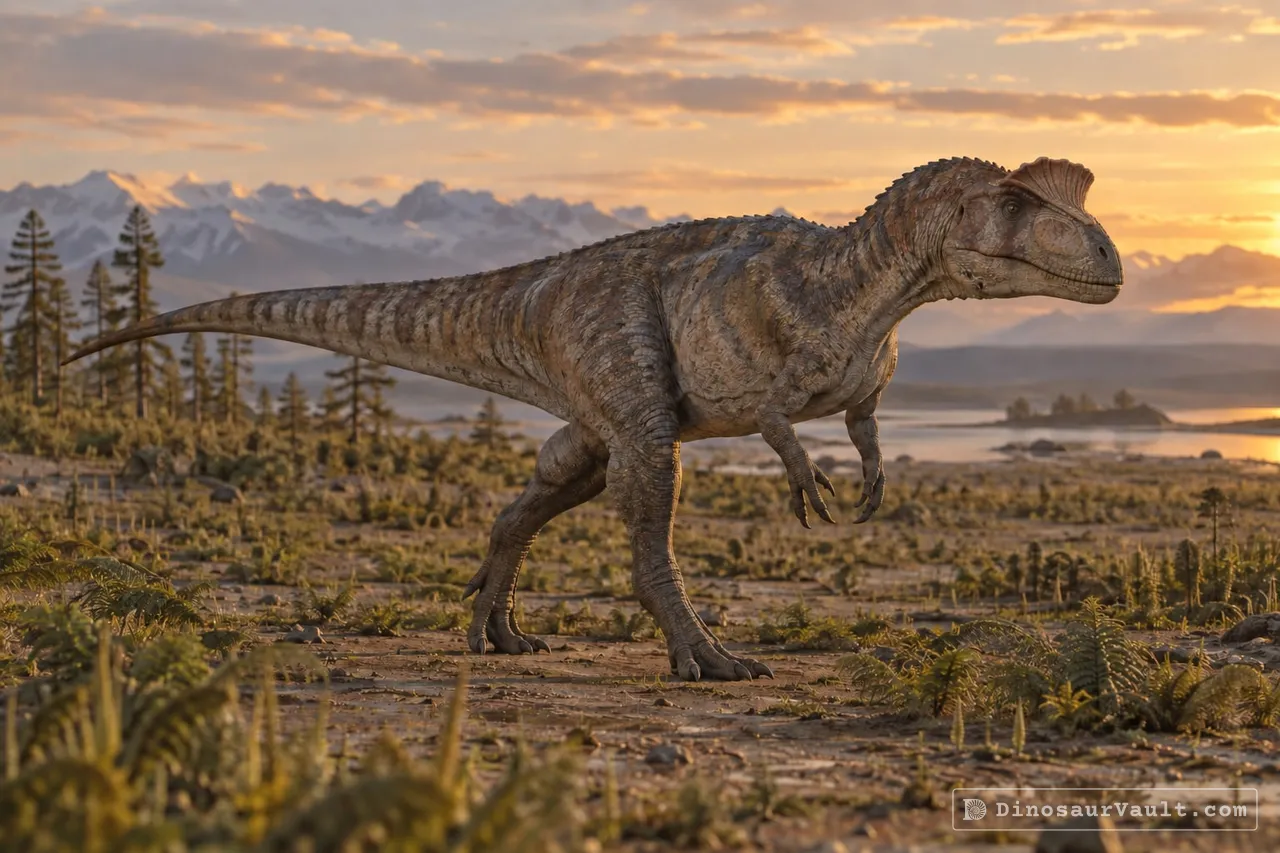
Cryolophosaurus was a large meat eater about 8 meters (26 feet) long, with a strange crest on its head. The crest ran across the skull from side to side, just above the eyes, and was ruffled like a fan or a comb.
It was probably used for display. It was one of the largest meat eaters of the Early Jurassic.
Its world
It lived in the Early Jurassic in what is now Antarctica. At that time Antarctica was farther north and had forests, not ice. Its bones come from the Hanson Formation, where it shared the land with the long-necked plant eater Glacialisaurus.
How it was found
Hammer and Hickerson named Cryolophosaurus in 1994. It was the first meat-eating dinosaur named from Antarctica, and its bones were dug out of rock high on a mountain.
Field gallery
More views of Cryolophosaurus
Scenes reconstructed from the available fossil evidence.
1 of 3
Lived alongside
Found in the same rock formations

A rock formation can hold fossils laid down millions of years apart, so not every animal here met Cryolophosaurus.
The evidence
The science behind Cryolophosaurus
Which parts of the picture come from its own bones, and which come from its relatives.
From its own fossils
- A partial skull and much of the skeleton show a large meat eater with a crest spreading across the top of its head.
- The bones beside the eyes form most of the crest.
- Its neck ribs have unusually long forward-pointing projections.
Borrowed from relatives
- Missing bones are restored by comparison with other early meat eaters, including Dilophosaurus.
- Much of the body shape comes from its own skeleton.
Still unknown
- The color of the crest and the skin around it.
- How the crest changed as it grew.
- Its exact position among the earliest large meat-eating dinosaurs.
Discovery timeline
- 1994Named itHammer & Hickerson
- 2007Full descriptionSMITH et al.
- 2007Its worldSmith et al.
- 2012Family treeCarrano, Benson & Sampson
- 2020Family treeMarsh & Rowe
Key papers
The research behind what we know of Cryolophosaurus
Named it
Named a crested meat eater from Antarctica and described a fossil community that pointed to a mild ancient climate.
A Crested Theropod Dinosaur from Antarctica. Science 264: 828-830
Read the paper : A Crested Theropod Dinosaur from Antarctica (opens in a new tab)Full description
Described the skeleton in detail, including its unusual crest and neck ribs, and compared it with other early meat eaters.
Osteology of Cryolophosaurus ellioti (Dinosauria: Theropoda) from the Early Jurassic of Antarctica and implications for early theropod evolution. Zoological Journal of the Linnean Society 151: 377-421
Read the paper : Osteology of Cryolophosaurus ellioti (Dinosauria: Theropoda) from the Early Jurassic of Antarctica and implications for early theropod evolution (opens in a new tab)Its world
Compared the Antarctic dinosaurs with relatives from other continents and found similarities among Early Jurassic dinosaur communities.
The dinosaurs of the Early Jurassic Hanson Formation of the Central Transantarctic Mountains: phylogenetic review and synthesis. Open-File Report
Read the paper : The dinosaurs of the Early Jurassic Hanson Formation of the Central Transantarctic Mountains: phylogenetic review and synthesis (opens in a new tab)Family tree
Compared skeletons across a major group of meat-eating dinosaurs to test their evolutionary relationships.
The phylogeny of Tetanurae (Dinosauria: Theropoda). Journal of Systematic Palaeontology 10: 211-300
Read the paper : The phylogeny of Tetanurae (Dinosauria: Theropoda) (opens in a new tab)Family tree
Placed Cryolophosaurus and Dilophosaurus on early branches of the meat-eating dinosaur family tree rather than together in a single crested family.
A comprehensive anatomical and phylogenetic evaluation of Dilophosaurus wetherilli (Dinosauria, Theropoda) with descriptions of new specimens from the Kayenta Formation of northern Arizona. Journal of Paleontology 94: 1-103
Read the paper : A comprehensive anatomical and phylogenetic evaluation of Dilophosaurus wetherilli (Dinosauria, Theropoda) with descriptions of new specimens from the Kayenta Formation of northern Arizona (opens in a new tab)
Close relatives
Other members of Tetanurae


Sources: Wikidata