Yunyangosaurus
"Yunyang lizard"
- Lived
- 184 to 171 million years ago, Early Jurassic to Middle Jurassic
- Diet
- Carnivore
- Group
- Theropods
- Found in
- China
- Named by
- Dai et al. 2020
Where its fossils were found
The evidence
Today

180 million years ago
Habitat
Its bones come from shell-bearing siltstone in the Xintiangou Formation of China. The small plant eater Sanxiasaurus lived in the same region.
Field notes
About Yunyangosaurus
What it was like
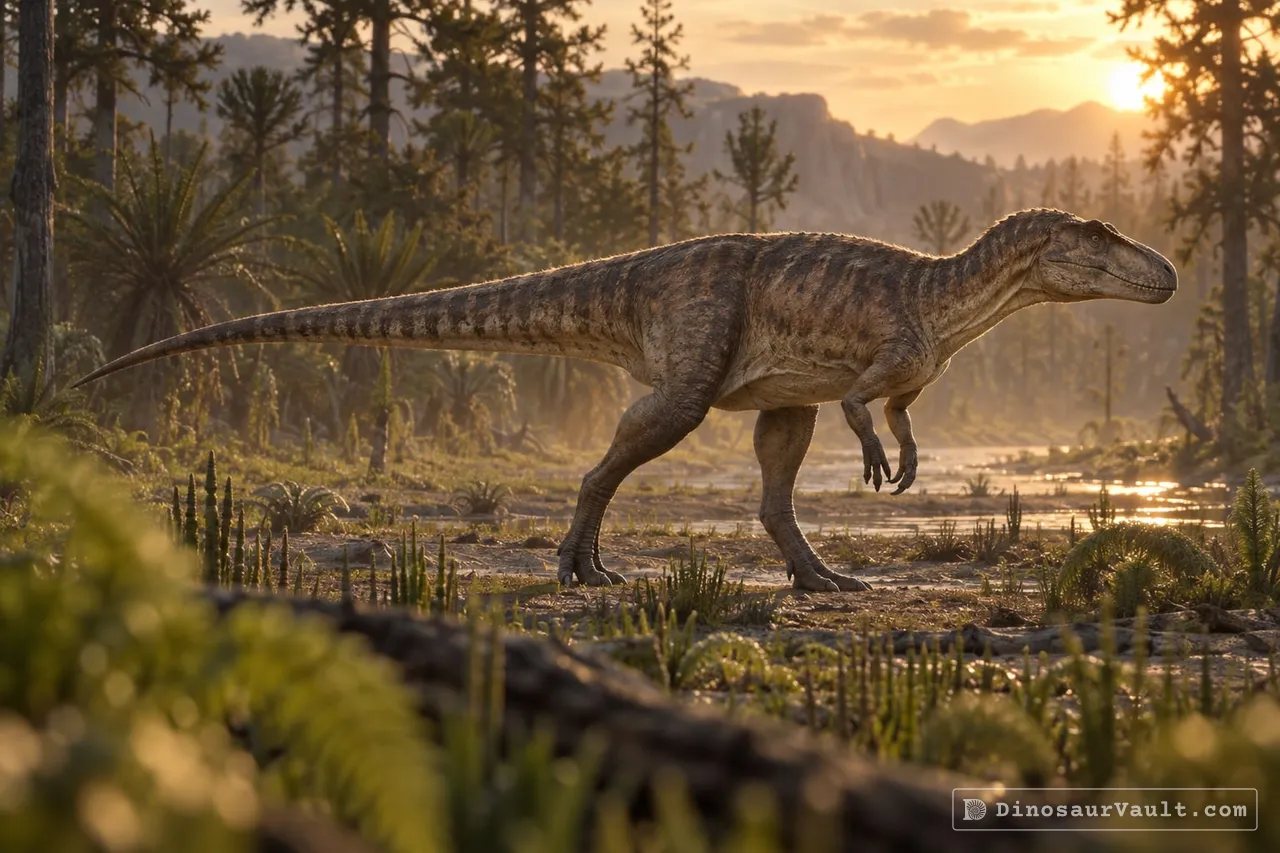
Yunyangosaurus was a two-legged predator known from a few backbones and other bones. It may be related to Megalosaurus.
Its world
It lived in the Jurassic in what is now China. Its bones come from the Xintiangou Formation, where the small plant eater Sanxiasaurus also lived.
How it was found
Dai and colleagues named it in 2020 from one find.
Field gallery
More views of Yunyangosaurus
Scenes reconstructed from the available fossil evidence.
1 of 2
Lived alongside
Found in the same rock formations

A rock formation can hold fossils laid down millions of years apart, so not every animal here met Yunyangosaurus.
The evidence
The science behind Yunyangosaurus
Which parts of the picture come from its own bones, and which come from its relatives.
From its own fossils
- The disarticulated type skeleton includes neck and back vertebrae, ribs and bones from beneath the tail.
- Some neck and back vertebrae have spines that split at the top, and the neck vertebrae have prominent backward-pointing projections.
Borrowed from relatives
- Its missing skull is restored by comparison with Dubreuillosaurus, which also offers a broader comparison for the shoulder region.
Still unknown
- The shape of its skull and the proportions of its limbs.
- Its skin covering and color.
- Its exact place among the early branches of Tetanurae.
Discovery timeline
- 2019Same rocksLi et al.
- 2020Named itDai et al.
- 2024Family treeRauhut et al.
- 2025Family treeZou et al.
Key papers
The research behind what we know of Yunyangosaurus
Same rocks
Described Sanxiasaurus, a small dinosaur from the same formation, adding to the picture of the animals in this region.
A neornithischian dinosaur from the Middle Jurassic Xintiangou Formation of Yunyang, Chongqing, China: the earliest record in Asia. Historical Biology 33: 1089-1102
Read the paper : A neornithischian dinosaur from the Middle Jurassic Xintiangou Formation of Yunyang, Chongqing, China: the earliest record in Asia (opens in a new tab)Named it
Named a theropod from vertebrae and ribs with an unusual mixture of features found in early branches of the predator family tree.
A new possible megalosauroid theropod from the Middle Jurassic Xintiangou Formation of Chongqing, People’s Republic of China and its implication for early tetanuran evolution. Scientific Reports 10
Read the paper : A new possible megalosauroid theropod from the Middle Jurassic Xintiangou Formation of Chongqing, People’s Republic of China and its implication for early tetanuran evolution (opens in a new tab)Family tree
One family-tree analysis placed Yunyangosaurus on an early branch of the Piatnitzkysaurus family.
A new theropod dinosaur from the Callovian Balabansai Formation of Kyrgyzstan. Zoological Journal of the Linnean Society 201
Read the paper : A new theropod dinosaur from the Callovian Balabansai Formation of Kyrgyzstan (opens in a new tab)Family tree
Some family-tree analyses placed Yunyangosaurus beside Yuanmouraptor, offering an alternative to its original proposed relationship with megalosauroids.
A new metriacanthosaurid theropod dinosaur from the Middle Jurassic of Yunnan Province, China. PeerJ 13: e19218
Read the paper : A new metriacanthosaurid theropod dinosaur from the Middle Jurassic of Yunnan Province, China (opens in a new tab)
Close relatives
Other members of Tetanurae


Sources: Wikidata