Cruxicheiros
"cross hand"
Type species Cruxicheiros newmanorum
- Lived
- 168 to 165 million years ago, Middle Jurassic
- Diet
- Carnivore
- Group
- Theropods
- Found in
- United Kingdom
- Named by
- Benson and Radley 2010
Where its fossils were found
The evidence
Today

165 million years ago
Habitat
It lived on land close to shallow seas in what is now England. Megalosaurus and Cetiosaurus lived in the region during the Middle Jurassic.
Field notes
About Cruxicheiros
What it was like
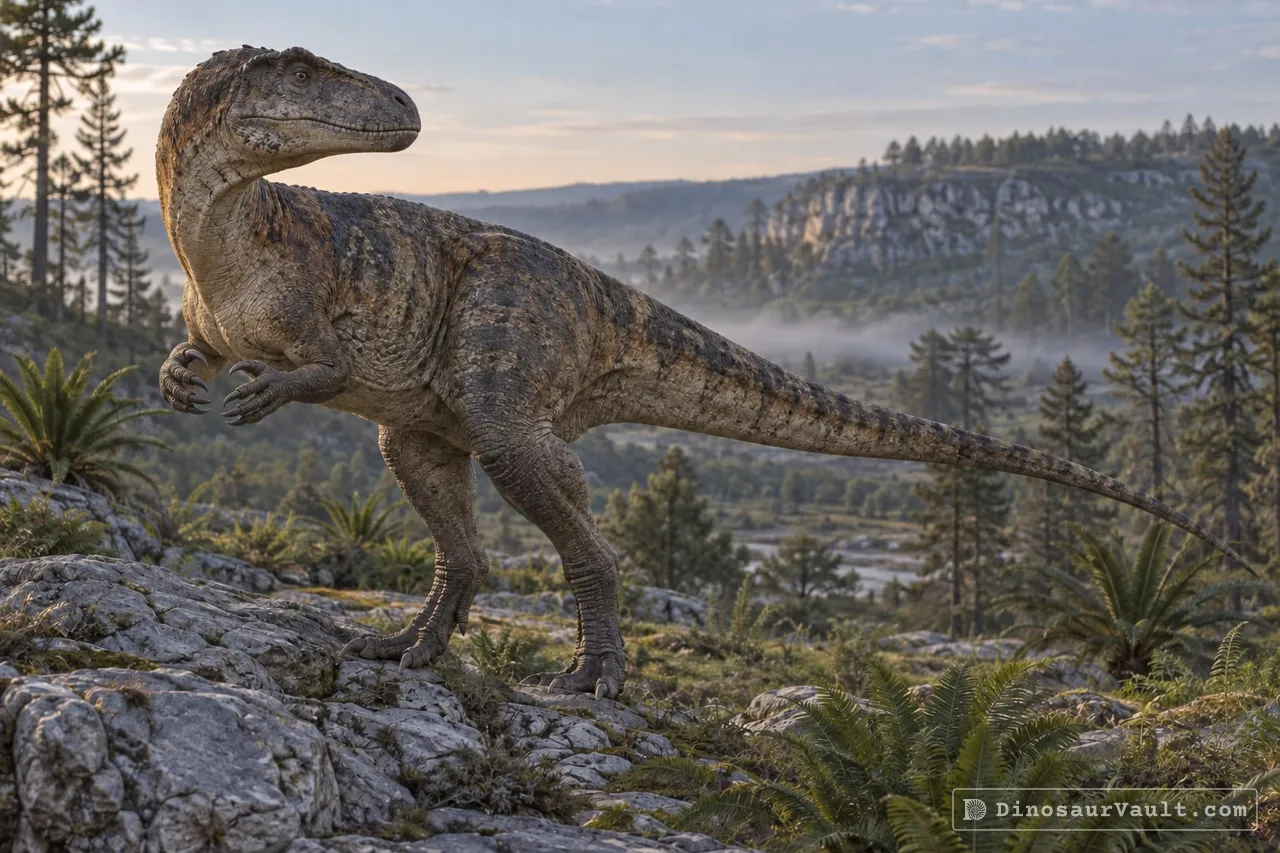
Cruxicheiros was a large two-legged predator known from a thigh bone, part of a hip and some backbones.
Its world
It lived about 168 to 165 million years ago, in the Middle Jurassic, in what is now England. Its bones come from the Chipping Norton Limestone. Megalosaurus and the sauropod Cetiosaurus lived in the region at about the same time.
How it was found
Benson and Radley named it in 2010. The type species is Cruxicheiros newmanorum. The name refers to a nearby place.
Field gallery
More views of Cruxicheiros
Scenes reconstructed from the available fossil evidence.
1 of 2
Lived alongside
Found in the same rock formations


A rock formation can hold fossils laid down millions of years apart, so not every animal here met Cruxicheiros.
The evidence
The science behind Cruxicheiros
Which parts of the picture come from its own bones, and which come from its relatives.
From its own fossils
- A partial thigh bone and other remains include vertebrae, hip bones, ribs and part of the shoulder.
- An unusual ridge near the head of the thigh bone distinguishes it from other known theropods.
Borrowed from relatives
- The missing skull, jaws and hands are restored from other early tetanurans such as Megalosaurus.
- Its full neck and tail follow the general body plan of better-known two-legged theropods.
Still unknown
- Its exact place among the early tetanurans.
- The shape of its skull and teeth.
- Its skin covering and color.
Discovery timeline
- 2010Named itBenson & Radley
- 2010Same rocksBENSON
- 2012Family treeCarrano, Benson & Sampson
Key papers
The research behind what we know of Cruxicheiros
Named it
Identified a large theropod distinct from Megalosaurus, using an unusual thigh-bone ridge and differences in its backbone and hips.
A New Large-Bodied Theropod Dinosaur from the Middle Jurassic of Warwickshire, United Kingdom. Acta Palaeontologica Polonica 55: 35-42
Read the paper : A New Large-Bodied Theropod Dinosaur from the Middle Jurassic of Warwickshire, United Kingdom (opens in a new tab)Same rocks
Described the regional contemporary Megalosaurus in detail, establishing skeletal features useful for comparison with other Middle Jurassic predators.
A description ofMegalosaurus bucklandii(Dinosauria: Theropoda) from the Bathonian of the UK and the relationships of Middle Jurassic theropods. Zoological Journal of the Linnean Society 158: 882-935
Read the paper : A description ofMegalosaurus bucklandii(Dinosauria: Theropoda) from the Bathonian of the UK and the relationships of Middle Jurassic theropods (opens in a new tab)Family tree
Compared early tetanurans across a broad family tree, providing a framework for placing fragmentary animals such as Cruxicheiros.
The phylogeny of Tetanurae (Dinosauria: Theropoda). Journal of Systematic Palaeontology 10: 211-300
Read the paper : The phylogeny of Tetanurae (Dinosauria: Theropoda) (opens in a new tab)
Close relatives
Other members of Tetanurae


Sources: Wikidata