Oryctodromeus
oh-RIK-toh-DROH-mee-us
"digging runner"
- Lived
- 106 to 94 million years ago, Early Cretaceous to Late Cretaceous
- Diet
- Herbivore
- Length
- about 2.1 m (7 ft)
- Group
- Early ornithischians, Thescelosauridae
- Found in
- United States
- Named by
- Varricchio et al. 2007
Size comparison
To scale

Scale in metersOutline: typical early ornithischian shape
Where its fossils were found
The evidence
Today

100 million years ago
Habitat
It lived on inland floodplains crossed by rivers in Montana and Idaho. Tenontosaurus lived in the region, while turtles and crocodilians inhabited the waterways.
A Dinosaur Vault film
This Dinosaur Made Its Home Underground
An adult Oryctodromeus and two young were found together inside the filled chamber of a burrow: a small running dinosaur that sheltered underground.
Subscribe on YouTubeField notes
About Oryctodromeus
What it was like
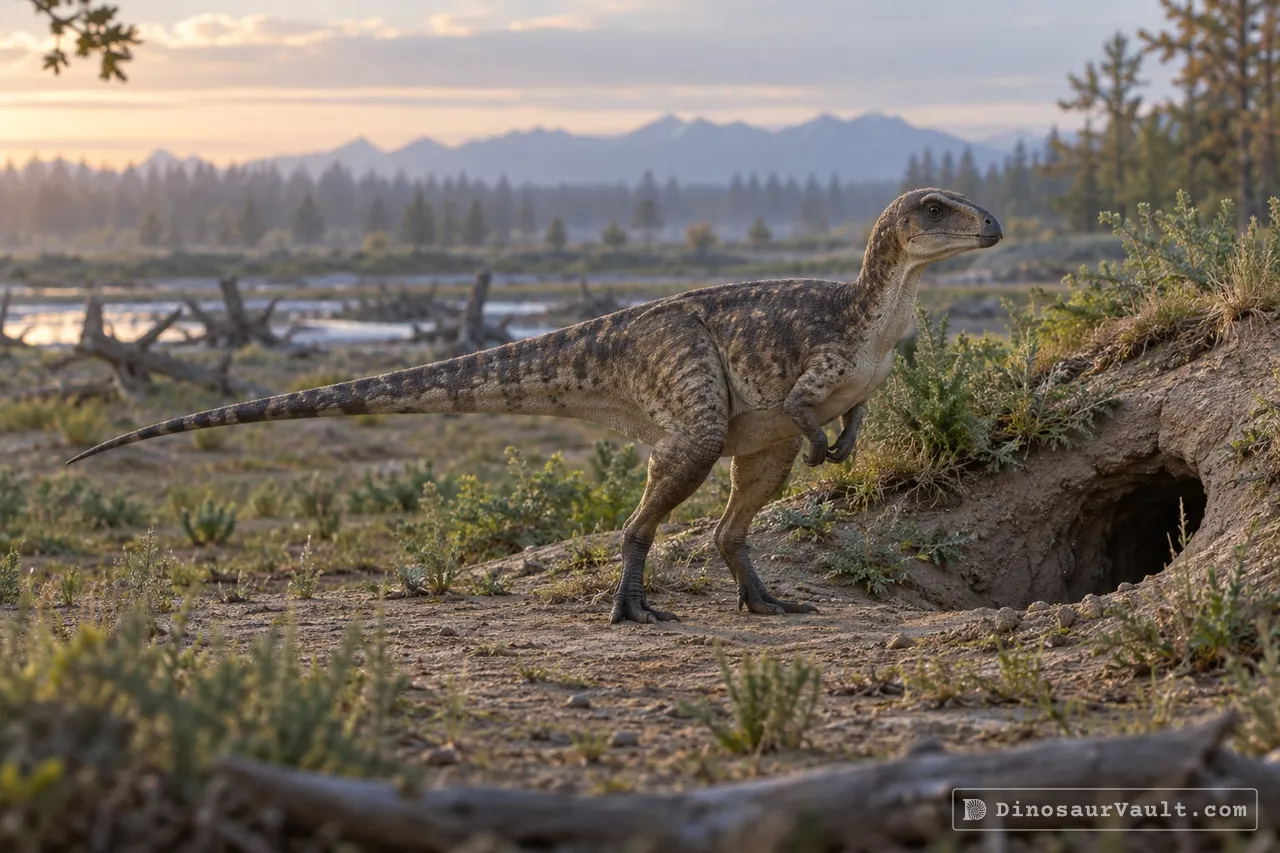
Oryctodromeus was a small plant eater about 2.1 meters (7 feet) long. It had strong shoulders and a snout suited to digging, and it is the first dinosaur shown to have lived in burrows.
Its world
It lived about 106 to 94 million years ago, in the middle of the Cretaceous, in what is now Montana and Idaho. Its bones come from the Blackleaf and Wayan formations. The plant eater Tenontosaurus lived in the same region.
How it was found
Varricchio and colleagues named Oryctodromeus in 2007. The first find was an adult and two young animals preserved inside a filled-in burrow. This suggests that parents may have cared for their young.
Field gallery
More views of Oryctodromeus
Scenes reconstructed from the available fossil evidence.
1 of 3
Lived alongside
Found in the same rock formations

A rock formation can hold fossils laid down millions of years apart, so not every animal here met Oryctodromeus.
The evidence
The science behind Oryctodromeus
Which parts of the picture come from its own bones, and which come from its relatives.
From its own fossils
- An adult and two young animals were buried inside the end chamber of a burrow.
- A broad snout tip, strong shoulders and long lower legs show a small biped built for both digging and running.
- New skeletons preserve a very long tail surrounded by bony tendons.
Borrowed from relatives
- Orodromeus helps fill gaps in the middle of the skull, jaws, hands and feet.
Still unknown
- Whether the adult in the burrow was the parent of the young animals.
- How tightly it could bend its long tail underground.
- Its skin covering and color.
Discovery timeline
- 2007Named itVarricchio, Martin & Katsura
- 2016PostureFearon & Varricchio
- 2023Full descriptionKrumenacker et al.
Key papers
The research behind what we know of Oryctodromeus
Named it
Described an adult and young dinosaurs inside a burrow, linking the skeleton's digging adaptations with an underground shelter.
First trace and body fossil evidence of a burrowing, denning dinosaur. Proceedings of the Royal Society B: Biological Sciences 274: 1361-1368
Read the paper : First trace and body fossil evidence of a burrowing, denning dinosaur (opens in a new tab)Posture
Reconstructed the shoulder and arm muscles, finding enlarged attachment areas consistent with digging.
Reconstruction of the forelimb musculature of the Cretaceous ornithopod dinosaurOryctodromeus cubicularis: implications for digging. Journal of Vertebrate Paleontology 36: e1078341
Read the paper : Reconstruction of the forelimb musculature of the Cretaceous ornithopod dinosaurOryctodromeus cubicularis: implications for digging (opens in a new tab)Full description
Described new skeletons, documented the long tail and its bony tendons, and placed Oryctodromeus among related burrowing dinosaurs.
Osteology and phylogenetic relationships of the mid-Cretaceous neornithischian dinosaur Oryctodromeus cubicularis Varricchio, 2007. Journal of Vertebrate Paleontology 43
Read the paper : Osteology and phylogenetic relationships of the mid-Cretaceous neornithischian dinosaur Oryctodromeus cubicularis Varricchio, 2007 (opens in a new tab)
Close relatives
Other members of Thescelosauridae


Sources: Wikidata