Koreanosaurus
"Korean lizard"
- Lived
- 84 to 72 million years ago, Late Cretaceous
- Diet
- Herbivore
- Group
- Early ornithischians, Thescelosauridae
- Found in
- South Korea
- Named by
- Huh et al. 2011
Where its fossils were found
The evidence
Today

80 million years ago
Habitat
It lived on a seasonally dry floodplain in what is now South Korea. Mud and sand in the Seonso Conglomerate preserve old soils, dinosaur eggs and small animal burrows.
Field notes
About Koreanosaurus
What it was like
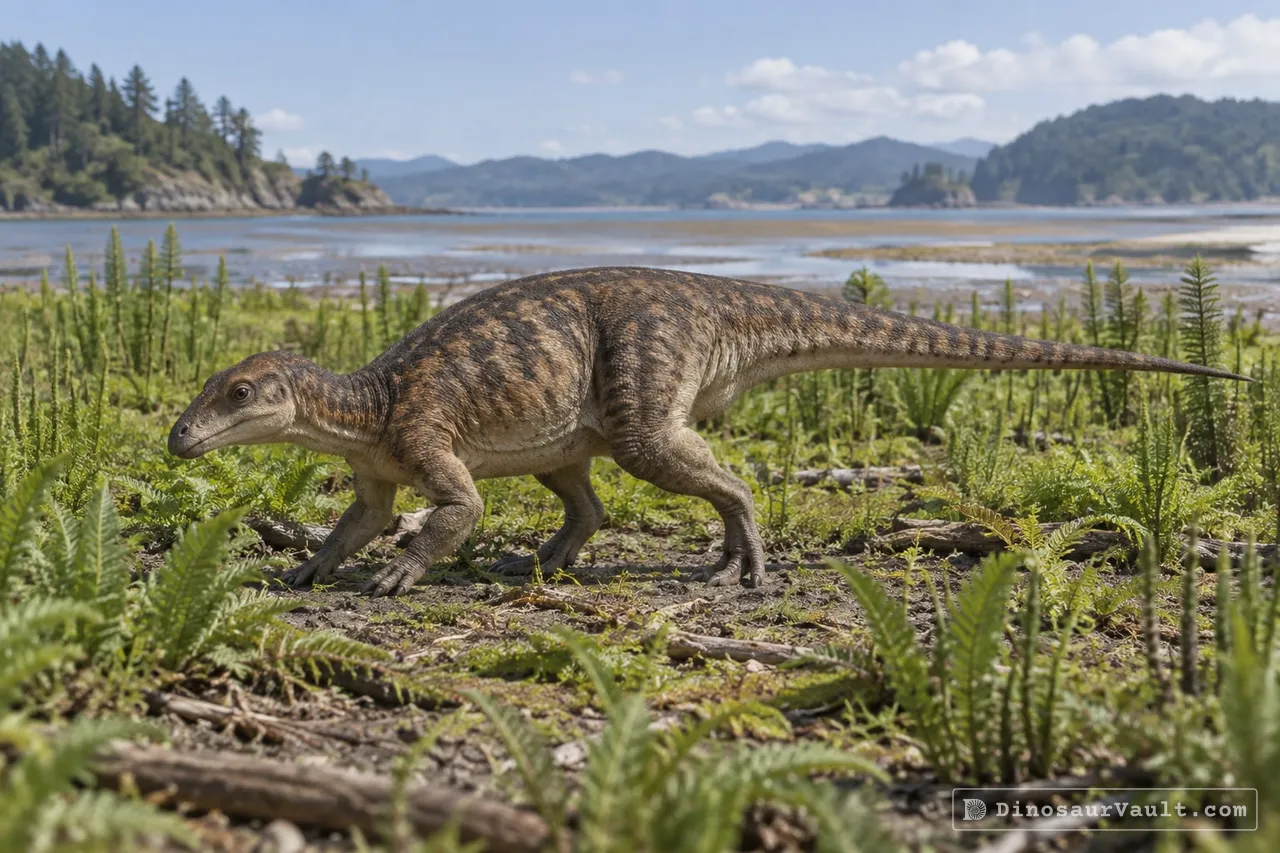
Koreanosaurus was a small plant eater that probably walked on two legs. Its arms were strong, and it may have dug burrows like its relative Oryctodromeus.
Its world
It lived in the Late Cretaceous, in what is now South Korea. It comes from the Seonso Conglomerate.
How it was found
Huh and colleagues named Koreanosaurus in 2011.
Field gallery
More views of Koreanosaurus
Scenes reconstructed from the available fossil evidence.
1 of 3
The evidence
The science behind Koreanosaurus
Which parts of the picture come from its own bones, and which come from its relatives.
From its own fossils
- Partial skeletons preserve neck and back vertebrae, ribs, shoulders, arm bones, hips and hindlimbs.
- The neck vertebrae are elongated, and the shoulders and upper arms are especially large and strong.
- The lower leg is only slightly longer than the thigh.
Borrowed from relatives
- Fona helps restore the missing head, fingers and toe tips as those of a small plant-eating dinosaur.
- Comparison with Oryctodromeus helped inspire the idea that its strong forequarters may have been useful for digging.
Still unknown
- Whether the main forequarter and hindquarter skeletons belonged to the same individual.
- Whether it dug burrows, and how often it walked on all fours.
- The shape of its skull, its complete hands and feet, and its skin covering.
Discovery timeline
- 2011Named itHuh et al.
- 2024Close relativeAvrahami et al.
- 2026Family treeJung et al.
Key papers
The research behind what we know of Koreanosaurus
Named it
Described a small plant eater with an elongated neck and powerful forequarters, and suggested that it may have dug burrows.
A new basal ornithopod dinosaur from the Upper Cretaceous of South Korea. Neues Jahrbuch für Geologie und Paläontologie - Abhandlungen 259: 1-24
Read the paper : A new basal ornithopod dinosaur from the Upper Cretaceous of South Korea (opens in a new tab)Close relative
Described Fona, whose skull and limb bones provide comparisons for the missing head, hands and feet of Koreanosaurus.
A new semi‐fossorial thescelosaurine dinosaur from the Cenomanian‐age Mussentuchit Member of the Cedar Mountain Formation, Utah. The Anatomical Record 307: 3717-3781
Read the paper : A new semi‐fossorial thescelosaurine dinosaur from the Cenomanian‐age Mussentuchit Member of the Cedar Mountain Formation, Utah (opens in a new tab)Family tree
Reexamined Koreanosaurus while describing Doolysaurus, finding differences between them and testing their relationships to other small plant eaters.
A new dinosaur species from Korea and its implications for early-diverging neornithischian diversity. Fossil Record 29: 87-113
Read the paper : A new dinosaur species from Korea and its implications for early-diverging neornithischian diversity (opens in a new tab)
Close relatives
Other members of Thescelosauridae


Sources: Wikidata