Doolysaurus
Type species Doolysaurus huhmini
- Lived
- 113 to 94 million years ago, Early Cretaceous to Late Cretaceous
- Diet
- Herbivore
- Group
- Early ornithischians, Thescelosauridae
- Found in
- South Korea
- Named by
- Jung et al. 2026
Where its fossils were found
The evidence
Today

105 million years ago
Habitat
Its skeleton comes from floodplain mudstone in the Ilseongsan Formation of South Korea.
Field notes
About Doolysaurus
What it was like
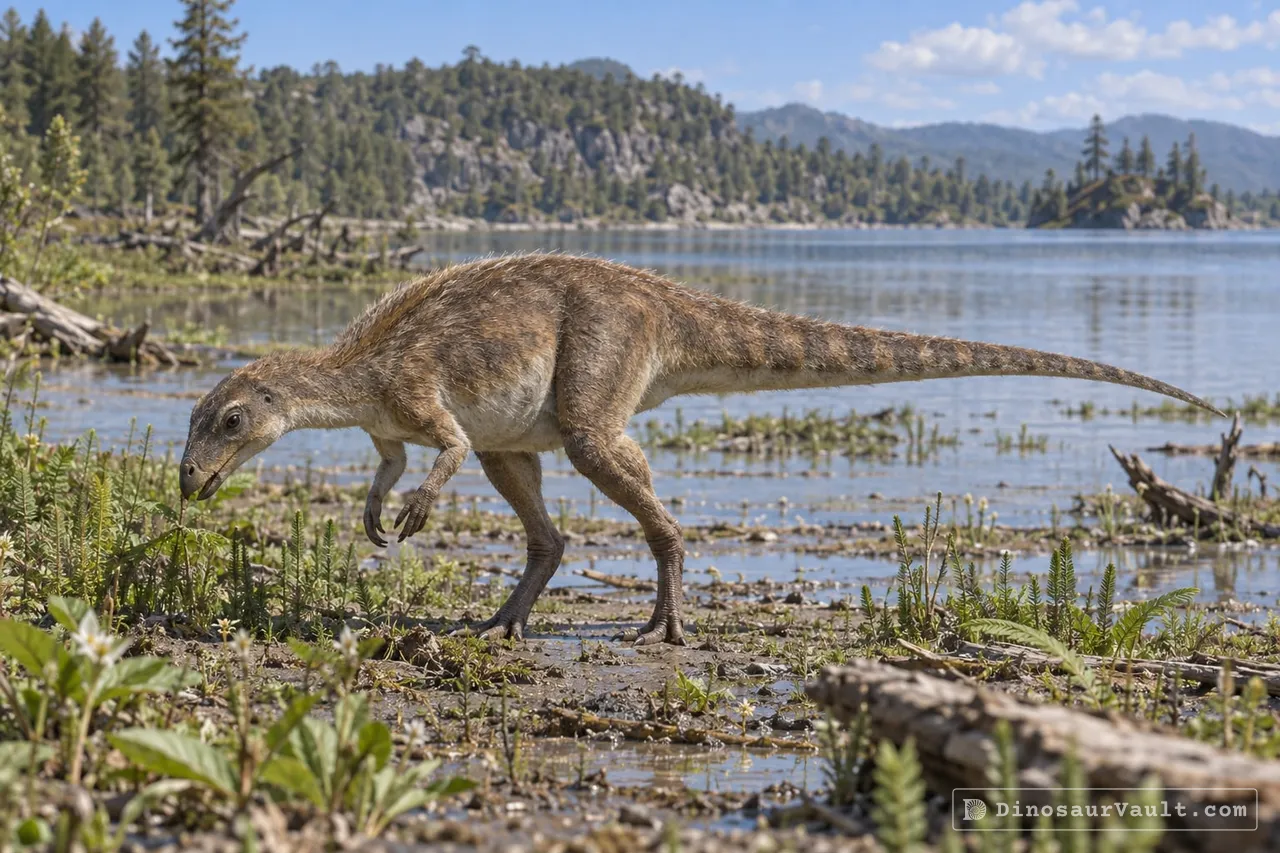
Doolysaurus was a small, plant-eating ornithischian known from the partial skeleton of a juvenile individual. It belonged to the thescelosaurids, a group of small, fast-moving herbivores that likely ran on two legs and relied on speed rather than size or armor to avoid predators. Because only one young individual has been found, its full adult size and appearance are not yet known.
Its world
Doolysaurus lived in what is now South Korea sometime between the Early and Late Cretaceous. It is only the second dinosaur of its kind named from South Korea, following Koreanosaurus, and its closest relatives include Thescelosaurus, Orodromeus, and Jeholosaurus from elsewhere in Asia and North America.
How it was found
Jung and colleagues named Doolysaurus in 2026, based on fossils from the Ilseongsan Formation. As a newly described genus, much about how it lived is still being studied.
Field gallery
More views of Doolysaurus
Scenes reconstructed from the available fossil evidence.
1 of 7
The evidence
The science behind Doolysaurus
Which parts of the picture come from its own bones, and which come from its relatives.
From its own fossils
- A young animal's partial skeleton preserves pieces of the skull, teeth, backbone, ribs and hindlimbs.
- A small cluster of stomach stones was found with the skeleton.
Borrowed from relatives
- A balancing tail and small forelimbs are reconstructed by comparison with small plant eaters such as Thescelosaurus and Jeholosaurus.
Still unknown
- Its adult size and proportions.
- Its skin covering and color.
- Whether it dug burrows or lived in groups.
Often drawn wrong
- Showing a full-grown Doolysaurus as a well-known animal goes beyond the only skeleton, which belongs to a youngster.
Discovery timeline
- 2011Close relativeHuh et al.
- 2024Close relativeAvrahami et al.
- 2026Named itJung et al.
Key papers
The research behind what we know of Doolysaurus
Close relative
Described Koreanosaurus, another small plant eater from South Korea, whose powerful forelimbs suggested a possible burrowing lifestyle.
A new basal ornithopod dinosaur from the Upper Cretaceous of South Korea. Neues Jahrbuch für Geologie und Paläontologie - Abhandlungen 259: 1-24
Read the paper : A new basal ornithopod dinosaur from the Upper Cretaceous of South Korea (opens in a new tab)Close relative
Described numerous Fona skeletons and linked this thescelosaurid's anatomy to a possible partly underground lifestyle.
A new semi‐fossorial thescelosaurine dinosaur from the Cenomanian‐age Mussentuchit Member of the Cedar Mountain Formation, Utah. The Anatomical Record 307: 3717-3781
Read the paper : A new semi‐fossorial thescelosaurine dinosaur from the Cenomanian‐age Mussentuchit Member of the Cedar Mountain Formation, Utah (opens in a new tab)Named it
Named Doolysaurus from a juvenile partial skeleton and described a cluster of stomach stones found with it.
A new dinosaur species from Korea and its implications for early-diverging neornithischian diversity. Fossil Record 29: 87-113
Read the paper : A new dinosaur species from Korea and its implications for early-diverging neornithischian diversity (opens in a new tab)
Close relatives
Other members of Thescelosauridae


Sources: Wikidata