Normanniasaurus
"Normandy lizard"
- Lived
- 110 to 106 million years ago, Early Cretaceous
- Diet
- Herbivore
- Group
- Sauropods
- Found in
- France
- Named by
- Le Loeuff et al. 2013
Where its fossils were found
The evidence
Today

110 million years ago
Habitat
It probably lived on land west of the place where its bones were buried at sea in what is now France. The same rock layer contains plant remains, ammonites and crocodile fossils.
Field notes
About Normanniasaurus
What it was like
Normanniasaurus was a titanosaur, a long-necked, four-legged plant eater, known from backbones and parts of the limbs and hips.
Its world
It lived in the Early Cretaceous in what is now northwestern France. Its bones come from the Poudingue ferrugineux, a rock layer rich in iron.
How it was found
Le Loeuff and colleagues named Normanniasaurus in 2013. An isolated tail bone from another find has also been tentatively assigned to it. Its closest relatives remain uncertain.
Field gallery
More views of Normanniasaurus
Scenes reconstructed from the available fossil evidence.
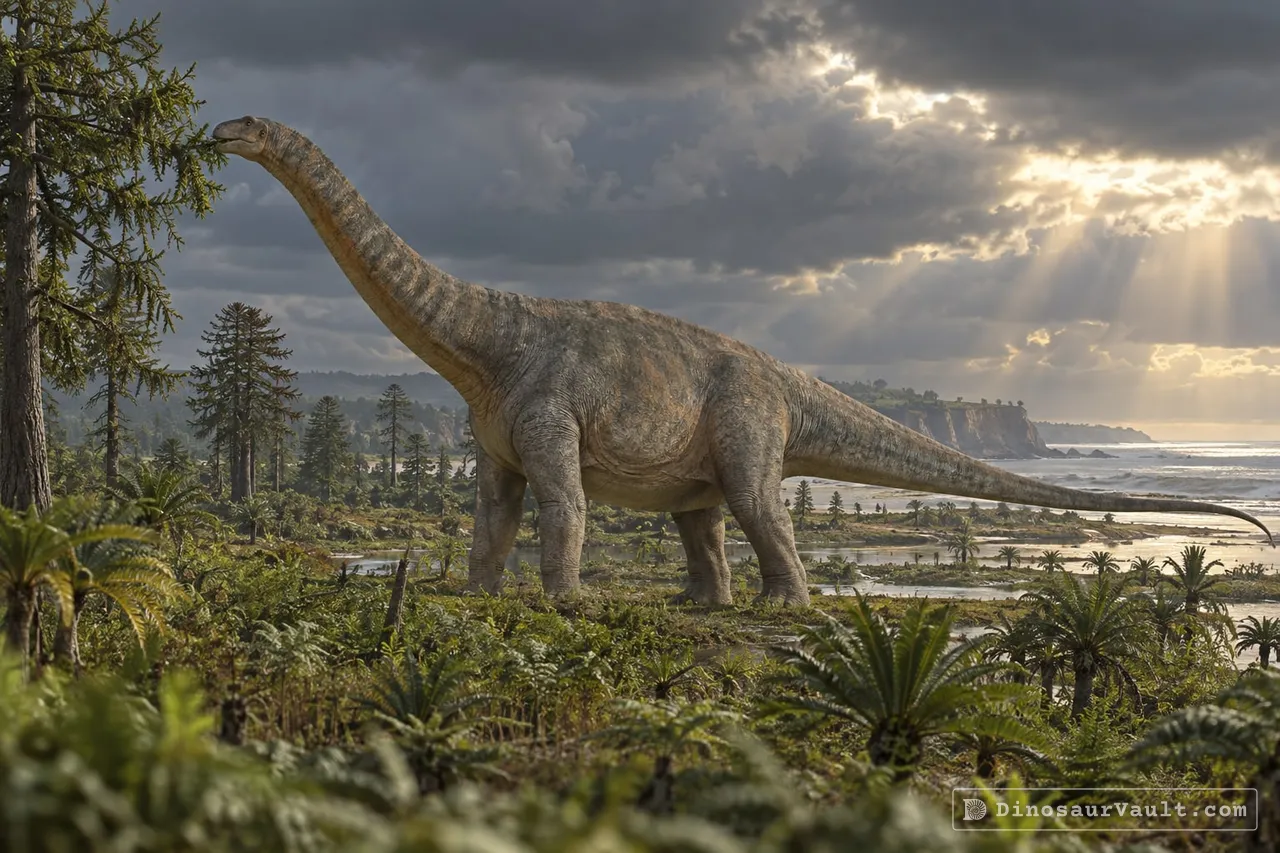
The evidence
The science behind Normanniasaurus
Which parts of the picture come from its own bones, and which come from its relatives.
From its own fossils
- The partial skeleton, probably from a single animal, includes pieces of vertebrae from in front of the hips, part of the hip vertebrae, tail vertebrae from the front and middle of the tail, the right shoulder blade, parts of both hip bones, and the upper ends of a thigh bone and a calf bone.
- The front of its hip blade flares outward and forward, and a vertebra near the base of the tail has a deeply cupped front end and a rounded back end.
- The back vertebrae have a spongy internal structure.
Borrowed from relatives
- Its missing skull is restored after the titanosaur Tapuiasaurus, and its neck, body, limbs, feet and tail tip after the more complete titanosaur Mnyamawamtuka.
- Its hands follow the compact, column-like hands of sauropods such as Camarasaurus.
- Its describers compared its bones with those of Andesaurus and Malawisaurus.
Still unknown
- Its skull, the shape of its neck, its skin, and whether it carried bony armor.
- Its place in the titanosaur family tree. Its describers saw it as an early titanosaur, but later studies placed it among more advanced titanosaurs.
- Whether isolated bones from other sites belong to it. A tail vertebra from slightly younger rocks nearby probably does, and other finds have been linked to it only tentatively.
Discovery timeline
- 2013Named itLoeuff, Suteethorn & Buffetaut
- 2019Family treeMannion et al.
- 2026Fossil sitesBuffetaut
Key papers
The research behind what we know of Normanniasaurus
Named it
Described the partial skeleton and named a titanosaur with distinctive tail vertebrae and a flaring hip blade from France.
A new sauropod dinosaur from the Albian of Le Havre (Normandy, France). Oryctos 10: 23-30
No link available
Family tree
Placed Normanniasaurus among more advanced titanosaurs, clustering with relatives from Gondwana.
New information on the Cretaceous sauropod dinosaurs of Zhejiang Province, China: impact on Laurasian titanosauriform phylogeny and biogeography. Royal Society Open Science 6: 191057
Read the paper : New information on the Cretaceous sauropod dinosaurs of Zhejiang Province, China: impact on Laurasian titanosauriform phylogeny and biogeography (opens in a new tab)Fossil sites
Reviewed the skeleton as one individual, weighed other possible Normanniasaurus finds and rival family-tree placements, and traced the burial in marine sediments to nearby land.
The Cretaceous Dinosaur Record from Normandy (NW France): A Review. Fossil Studies 4: 5
Read the paper : The Cretaceous Dinosaur Record from Normandy (NW France): A Review (opens in a new tab)
Close relatives
Other members of Eutitanosauria


Sources: Wikidata