Narindasaurus
"Narinda lizard"
Type species Narindasaurus thevenini
- Lived
- 168 to 165 million years ago, Middle Jurassic
- Diet
- Herbivore
- Group
- Sauropods
- Found in
- Madagascar
- Named by
- Royo-Torres et al. 2021
Where its fossils were found
The evidence
Today

165 million years ago
Habitat
It probably lived on low coastal land crossed by rivers in what is now northwestern Madagascar. The Isalo III Formation also preserves Lapparentosaurus and Archaeodontosaurus.
Field notes
About Narindasaurus
What it was like
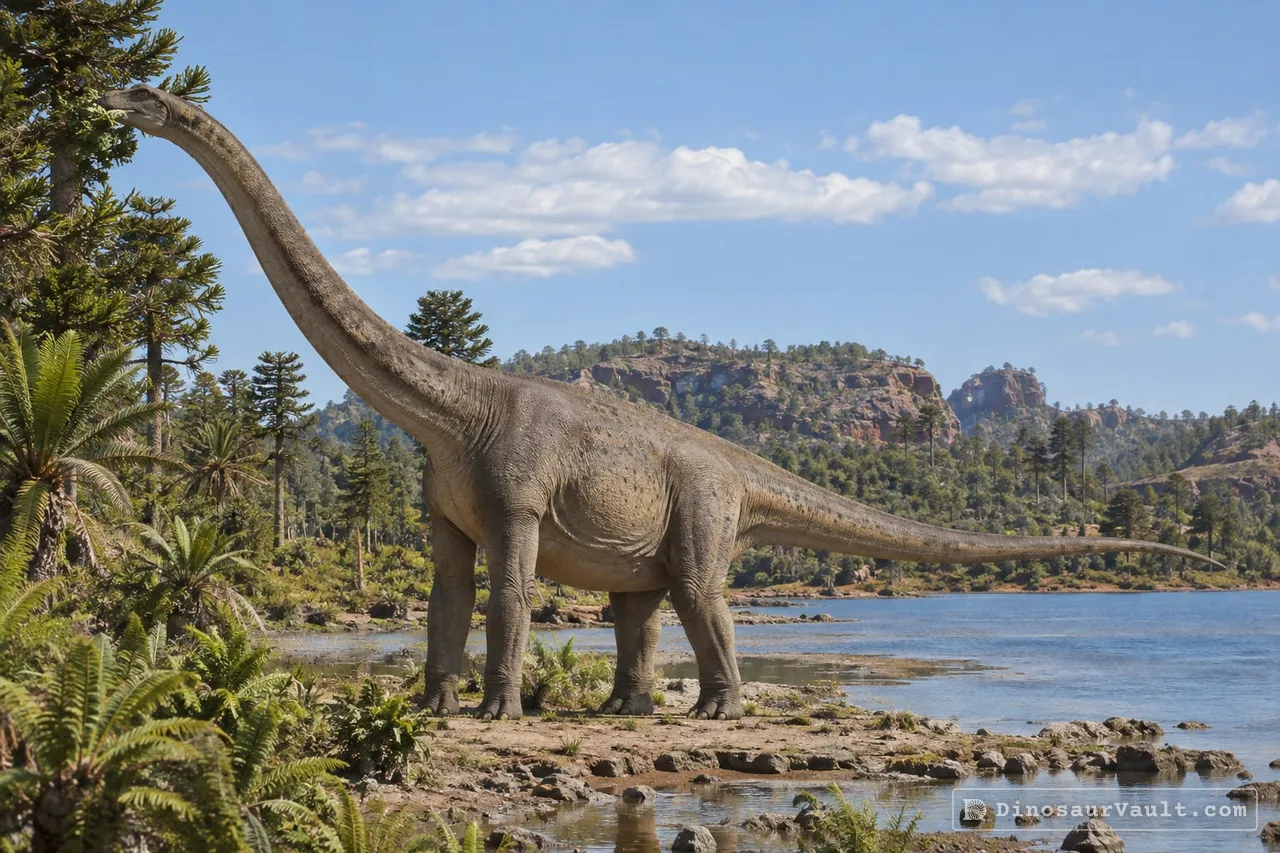
Narindasaurus was a long-necked, four-legged plant eater from the turiasaurs, a group best known from Europe. It is known from teeth, backbones and limb bones.
Its world
It lived in the Middle Jurassic in what is now northwestern Madagascar. Its bones come from the Isalo III Formation, where it shared the land with the sauropod Lapparentosaurus.
How it was found
Royo-Torres and colleagues named Narindasaurus in 2021. The bones had been found more than a century earlier.
Field gallery
More views of Narindasaurus
Scenes reconstructed from the available fossil evidence.
1 of 3
Lived alongside
Found in the same rock formations

A rock formation can hold fossils laid down millions of years apart, so not every animal here met Narindasaurus.
The evidence
The science behind Narindasaurus
Which parts of the picture come from its own bones, and which come from its relatives.
From its own fossils
- The partial type skeleton belongs to a single individual and preserves a tooth, tail backbones, bones beneath the tail, an ulna, shin bones and part of the hip.
- Its tooth has the heart-shaped outline found in other turiasaurs.
- A long ridge on a hip bone and distinctive hollows in the tail backbones help distinguish it from other sauropods.
Borrowed from relatives
- Losillasaurus provides a comparison for the missing jaws; Mierasaurus provides comparisons for the skull roof, neck, trunk and missing parts of the limbs and tail.
- Camarasaurus and Apatosaurus provide broader comparisons for the missing wrists and hands; Camarasaurus also provides a comparison for the missing feet.
Still unknown
- Its closest relatives: the naming study placed it outside the turiasaurs when traits were weighted equally and elsewhere under other weightings, and a later study kept it in an unresolved turiasaur group.
- The length and proportions of its complete body, and its skin covering and color.
- What its hatchlings looked like.
Discovery timeline
- 2010RedescriptionMANNION
- 2012Family treeRoyo-Torres & Upchurch
- 2021Named itRoyo-Torres et al.
Key papers
The research behind what we know of Narindasaurus
Redescription
Bothriospondylus had become a catch-all for unrelated sauropods; this revision separated the fossils and helped lay the groundwork for recognizing Narindasaurus.
A revision of the sauropod dinosaur genus ‘Bothriospondylus’ with a redescription of the type material of the Middle Jurassic form ‘B. madagascariensis’. Palaeontology 53: 277-296
Read the paper : A revision of the sauropod dinosaur genus ‘Bothriospondylus’ with a redescription of the type material of the Middle Jurassic form ‘B. madagascariensis’ (opens in a new tab)Family tree
Described the skull and teeth of Turiasaurus and examined its place in the sauropod family tree.
The cranial anatomy of the sauropod Turiasaurus riodevensis and implications for its phylogenetic relationships. Journal of Systematic Palaeontology 10: 553-583
Read the paper : The cranial anatomy of the sauropod Turiasaurus riodevensis and implications for its phylogenetic relationships (opens in a new tab)Named it
Recognized the old Madagascar skeleton as Narindasaurus and recovered different family-tree positions when skeletal traits were weighted differently.
Origin and evolution of turiasaur dinosaurs set by means of a new ‘rosetta’ specimen from Spain. Zoological Journal of the Linnean Society 191: 201-227
Read the paper : Origin and evolution of turiasaur dinosaurs set by means of a new ‘rosetta’ specimen from Spain (opens in a new tab)
Close relatives
Other members of Turiasauria


Sources: Wikidata