Amanzia
- Lived
- 155 to 152 million years ago, Late Jurassic
- Diet
- Herbivore
- Group
- Sauropods
- Found in
- Switzerland
- Named by
- Schwarz et al. 2020
Where its fossils were found
The evidence
Today

155 million years ago
Habitat
It lived on land close to the sea in what is now Switzerland. Root traces and burned wood record vegetation and wildfires; marine crocodile relatives and a meat-eating dinosaur also occur at its fossil site.
Field notes
About Amanzia
What it was like
Amanzia was a sauropod, a long-necked plant eater. It belonged to the turiasaurs, a group known mostly from Europe and Africa. Its bones are thick and heavy.
Its world
It lived in the Late Jurassic, in what is now Switzerland. It comes from the Reuchenette Formation, which formed along a coast.
How it was found
Schwarz and colleagues named Amanzia in 2020, for bones that had first been placed in another genus. The name honors a geologist from the region.
Field gallery
More views of Amanzia
Scenes reconstructed from the available fossil evidence.
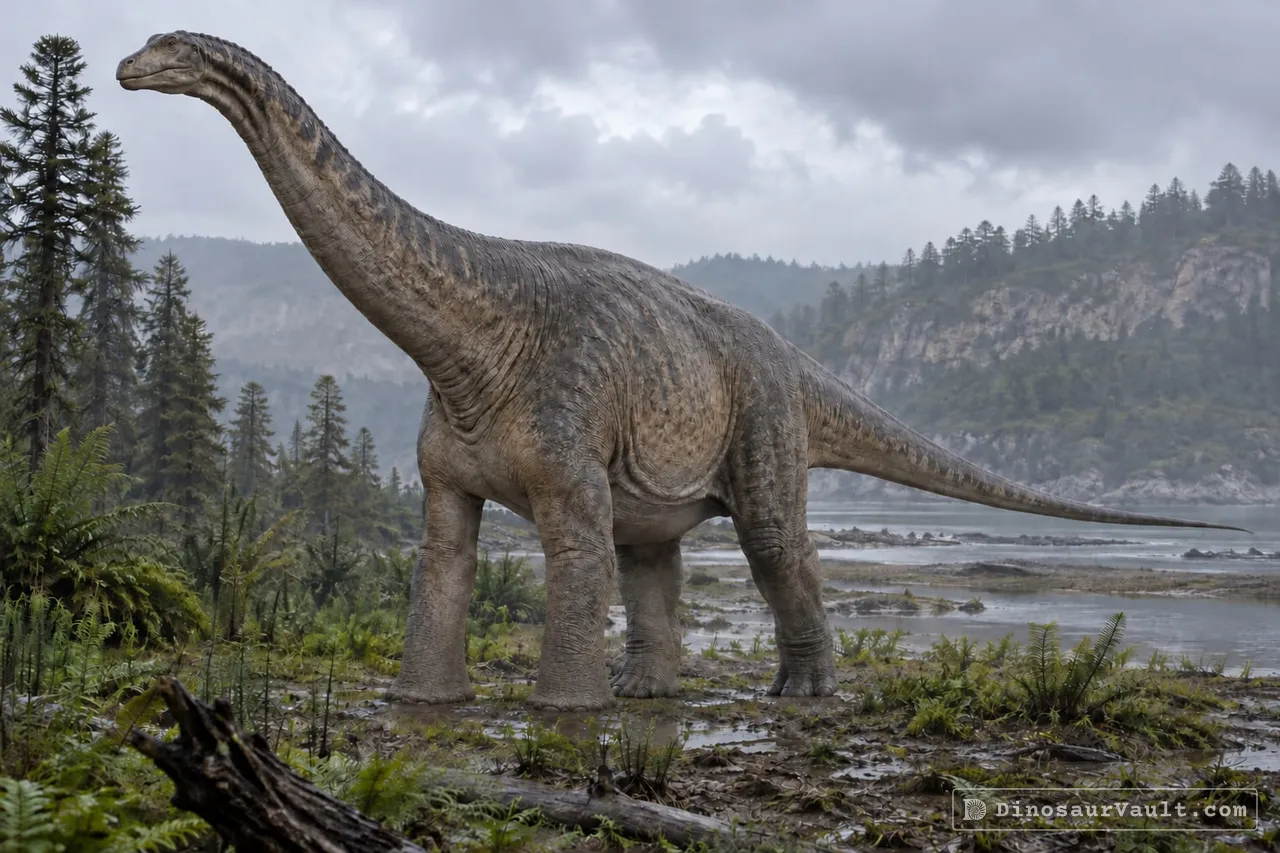
The evidence
The science behind Amanzia
Which parts of the picture come from its own bones, and which come from its relatives.
From its own fossils
- Several incomplete skeletons preserve bones from most body regions.
- Cartilage survives at the elbow end of an upper arm bone.
- Some limb bones bear punctures and grooves left by teeth.
Borrowed from relatives
- The missing skull shape and much of the neck and tail are restored by comparison with other sauropods, including turiasaurs such as Zby.
Still unknown
- The shape of its skull and the full length of its neck and tail.
- Its skin texture and color.
- What its hatchlings looked like.
Discovery timeline
- 2017Close relativeRoyo-Torres et al.
- 2019Family treeMannion et al.
- 2020Named itSchwarz et al.
Key papers
The research behind what we know of Amanzia
Close relative
Described Mierasaurus and linked it and Moabosaurus to the turiasaurs, expanding the known range of this sauropod family.
Descendants of the Jurassic turiasaurs from Iberia found refuge in the Early Cretaceous of western USA. Scientific Reports 7
Read the paper : Descendants of the Jurassic turiasaurs from Iberia found refuge in the Early Cretaceous of western USA (opens in a new tab)Family tree
Placed Tendaguria among the turiasaurs and developed the sauropod comparisons later used to examine Amanzia's relationships.
Taxonomic affinities of the putative titanosaurs from the Late Jurassic Tendaguru Formation of Tanzania: phylogenetic and biogeographic implications for eusauropod dinosaur evolution. Zoological Journal of the Linnean Society 185: 784-909
Read the paper : Taxonomic affinities of the putative titanosaurs from the Late Jurassic Tendaguru Formation of Tanzania: phylogenetic and biogeographic implications for eusauropod dinosaur evolution (opens in a new tab)Named it
Separated Amanzia from Cetiosauriscus and described its bones, preserved joint cartilage and signs of continued growth.
Re-description of the sauropod dinosaur Amanzia (“Ornithopsis/Cetiosauriscus”) greppini n. gen. and other vertebrate remains from the Kimmeridgian (Late Jurassic) Reuchenette Formation of Moutier, Switzerland. Swiss Journal of Geosciences 113
Read the paper : Re-description of the sauropod dinosaur Amanzia (“Ornithopsis/Cetiosauriscus”) greppini n. gen. and other vertebrate remains from the Kimmeridgian (Late Jurassic) Reuchenette Formation of Moutier, Switzerland (opens in a new tab)
Close relatives
Other members of Turiasauria


Sources: Wikidata