Lapparentosaurus
"Lapparent's lizard"
Type species Lapparentosaurus madagascariensis
- Lived
- 168 to 165 million years ago, Middle Jurassic
- Diet
- Herbivore
- Group
- Sauropods
- Found in
- Madagascar
- Named by
- Bonaparte 1986
Where its fossils were found
The evidence
Today

165 million years ago
Habitat
It lived in Madagascar, where the Isalo III rocks preserve sand, mud and fossil wood from a landscape with trees. Other sauropods recorded from these rocks include Narindasaurus and Archaeodontosaurus.
Field notes
About Lapparentosaurus
What it was like
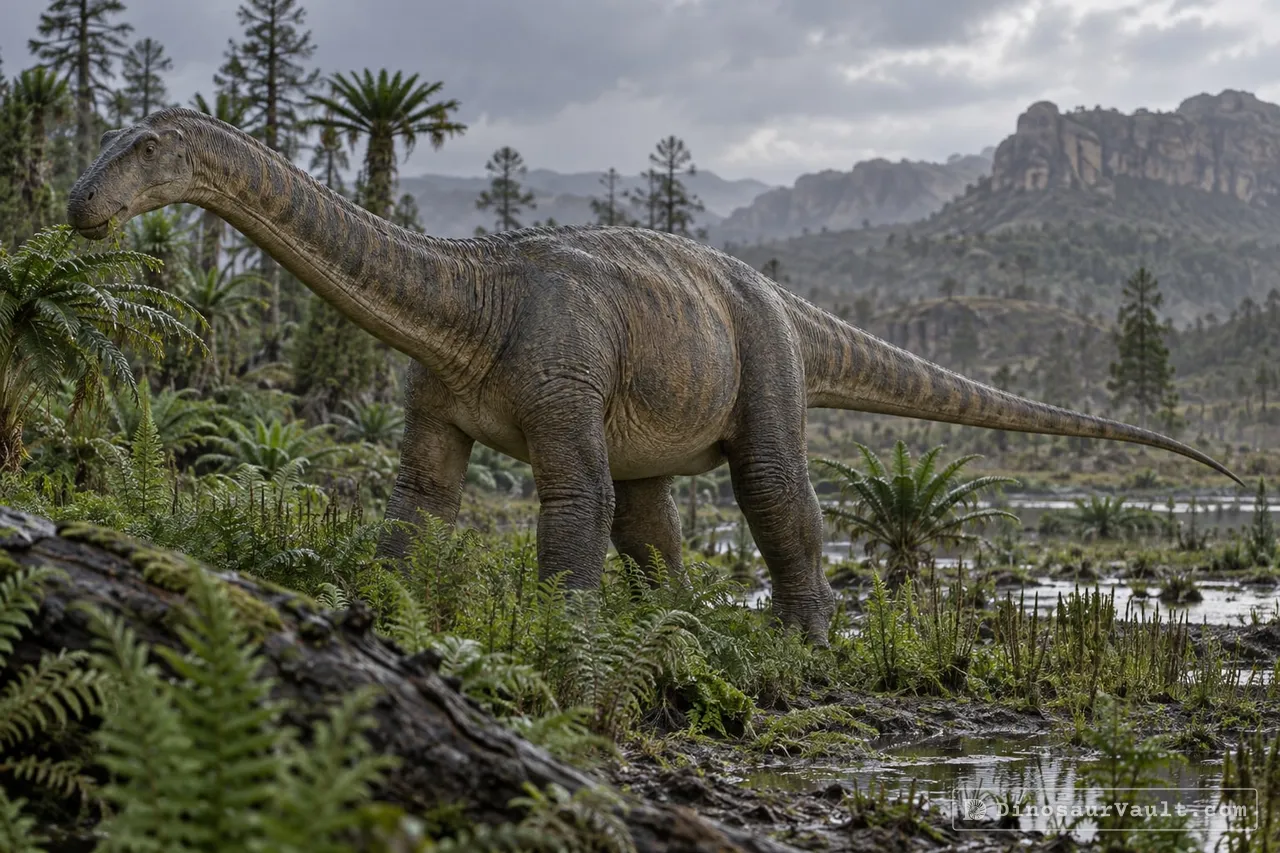
Lapparentosaurus was a long-necked, four-legged plant eater, known mostly from young animals. Its place among the sauropods is uncertain, as it has a mix of features from different groups.
Its world
It lived in the Middle Jurassic in what is now Madagascar. Its bones come from the Isalo III Formation.
How it was found
Bonaparte named Lapparentosaurus in 1986, for bones that had been placed in another genus.
Field gallery
More views of Lapparentosaurus
Scenes reconstructed from the available fossil evidence.
Lived alongside
Found in the same rock formations

A rock formation can hold fossils laid down millions of years apart, so not every animal here met Lapparentosaurus.
The evidence
The science behind Lapparentosaurus
Which parts of the picture come from its own bones, and which come from its relatives.
From its own fossils
- Scattered bones from at least five young animals include vertebrae, shoulder bones and limb bones.
- The upper arm bones are slender, and vertebrae from the neck and front of the back have shallow hollows along their sides.
- A shallow hollow at the back of the lower end of the upper arm bone, and two ridges near the top of the thigh bone, are features used to recognize it.
Borrowed from relatives
- The missing head is restored after Shunosaurus, and the neck, body and tail after Cetiosaurus.
- Its hands are restored after Apatosaurus and its feet after Camarasaurus.
Still unknown
- Its exact place among the sauropods.
- The shape of its skull.
- Its adult size and skin color.
Discovery timeline
- 1986Named itBonaparte
- 2010RedescriptionMANNION
- 2013Family treeMannion et al.
- 2019New findRaveloson, Clark & Rasoamiaramana
Key papers
The research behind what we know of Lapparentosaurus
Named it
Gave the sauropod from Madagascar its own genus after its bones had been assigned to another genus.
The early radiation and phylogenetic relationships of the Jurassic sauropod dinosaurs, based on vertebral anatomy. The Beginning of the Age of Dinosaurs: Faunal Change Across the Triassic–Jurassic Boundary. Cambridge University Press, Cambridge.
No link available
Redescription
Sorted out the Madagascar bones, finding at least five young skeletons and features of the upper arm and thigh bones that set Lapparentosaurus apart.
A revision of the sauropod dinosaur genus ‘Bothriospondylus’ with a redescription of the type material of the Middle Jurassic form ‘B. madagascariensis’. Palaeontology 53: 277-296
Read the paper : A revision of the sauropod dinosaur genus ‘Bothriospondylus’ with a redescription of the type material of the Middle Jurassic form ‘B. madagascariensis’ (opens in a new tab)Family tree
Included Lapparentosaurus in a broad comparison of sauropods and placed it outside the group containing brachiosaurs and titanosaurs.
Osteology of the Late Jurassic Portuguese sauropod dinosaurLusotitan atalaiensis(Macronaria) and the evolutionary history of basal titanosauriforms. Zoological Journal of the Linnean Society 168: 98-206
Read the paper : Osteology of the Late Jurassic Portuguese sauropod dinosaurLusotitan atalaiensis(Macronaria) and the evolutionary history of basal titanosauriforms (opens in a new tab)New find
Described additional fragmentary bones and argued that features of the backbone link Lapparentosaurus with Cetiosaurus.
New Information on the Madagascan Middle Jurassic Sauropod Lapparentosaurus madagascariensis. Geosciences 9: 498
Read the paper : New Information on the Madagascan Middle Jurassic Sauropod Lapparentosaurus madagascariensis (opens in a new tab)
Close relatives
Other members of Eusauropoda


Sources: Wikidata