Karongasaurus
"Karonga lizard"
Type species Karongasaurus gittelmani
- Lived
- 121 to 113 million years ago, Early Cretaceous
- Diet
- Herbivore
- Group
- Sauropods
- Found in
- Malawi
- Named by
- Gomani 2005
Where its fossils were found
The evidence
Today

115 million years ago
Habitat
Rivers that sometimes dried up crossed the landscape recorded by the Dinosaur Beds of Malawi. Malawisaurus and small crocodile relatives also lived there.
Field notes
About Karongasaurus
What it was like
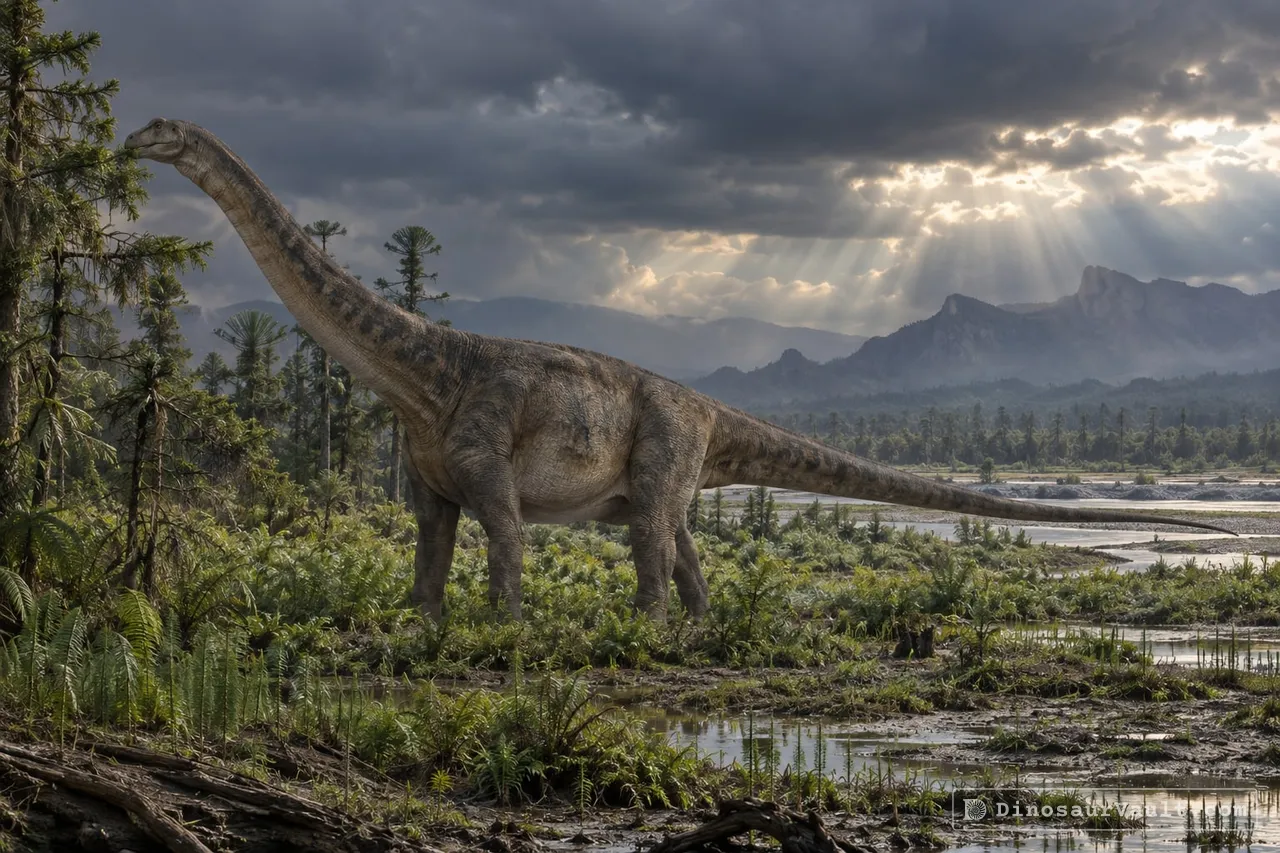
Karongasaurus was a titanosaur, a long-necked, four-legged plant eater, known from a lower jaw with teeth.
Its world
It lived in the Early Cretaceous in what is now Malawi. Its bones come from the Dinosaur Beds, where it shared the land with the titanosaur Malawisaurus.
How it was found
Gomani named Karongasaurus in 2005. Two finds are known.
Field gallery
More views of Karongasaurus
Scenes reconstructed from the available fossil evidence.
Lived alongside
Found in the same rock formations

A rock formation can hold fossils laid down millions of years apart, so not every animal here met Karongasaurus.
The evidence
The science behind Karongasaurus
Which parts of the picture come from its own bones, and which come from its relatives.
From its own fossils
- The type specimen is a left lower jaw bone with replacement teeth. Isolated teeth were also referred to it.
- Its slender, pencil-like teeth, worn at a slant, were clustered toward the front of the jaw, and a sharp ridge runs behind the tooth row.
- As first described, the shallow jaw curves inward toward the chin and its outer edge flares out at the front, suggesting a long, low skull.
Borrowed from relatives
- The missing upper part of the head is restored after Tapuiasaurus, and its jaw is compared with the squared-off lower jaw of Bonitasaura.
- The long neck, four-legged body and tail follow better-known titanosaurs such as Mnyamawamtuka.
Still unknown
- The length of its neck, the size of its body and its skin covering.
- Whether any of the unnamed backbone fossils from the Dinosaur Beds belong to it.
- The shape of the front of its jaw. A preliminary re-examination of the type jaw suggests it turned sharply inward in a squared-off corner rather than curving gently.
Discovery timeline
- 2005Named itGomani
- 2016SkullMartínez et al.
- 2019Same rocksAndrzejewski et al.
- 2022How it fedPoropat et al.
Key papers
The research behind what we know of Karongasaurus
Named it
Named Karongasaurus from a jaw and teeth, showing that it differed from Malawisaurus in its tooth shape and jaw proportions.
Sauropod dinosaurs from the Early Cretaceous of Malawi. Palaeontologia Electronica 8: 1-37
No link available
Skull
Described the complete skull of Sarmientosaurus and, comparing lower jaws, noted a possible sharp crest behind the tooth row of Karongasaurus.
A Basal Lithostrotian Titanosaur (Dinosauria: Sauropoda) with a Complete Skull: Implications for the Evolution and Paleobiology of Titanosauria. PLOS ONE 11: e0151661
Read the paper : A Basal Lithostrotian Titanosaur (Dinosauria: Sauropoda) with a Complete Skull: Implications for the Evolution and Paleobiology of Titanosauria (opens in a new tab)Same rocks
Scanned the braincase of Malawisaurus from the Dinosaur Beds and found inner-ear features consistent with an early branch of titanosaurs.
The braincase of Malawisaurus dixeyi (Sauropoda: Titanosauria): A 3D reconstruction of the brain endocast and inner ear. PLOS ONE 14: e0211423
Read the paper : The braincase of Malawisaurus dixeyi (Sauropoda: Titanosauria): A 3D reconstruction of the brain endocast and inner ear (opens in a new tab)How it fed
Reviewed early titanosauriform teeth worldwide, including the contrasting narrow teeth of Karongasaurus and broader teeth of Malawisaurus.
Sauropod dinosaur teeth from the lower Upper Cretaceous Winton Formation of Queensland, Australia and the global record of early titanosauriforms. Royal Society Open Science 9
Read the paper : Sauropod dinosaur teeth from the lower Upper Cretaceous Winton Formation of Queensland, Australia and the global record of early titanosauriforms (opens in a new tab)
Close relatives
Other members of Titanosauria


Sources: Wikidata