Lucianovenator
- Lived
- 227 to 206 million years ago, Late Triassic
- Diet
- Carnivore
- Group
- Theropods, Coelophysidae
- Found in
- Argentina
- Named by
- Martinez and Apaldetti 2017
Where its fossils were found
The evidence
Today

220 million years ago
Habitat
A warm, dry landscape crossed by rivers and floodplains in Argentina. Other animals from these rocks include Ingentia, Leyesaurus and tuatara relatives.
Field notes
About Lucianovenator
What it was like
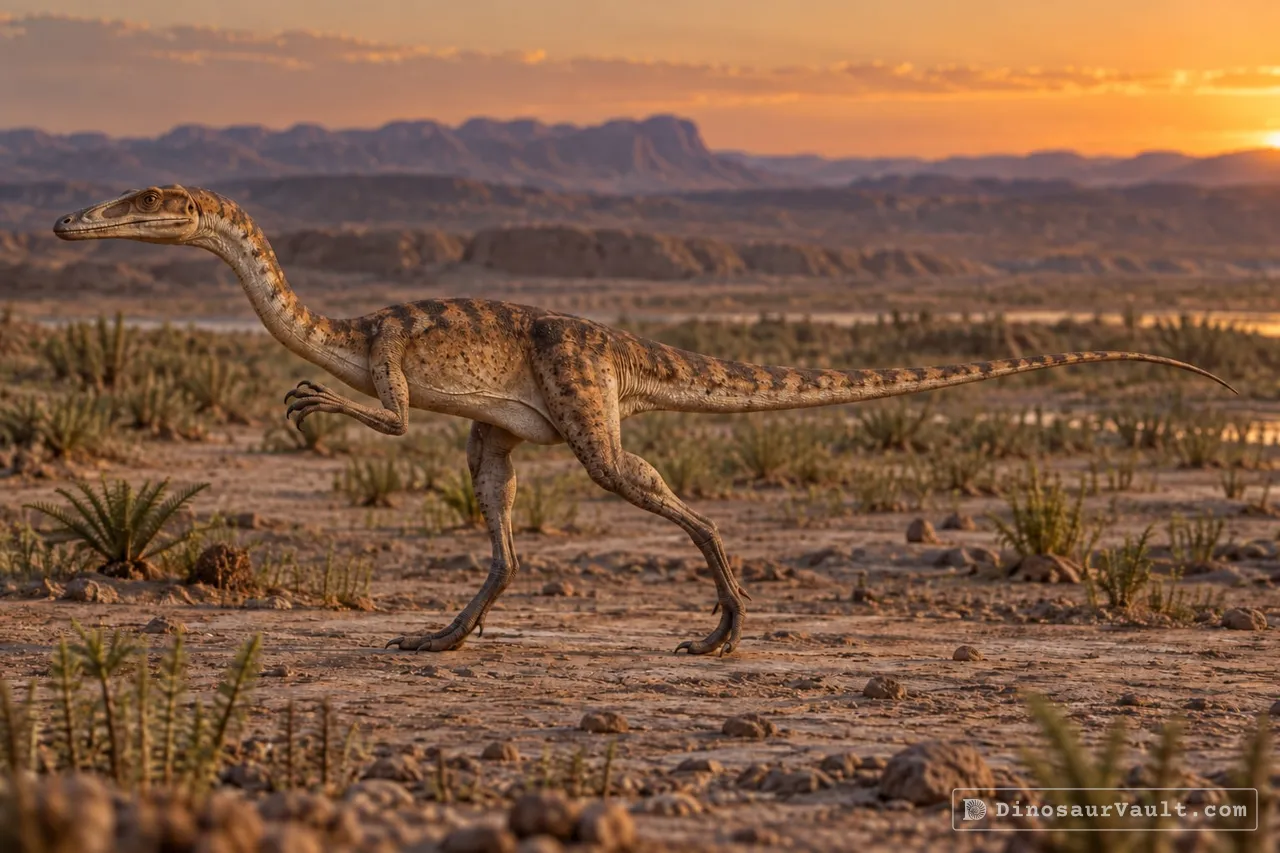
Lucianovenator was a slender, two-legged meat eater related to Coelophysis. It is known from part of the backbone and legs.
Its world
It lived in the Late Triassic, in what is now Argentina. It comes from the Quebrada del Barro Formation, where the large early sauropodomorph Ingentia also lived.
How it was found
Martinez and Apaldetti named Lucianovenator in 2017, in honor of the owner of the land where it was found.
Field gallery
More views of Lucianovenator
Scenes reconstructed from the available fossil evidence.
1 of 3
Lived alongside
Found in the same rock formations

A rock formation can hold fossils laid down millions of years apart, so not every animal here met Lucianovenator.
The evidence
The science behind Lucianovenator
Which parts of the picture come from its own bones, and which come from its relatives.
From its own fossils
- The original skeleton preserves much of the neck, part of the back and hip region, and the start of the tail.
- Long neck vertebrae have deep pits, thin ridges and internal air spaces.
- Additional specimens referred to Lucianovenator preserve partial hips of different sizes.
Borrowed from relatives
- The missing skull, arms, legs and most of the tail are restored from Coelophysis.
Still unknown
- The shape of its skull and teeth.
- Its skin covering and color.
- Whether the separate shin bone tentatively assigned to it really belongs to Lucianovenator. Its precise place among early theropods is unsettled.
Discovery timeline
- 2015Same rocksMartínez et al.
- 2017Named itMartínez & Apaldetti
- 2018Same rocksApaldetti et al.
Key papers
The research behind what we know of Lucianovenator
Same rocks
Reported the varied animals of the Quebrada del Barro Formation, including early theropods, turtles and relatives of mammals.
A New Late Triassic Vertebrate Assemblage from Northwestern Argentina. Ameghiniana 52: 379-390
Read the paper : A New Late Triassic Vertebrate Assemblage from Northwestern Argentina (opens in a new tab)Named it
Described the neck and hip bones and placed Lucianovenator among the slender early theropods related to Coelophysis.
A Late Norian—Rhaetian Coelophysid Neotheropod (Dinosauria, Saurischia) from the Quebrada Del Barro Formation, Northwestern Argentina. Ameghiniana 54: 488
Read the paper : A Late Norian—Rhaetian Coelophysid Neotheropod (Dinosauria, Saurischia) from the Quebrada Del Barro Formation, Northwestern Argentina (opens in a new tab)Same rocks
Described Ingentia, a large plant eater from the same formation, and showed that dinosaur gigantism began before the Jurassic.
An early trend towards gigantism in Triassic sauropodomorph dinosaurs. Nature Ecology & Evolution 2: 1227-1232
Read the paper : An early trend towards gigantism in Triassic sauropodomorph dinosaurs (opens in a new tab)
Close relatives
Other members of Coelophysidae


Sources: Wikidata