Lepidus
"charming"
- Lived
- 227 to 206 million years ago, Late Triassic
- Diet
- Carnivore
- Group
- Theropods, Coelophysidae
- Found in
- United States
- Named by
- Nesbitt and Ezcurra 2015
Where its fossils were found
The evidence
Today

220 million years ago
Habitat
It lived in what is now Texas, in a region of river channels, floodplains and lakes.
Field notes
About Lepidus
What it was like
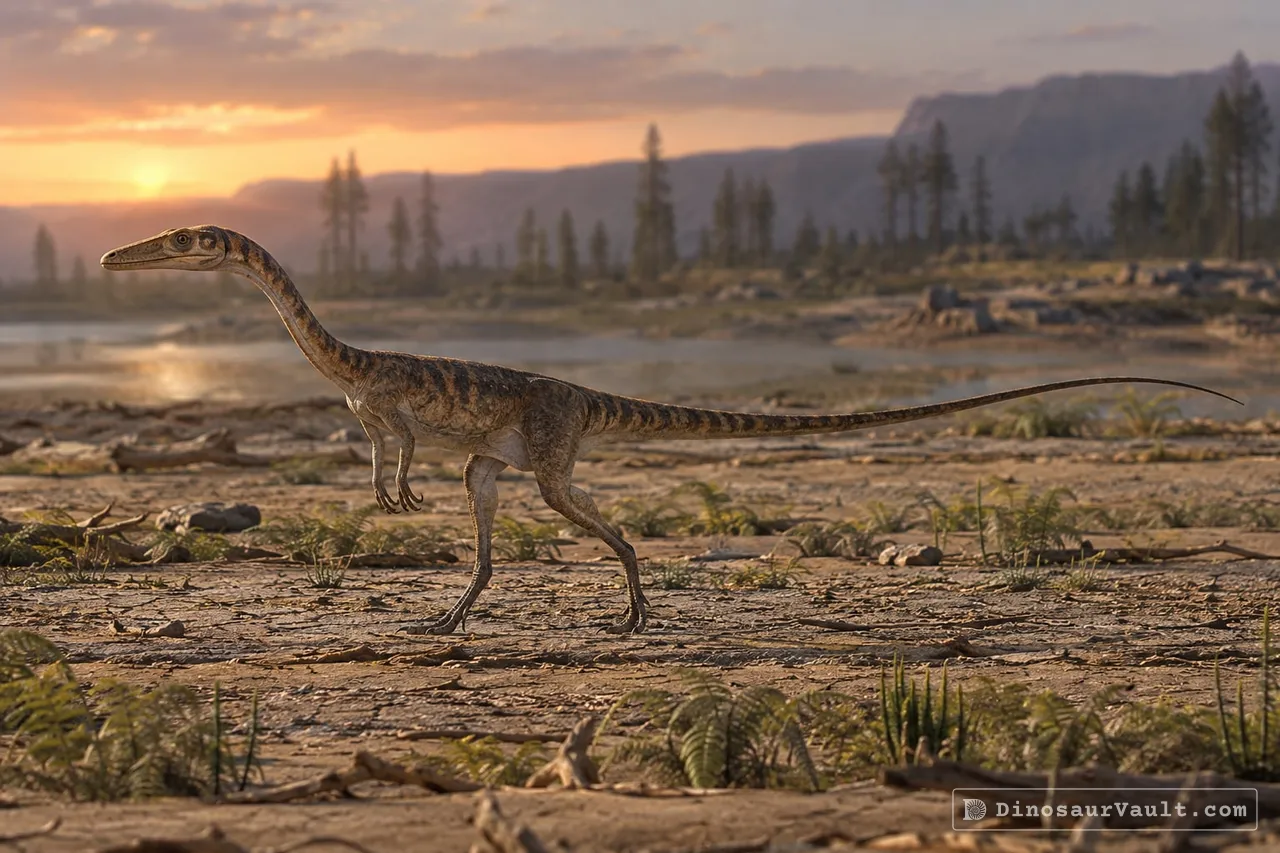
Lepidus was a small, slender predator related to Coelophysis. It is known from part of a leg and a few other bones.
Its world
It lived in the Late Triassic in what is now Texas.
How it was found
Nesbitt and Ezcurra named it in 2015.
Field gallery
More views of Lepidus
Scenes reconstructed from the available fossil evidence.
1 of 3
The evidence
The science behind Lepidus
Which parts of the picture come from its own bones, and which come from its relatives.
From its own fossils
- The specimen used to name Lepidus preserves the lower ends of the shin bones and the ankle, still joined together.
- The main ankle bones are fused into a single unit.
- The shin bone has distinctive ridges and muscle attachment scars.
Borrowed from relatives
- The missing head, arms and body are restored by comparison with slender early theropods such as Coelophysis.
- Comparisons with Coelophysis and Camposaurus link its ankle anatomy to the coelophysoid group.
Still unknown
- Whether the jaw and thigh fragments assigned to Lepidus belong to it.
- Its exact position among early theropods.
- Its full body size, skin covering and color.
Discovery timeline
- 2005Its worldLehman & Chatterjee
- 2011Close relativeEZCURRA & BRUSATTE
- 2015Named itNesbitt & EZCURRA
Key papers
The research behind what we know of Lepidus
Its world
Reconstructed the regional river, floodplain and lake deposits and reviewed the reptiles and amphibians that lived there.
Depositional setting and vertebrate biostratigraphy of the Triassic Dockum Group of Texas. Journal of Earth System Science 114: 325-351
Read the paper : Depositional setting and vertebrate biostratigraphy of the Triassic Dockum Group of Texas (opens in a new tab)Close relative
Identified distinctive ankle features in Camposaurus and placed it close to Coelophysis, providing comparisons later used to study Lepidus.
Taxonomic and phylogenetic reassessment of the early neotheropod dinosaur Camposaurus arizonensis from the Late Triassic of North America. Palaeontology 54: 763-772
Read the paper : Taxonomic and phylogenetic reassessment of the early neotheropod dinosaur Camposaurus arizonensis from the Late Triassic of North America (opens in a new tab)Named it
Named Lepidus from an articulated lower leg and ankle and placed it among early theropods related to Coelophysis.
The early fossil record of dinosaurs in North America: A new neotheropod from the base of the Upper Triassic Dockum Group of Texas. Acta Palaeontologica Polonica 60
Read the paper : The early fossil record of dinosaurs in North America: A new neotheropod from the base of the Upper Triassic Dockum Group of Texas (opens in a new tab)
Close relatives
Other members of Coelophysidae


Sources: Wikidata