Ingentia
"enormous"
Type species Ingentia prima
- Lived
- 227 to 206 million years ago, Late Triassic
- Diet
- Herbivore
- Group
- Sauropods, Lessemsauridae
- Found in
- Argentina
- Named by
- Apaldetti et al. 2018
Where its fossils were found
The evidence
Today

220 million years ago
Habitat
River channels and floodplains spread across the land now called Argentina. Lucianovenator lived in the same region, along with early crocodile relatives and turtle relatives.
Field notes
About Ingentia
What it was like
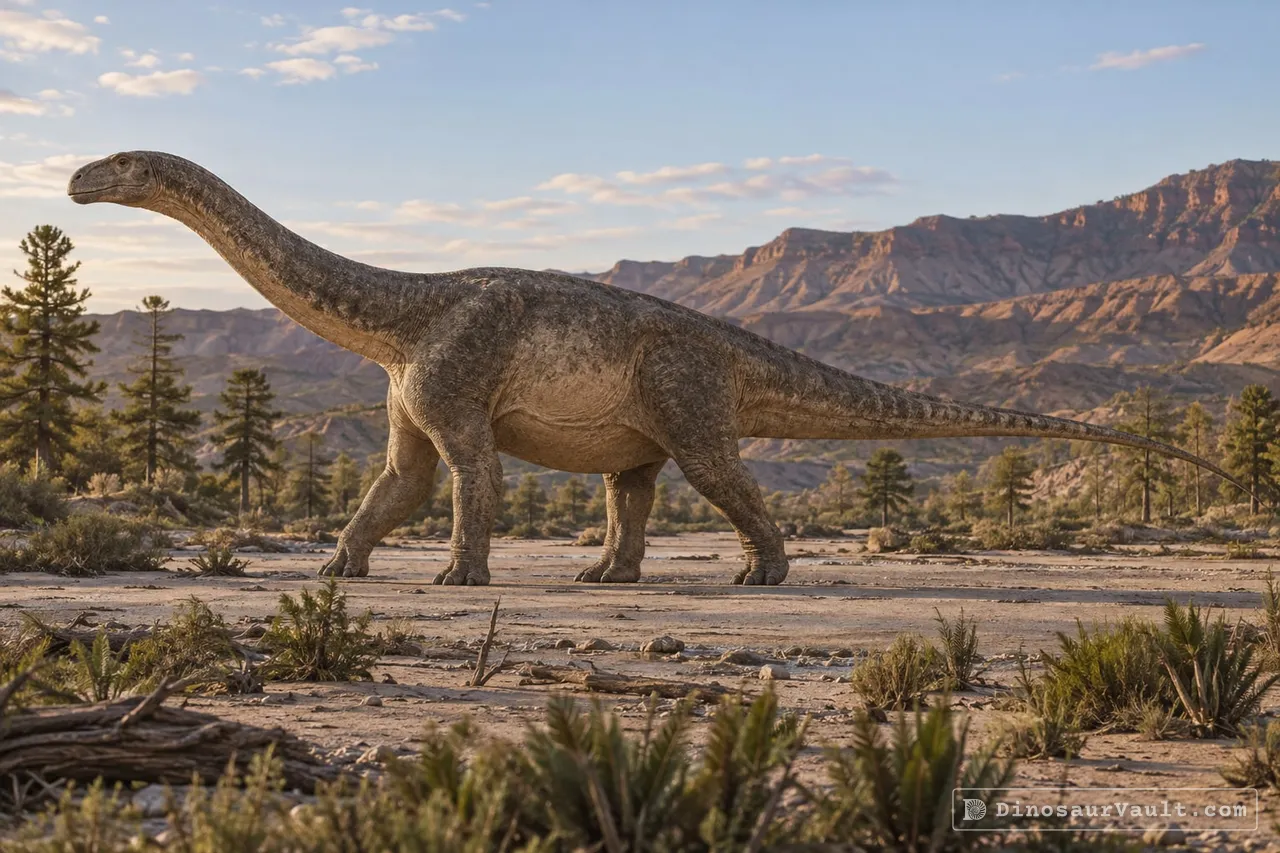
Ingentia was a large plant eater from the Late Triassic, when most long-necked dinosaurs were still small. It walked on all fours and was much heavier than its relatives of the time.
Its bones show it grew fast in bursts, and it had air sacs in its bones like later sauropods.
Its world
It lived in the Late Triassic in what is now Argentina. Its bones come from the Quebrada del Barro Formation, where it shared the land with the small hunter Lucianovenator.
How it was found
Apaldetti and colleagues named Ingentia prima in 2018. It showed that sauropod relatives became giants earlier than scientists had thought.
Field gallery
More views of Ingentia
Scenes reconstructed from the available fossil evidence.
1 of 3
Lived alongside
Found in the same rock formations

A rock formation can hold fossils laid down millions of years apart, so not every animal here met Ingentia.
The evidence
The science behind Ingentia
Which parts of the picture come from its own bones, and which come from its relatives.
From its own fossils
- The original skeleton preserves part of the neck, a shoulder blade and a forelimb.
- Its hand had short, sturdy palm bones and an especially thick thumb bone.
- Hollows in the neck bones housed extensions of air sacs.
Borrowed from relatives
- Antetonitrus helps fill in the missing hind limbs and feet.
- The missing head is restored by comparison with early long-necked plant eaters such as Plateosaurus.
Still unknown
- The shape of its skull.
- The complete arrangement of its fingers and claws.
- Its skin covering and color.
Discovery timeline
- 2014Close relativeMcPhee et al.
- 2018Named itApaldetti et al.
- 2022PostureLefebvre et al.
Key papers
The research behind what we know of Ingentia
Close relative
Described Antetonitrus, whose grasping forelimbs and weight-bearing hind limbs help explain the transition toward the sauropod body plan.
The complete anatomy and phylogenetic relationships ofAntetonitrus ingenipes(Sauropodiformes, Dinosauria): implications for the origins of Sauropoda. Zoological Journal of the Linnean Society 171: 151-205
Read the paper : The complete anatomy and phylogenetic relationships ofAntetonitrus ingenipes(Sauropodiformes, Dinosauria): implications for the origins of Sauropoda (opens in a new tab)Named it
Described a giant early sauropod relative with rapid growth in bursts and air sacs extending into its neck bones.
An early trend towards gigantism in Triassic sauropodomorph dinosaurs. Nature Ecology & Evolution 2: 1227-1232
Read the paper : An early trend towards gigantism in Triassic sauropodomorph dinosaurs (opens in a new tab)Posture
Compared limb shapes, including Ingentia, to trace how the weight-bearing limbs of giant sauropods evolved.
A path to gigantism: Three‐dimensional study of the sauropodomorph limb long bone shape variation in the context of the emergence of the sauropod bauplan. Journal of Anatomy 241: 297-336
Read the paper : A path to gigantism: Three‐dimensional study of the sauropodomorph limb long bone shape variation in the context of the emergence of the sauropod bauplan (opens in a new tab)
Close relatives
Other members of Lessemsauridae


Sources: Wikidata