Lavocatisaurus
"Lavocat's lizard"
- Lived
- 121 to 110 million years ago, Early Cretaceous
- Diet
- Herbivore
- Group
- Sauropods, Rebbachisauridae
- Found in
- Argentina
- Named by
- Canudo et al. 2018
Where its fossils were found
The evidence
Today

115 million years ago
Habitat
It lived in the dry landscape of the Rayoso Formation in Argentina. Sandstone around the bones preserves ripples and mudcracks left as shallow water moved and dried.
Field notes
About Lavocatisaurus
What it was like
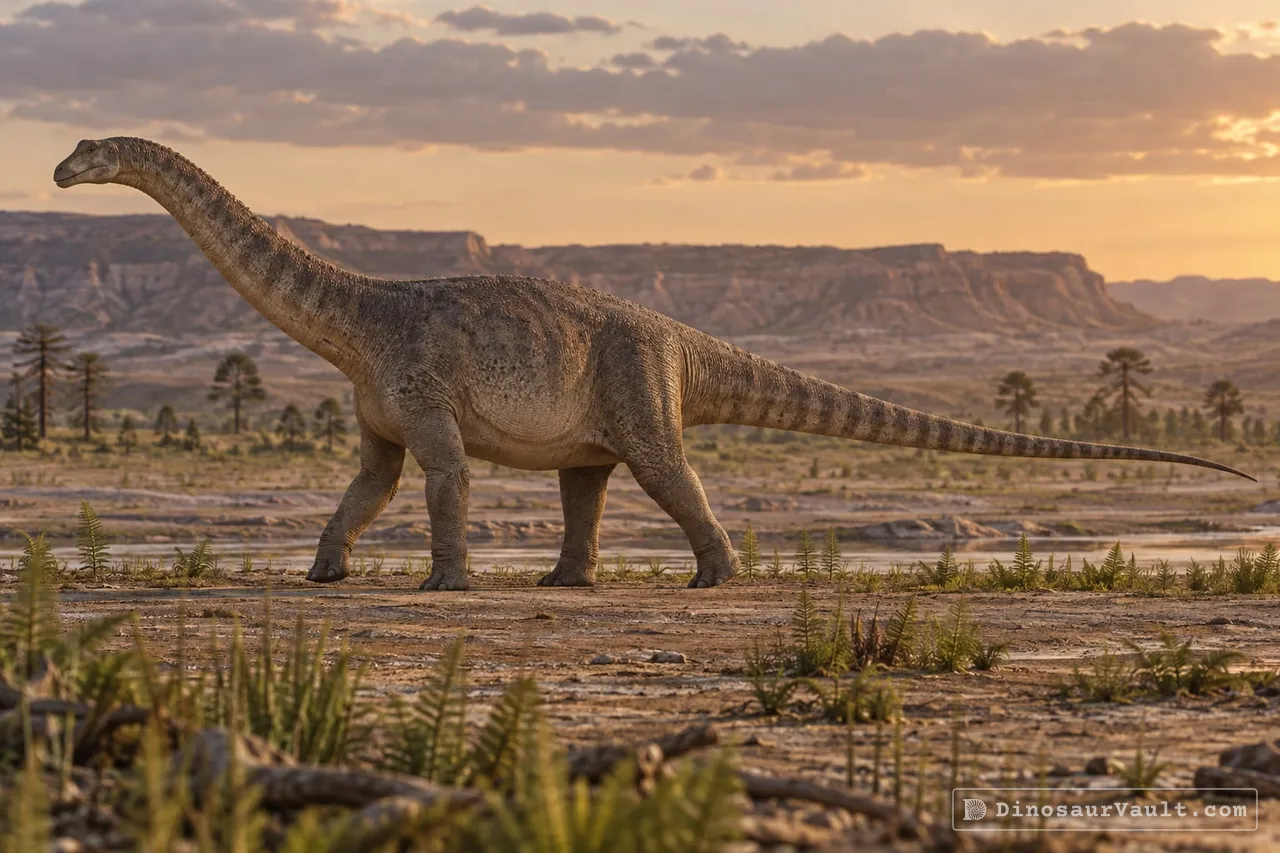
Lavocatisaurus was a rebbachisaur, a long-necked plant eater from a family related to Diplodocus. It is known from much of a skull and parts of the skeleton of an adult and two young animals. Missing parts of the skull roof and the area around the eyes are reconstructed from relatives.
Like its relatives, it probably fed on low plants.
Its world
It lived in the Early Cretaceous in what is now Argentina. Its bones come from the Rayoso Formation, which was a dry land in its time.
How it was found
Canudo and colleagues named Lavocatisaurus in 2018. The adult and young were found together, which suggests they may have moved in a group.
Field gallery
More views of Lavocatisaurus
Scenes reconstructed from the available fossil evidence.
1 of 3
The evidence
The science behind Lavocatisaurus
Which parts of the picture come from its own bones, and which come from its relatives.
From its own fossils
- Bones of an adult and two young animals, found together, cover most parts of the skeleton between them.
- The adult type specimen includes many separate skull bones, a long run of neck and tail vertebrae, and a badly preserved upper arm bone. Its neck vertebrae are relatively short.
- The upper jaw teeth are much larger than the lower jaw teeth, the lower jaw has a pronounced chin at the front, and the elongated skull has a large extra opening ahead of the eye.
Borrowed from relatives
- The restored roof of the skull and the area around the eye follow Nigersaurus and Diplodocus, the relatives the naming study used to complete the skull.
- Its snout lacked the extremely broad front of Nigersaurus, so that part is not borrowed.
Still unknown
- The full shape of its skull roof and of the bones around its eyes.
- Which rebbachisaurid was its closest relative. Studies place it on an early branch of the family without settling one.
- Exactly which plants it ate.
Discovery timeline
- 2007Close relativeSereno et al.
- 2018Named itCanudo et al.
- 2025Family treevan der Linden et al.
Key papers
The research behind what we know of Lavocatisaurus
Close relative
Reconstructed the skull of Nigersaurus, the relative used with Diplodocus to restore the missing parts of the Lavocatisaurus skull.
Structural Extremes in a Cretaceous Dinosaur. PLoS ONE 2: e1230
Read the paper : Structural Extremes in a Cretaceous Dinosaur (opens in a new tab)Named it
Described an adult and two young Lavocatisaurus, including much of the skull, with upper teeth much larger than the lower ones.
A new rebbachisaurid sauropod from the Aptian–Albian, Lower Cretaceous Rayoso Formation, Neuquén, Argentina. Acta Palaeontologica Polonica 63
Read the paper : A new rebbachisaurid sauropod from the Aptian–Albian, Lower Cretaceous Rayoso Formation, Neuquén, Argentina (opens in a new tab)Family tree
Reviewed diplodocoid anatomy and evolution, keeping Lavocatisaurus on an early branch of the rebbachisaurid family tree and contrasting its snout with that of Nigersaurus.
Introduction to Diplodocoidea. Palaeontologia Electronica
Read the paper : Introduction to Diplodocoidea (opens in a new tab)
Close relatives
Other members of Rebbachisauridae


Sources: Wikidata