Ferrisaurus
"iron lizard"
Type species Ferrisaurus sustutensis
- Lived
- 72 to 66 million years ago, Late Cretaceous
- Diet
- Herbivore
- Group
- Ceratopsians, Leptoceratopsidae
- Found in
- Canada
- Named by
- Arbour and Evans 2019
Where its fossils were found
The evidence
Today

70 million years ago
Habitat
A floodplain with lakes and ponds lay between rising mountains. Conifers and flowering plants grew in the region, and a land turtle lived near its fossil site.
Field notes
About Ferrisaurus
What it was like
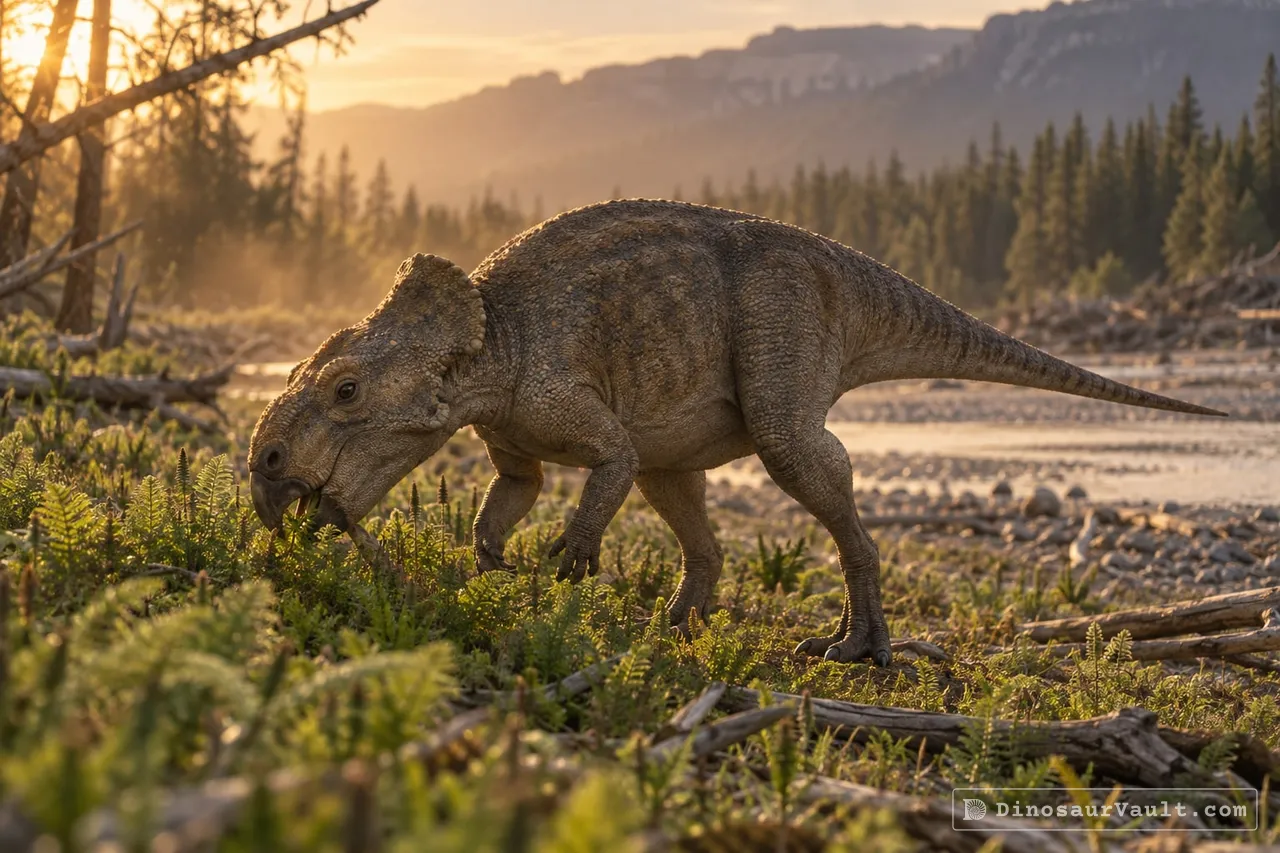
Ferrisaurus was a small horned dinosaur from the leptoceratopsids, known from part of a skeleton with arms and legs.
Its world
It lived about 72 to 66 million years ago, at the end of the Late Cretaceous, in what is now British Columbia, Canada. Its bones come from the Tango Creek Formation.
How it was found
Arbour and Evans named Ferrisaurus in 2019. It was found near a railway line, and it was the first dinosaur named from British Columbia.
Field gallery
More views of Ferrisaurus
Scenes reconstructed from the available fossil evidence.
The evidence
The science behind Ferrisaurus
Which parts of the picture come from its own bones, and which come from its relatives.
From its own fossils
- A partial skeleton preserves shoulder bones, part of an arm, lower leg bones and toes.
- The forearm bone has a broad, inward-curving end.
- The toe bones just before the claws are unusually long compared with those of most other leptoceratopsids. The claws are long, narrow and gently curved.
Borrowed from relatives
- The missing head and frill are compared with Leptoceratops, a small ceratopsian with a short, solid frill and no large facial horns.
Still unknown
- The shape of its skull and frill.
- Its skin texture and color.
- How its body proportions changed as it grew, and which leptoceratopsids were its closest relatives.
Discovery timeline
- 2008Full descriptionArbour & Graves
- 2019Named itArbour & Evans
- 2020Its worldArbour et al.
Key papers
The research behind what we know of Ferrisaurus
Full description
First described the skeleton later named Ferrisaurus, initially identifying it as an unnamed plant-eating dinosaur.
An ornithischian dinosaur from the Sustut Basin, north-central British Columbia, Canada. Canadian Journal of Earth Sciences 45: 457-463
Read the paper : An ornithischian dinosaur from the Sustut Basin, north-central British Columbia, Canada (opens in a new tab)Named it
Identified the partial skeleton as a new leptoceratopsid, distinguished by its forearm and toe bones.
A new leptoceratopsid dinosaur from Maastrichtian-aged deposits of the Sustut Basin, northern British Columbia, Canada. PeerJ 7: e7926
Read the paper : A new leptoceratopsid dinosaur from Maastrichtian-aged deposits of the Sustut Basin, northern British Columbia, Canada (opens in a new tab)Its world
Found turtle and plant fossils near the dinosaur's discovery area and used pollen to refine the age of its rocks.
Cretaceous flora and fauna of the Sustut Group near the Sustut River, northern British Columbia, Canada. Canadian Journal of Earth Sciences 57: 671-680
Read the paper : Cretaceous flora and fauna of the Sustut Group near the Sustut River, northern British Columbia, Canada (opens in a new tab)
Close relatives
Other members of Leptoceratopsidae


Sources: Wikidata