Kazaklambia
- Lived
- 90 to 84 million years ago, Late Cretaceous
- Diet
- Herbivore
- Group
- Ornithopods, Hadrosauridae
- Found in
- Kazakhstan
- Named by
- Bell and Brink 2013
Where its fossils were found
The evidence
Today

90 million years ago
Habitat
It lived in what is now southern Kazakhstan. Bactrosaurus and Jaxartosaurus are also recorded from the Dabrazhin Formation.
Field notes
About Kazaklambia
What it was like
Kazaklambia was a lambeosaurine duckbill, a plant eater that probably had a hollow crest. Its skeleton comes from a young animal, so the crest is only beginning to form.
Its world
It lived in the Late Cretaceous, in what is now Kazakhstan. It comes from the Dabrazhin Formation.
How it was found
Bell and Brink named Kazaklambia in 2013, for bones first placed in another duckbill. It is one of the most complete dinosaurs found in Kazakhstan.
Field gallery
More views of Kazaklambia
Scenes reconstructed from the available fossil evidence.
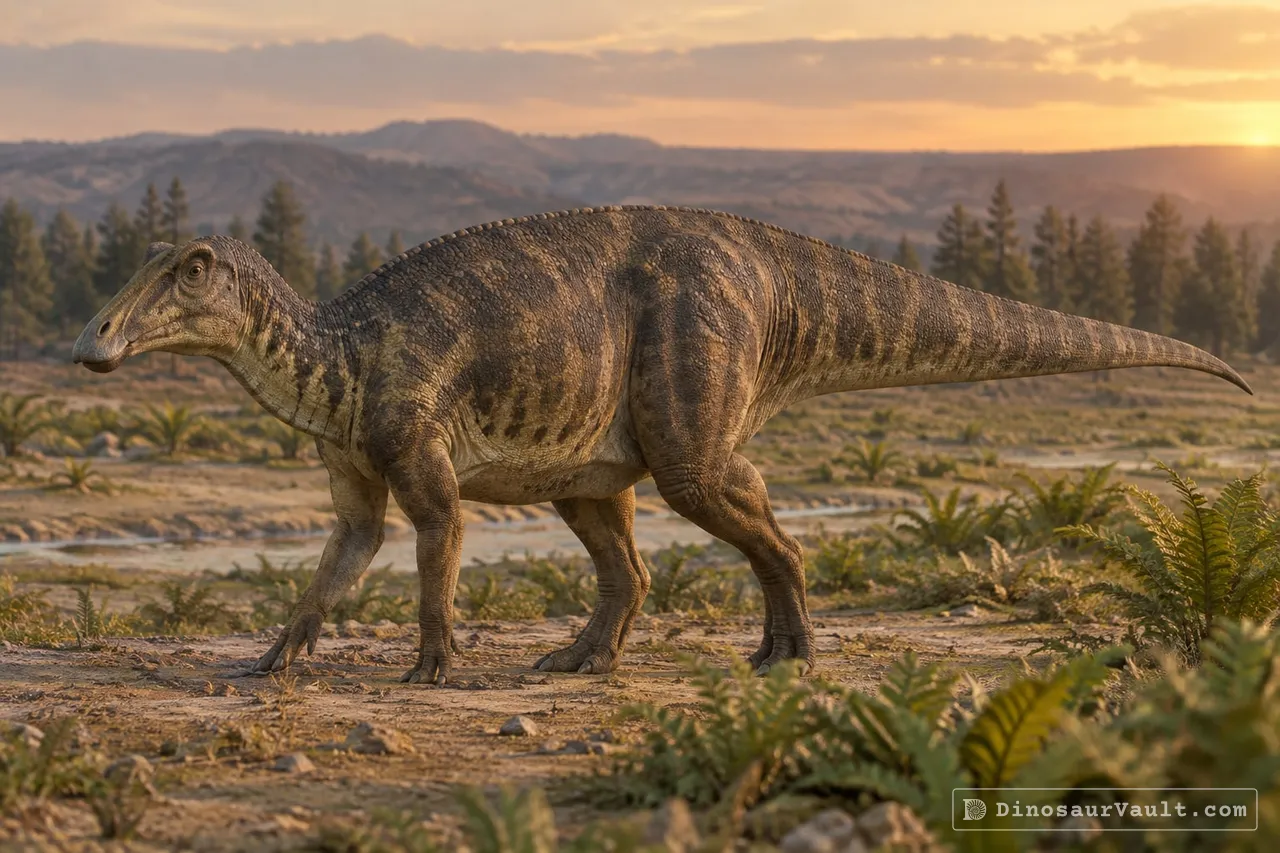
1 of 3
Lived alongside
Found in the same rock formations

A rock formation can hold fossils laid down millions of years apart, so not every animal here met Kazaklambia.
The evidence
The science behind Kazaklambia
Which parts of the picture come from its own bones, and which come from its relatives.
From its own fossils
- The type specimen is a nearly complete skeleton of a young animal, with much of the skull preserved.
- The skull has a low, hollow crest and small domes above and beside the eye socket.
Borrowed from relatives
- Most of the body is known from its own skeleton; the end of one hind leg is missing.
- An adult crest would be inferred from hollow-crested relatives such as Amurosaurus and Tsintaosaurus.
- Hypacrosaurus provides a comparison for the missing front of the snout and lower jaw.
Still unknown
- The missing front of its face and the shape and size of its adult crest.
- Its skin texture and color.
- The detailed landscape around its fossil site.
Discovery timeline
- 2013Named itBell & Brink
- 2013Close relativePrieto-Márquez & Wagner
- 2021Family treeRamírez Velasco et al.
- 2021Family treeHolland et al.
Key papers
The research behind what we know of Kazaklambia
Named it
Restudied the young animal's skull and separated it from other duckbills, naming Kazaklambia and linking it with early hollow-crested relatives.
Kazaklambia convincens comb. nov., a primitive juvenile lambeosaurine from the Santonian of Kazakhstan. Cretaceous Research 45: 265-274
Read the paper : Kazaklambia convincens comb. nov., a primitive juvenile lambeosaurine from the Santonian of Kazakhstan (opens in a new tab)Close relative
Rebuilt the hollow crest of Tsintaosaurus and traced how the skull and nasal passages changed in early crested duckbills.
The ‘Unicorn’ Dinosaur That Wasn’t: A New Reconstruction of the Crest of Tsintaosaurus and the Early Evolution of the Lambeosaurine Crest and Rostrum. PLoS ONE 8: e82268
Read the paper : The ‘Unicorn’ Dinosaur That Wasn’t: A New Reconstruction of the Crest of Tsintaosaurus and the Early Evolution of the Lambeosaurine Crest and Rostrum (opens in a new tab)Family tree
Described Tlatolophus and compared crested duckbill relationships, including Kazaklambia among the early branches.
Tlatolophus galorum, gen. et sp. nov., a parasaurolophini dinosaur from the upper Campanian of the Cerro del Pueblo Formation, Coahuila, northern Mexico. Cretaceous Research 126: 104884
Read the paper : Tlatolophus galorum, gen. et sp. nov., a parasaurolophini dinosaur from the upper Campanian of the Cerro del Pueblo Formation, Coahuila, northern Mexico (opens in a new tab)Family tree
Studied young hollow-crested duckbills whose bone behind the eye lacks the prominent dome found in Kazaklambia.
Taphonomy and taxonomy of a juvenile lambeosaurine (Ornithischia: Hadrosauridae) bonebed from the late Campanian Wapiti Formation of northwestern Alberta, Canada. PeerJ 9: e11290
Read the paper : Taphonomy and taxonomy of a juvenile lambeosaurine (Ornithischia: Hadrosauridae) bonebed from the late Campanian Wapiti Formation of northwestern Alberta, Canada (opens in a new tab)
Close relatives
Other members of Hadrosauridae


Sources: Wikidata