Jaxartosaurus
"Jaxartes lizard"
Type species Jaxartosaurus aralensis
- Lived
- 90 to 84 million years ago, Late Cretaceous
- Diet
- Herbivore
- Length
- about 9 m (30 ft)
- Group
- Ornithopods, Hadrosauridae
- Found in
- Kazakhstan
- Named by
- Riabinin 1937
Size comparison
To scale


Scale in metersOutline: typical ornithopod shape
Where its fossils were found
The evidence
Today

90 million years ago
Habitat
It lived in what is now Kazakhstan, where it probably browsed low vegetation. Other dinosaurs recorded in the region include Bactrosaurus and Kazaklambia.
Field notes
About Jaxartosaurus
What it was like
Jaxartosaurus was a duck-billed plant eater about 9 meters (30 feet) long. It belonged to the crested duckbills, relatives of Corythosaurus. It is known mainly from part of a skull.
Its world
It lived in the Late Cretaceous in what is now Kazakhstan. Its bones come from the Dabrazhin Formation.
How it was found
Riabinin named Jaxartosaurus in 1937. The type species is Jaxartosaurus aralensis. Its name comes from an old name of a river in the region.
Field gallery
More views of Jaxartosaurus
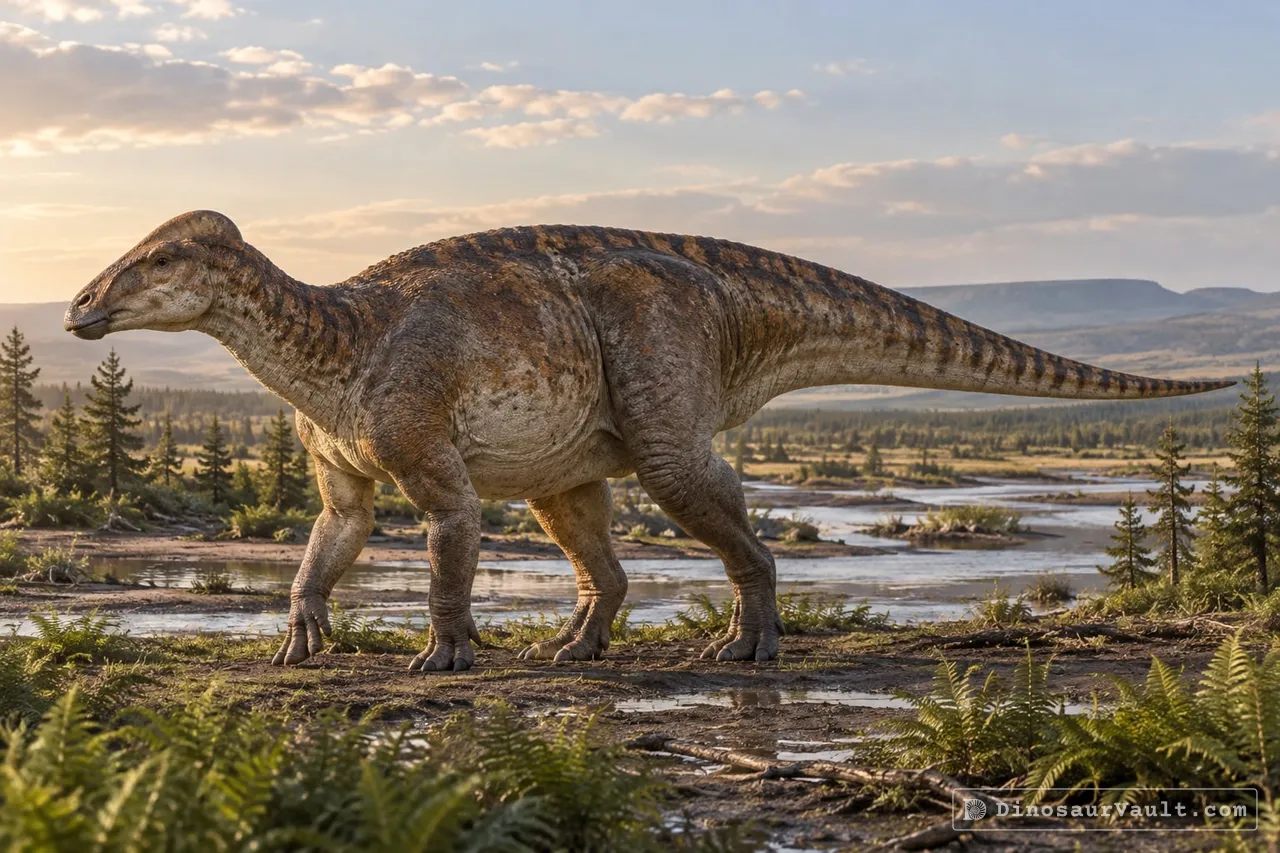
Scenes reconstructed from the available fossil evidence.
Lived alongside
Found in the same rock formations

A rock formation can hold fossils laid down millions of years apart, so not every animal here met Jaxartosaurus.
The evidence
The science behind Jaxartosaurus
Which parts of the picture come from its own bones, and which come from its relatives.
From its own fossils
- The best-known specimen preserves the skull roof and braincase.
- Its broad, swollen forehead bones helped support the base of a crest.
Borrowed from relatives
- The missing snout and body are restored by comparison with duckbills such as Edmontosaurus.
- A rounded crest is a possible restoration based on crested relatives such as Hypacrosaurus.
Still unknown
- The height and outline of its crest.
- Its skin color.
- How its head changed as it grew.
Discovery timeline
- 1937Named itRiabinin
- 2010Close relativeEVANS
- 2013SkullBell & Brink
Key papers
The research behind what we know of Jaxartosaurus
Named it
Named Jaxartosaurus from duckbill fossils found in Kazakhstan.
O nakhodke shlemonosnykh form Dinosauria verkhnemelovykh otlozheniyakh yuzhnogo Kazakhstana [The discovery of crested forms of Upper Cretaceous dinosaurs in southern Kazakhstan]. Priroda 1937: 91
No link available
Close relative
Tracked skull and crest growth in Hypacrosaurus, providing comparisons for the incomplete head of Jaxartosaurus.
Cranial anatomy and systematics of Hypacrosaurus altispinus, and a comparative analysis of skull growth in lambeosaurine hadrosaurids (Dinosauria: Ornithischia). Zoological Journal of the Linnean Society 159: 398-434
Read the paper : Cranial anatomy and systematics of Hypacrosaurus altispinus, and a comparative analysis of skull growth in lambeosaurine hadrosaurids (Dinosauria: Ornithischia) (opens in a new tab)Skull
Separated a young duckbill as Kazaklambia after comparing its skull with Jaxartosaurus and other crested duckbills.
Kazaklambia convincens comb. nov., a primitive juvenile lambeosaurine from the Santonian of Kazakhstan. Cretaceous Research 45: 265-274
Read the paper : Kazaklambia convincens comb. nov., a primitive juvenile lambeosaurine from the Santonian of Kazakhstan (opens in a new tab)
Close relatives
Other members of Hadrosauridae


Sources: Wikidata