Irisosaurus
"rainbow lizard"
- Lived
- 193 to 184 million years ago, Early Jurassic
- Found in
- China
- Named by
- Peyre de Fabrègues et al. 2020
Where its fossils were found
The evidence
Today

190 million years ago
Habitat
It lived in a region of rivers and lakes in what is now China. The Fengjiahe Formation also preserves Yunnanosaurus, Yimenosaurus and the armored Yuxisaurus.
Field notes
About Irisosaurus
What it was like
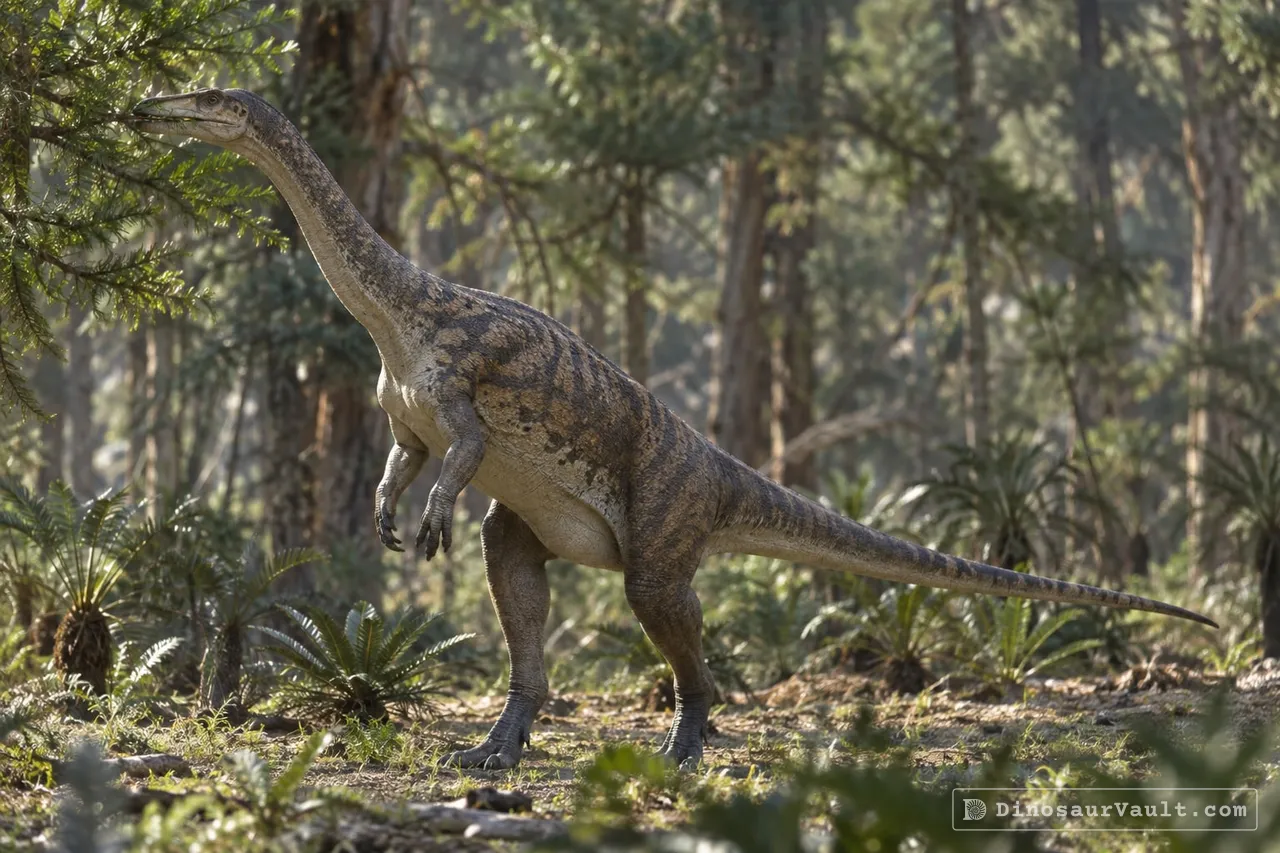
Irisosaurus was an early sauropodomorph, a plant eater with a long neck. It is known from part of the skeleton.
Its world
It lived in the Early Jurassic, in what is now China. It comes from the Fengjiahe Formation, where it shared the land with Yunnanosaurus and the early sauropod Chinshakiangosaurus.
How it was found
Peyre de Fabrègues and colleagues named Irisosaurus in 2020. Its name refers to rainbow-colored clouds seen in the region.
Field gallery
More views of Irisosaurus
Scenes reconstructed from the available fossil evidence.
1 of 3
Lived alongside
Found in the same rock formations


A rock formation can hold fossils laid down millions of years apart, so not every animal here met Irisosaurus.
The evidence
The science behind Irisosaurus
Which parts of the picture come from its own bones, and which come from its relatives.
From its own fossils
- A partial skeleton preserves jaw bones, teeth, neck and back vertebrae, ribs, shoulder bones, arms and hands, plus the ends of its lower hip bones and part of a toe claw.
- The upper jaw is short and deep at the front, with a deep, rimmed hollow around the nostril, and its teeth have smooth edges without the small serrations found in many other early long-necked dinosaurs.
- Its slender arms were built for grasping rather than bearing weight, suggesting it walked on its hind legs. Its sturdier hands bore the largest, sharply hooked claw on the inner finger.
Borrowed from relatives
- The original study found Mussaurus to be its closest known relative, though their jaws and arms differ.
- The missing face and skull roof can be restored after Massospondylus, and the rest of the hips and the hind legs after early long-necked dinosaurs such as Adeopapposaurus.
- Its skin covering follows comparisons with other dinosaurs.
Still unknown
- Its skin texture and color.
- Its complete skull, hind-limb and tail proportions.
- How its body changed as it grew.
Discovery timeline
- 2020Named itPeyre de Fabrègues et al.
- 2022Same rocksYao et al.
- 2025Family treeWang et al.
- 2025Its worldLuo et al.
Key papers
The research behind what we know of Irisosaurus
Named it
Described a partial skeleton with distinctive jaw bones and smooth-edged teeth, placing Irisosaurus close to Mussaurus.
A new species of early-diverging Sauropodiformes from the Lower Jurassic Fengjiahe Formation of Yunnan Province, China. Scientific Reports 10
Read the paper : A new species of early-diverging Sauropodiformes from the Lower Jurassic Fengjiahe Formation of Yunnan Province, China (opens in a new tab)Same rocks
Described Yuxisaurus, a heavily built armored dinosaur from the same formation, showing that this community included more than long-necked plant eaters.
A new early branching armored dinosaur from the Lower Jurassic of southwestern China. eLife 11
Read the paper : A new early branching armored dinosaur from the Lower Jurassic of southwestern China (opens in a new tab)Family tree
Named Wudingloong from China and kept Irisosaurus as a separate early sauropodiform in its family-tree analysis, comparing their thumbs.
A new Early Jurassic dinosaur represents the earliest-diverging and oldest sauropodomorph of East Asia. Scientific Reports 15
Read the paper : A new Early Jurassic dinosaur represents the earliest-diverging and oldest sauropodomorph of East Asia (opens in a new tab)Its world
Traced the origins of sand in the fossil-bearing formation, helping explain the history of its river and lake basin.
Detrital Zircon Geochronology of Early Jurassic Successions in the Central Yunnan Basin, Southwest China: Implications of Sedimentary Provenance and Tectonic Evolution. Journal of Earth Science 36: 1465-1478
Read the paper : Detrital Zircon Geochronology of Early Jurassic Successions in the Central Yunnan Basin, Southwest China: Implications of Sedimentary Provenance and Tectonic Evolution (opens in a new tab)
Close relatives
Other members of Sauropodiformes


Sources: Wikidata