Gondwanatitan
"Gondwana titan"
- Lived
- 84 to 66 million years ago, Late Cretaceous
- Diet
- Herbivore
- Group
- Sauropods
- Found in
- Brazil
- Named by
- Kellner and Azevedo 1999
Where its fossils were found
The evidence
Today

75 million years ago
Habitat
Rivers and lakes lay among sandy plains in what is now Brazil. Other titanosaurs from the Adamantina Formation include Maxakalisaurus and Brasilotitan.
Field notes
About Gondwanatitan
What it was like
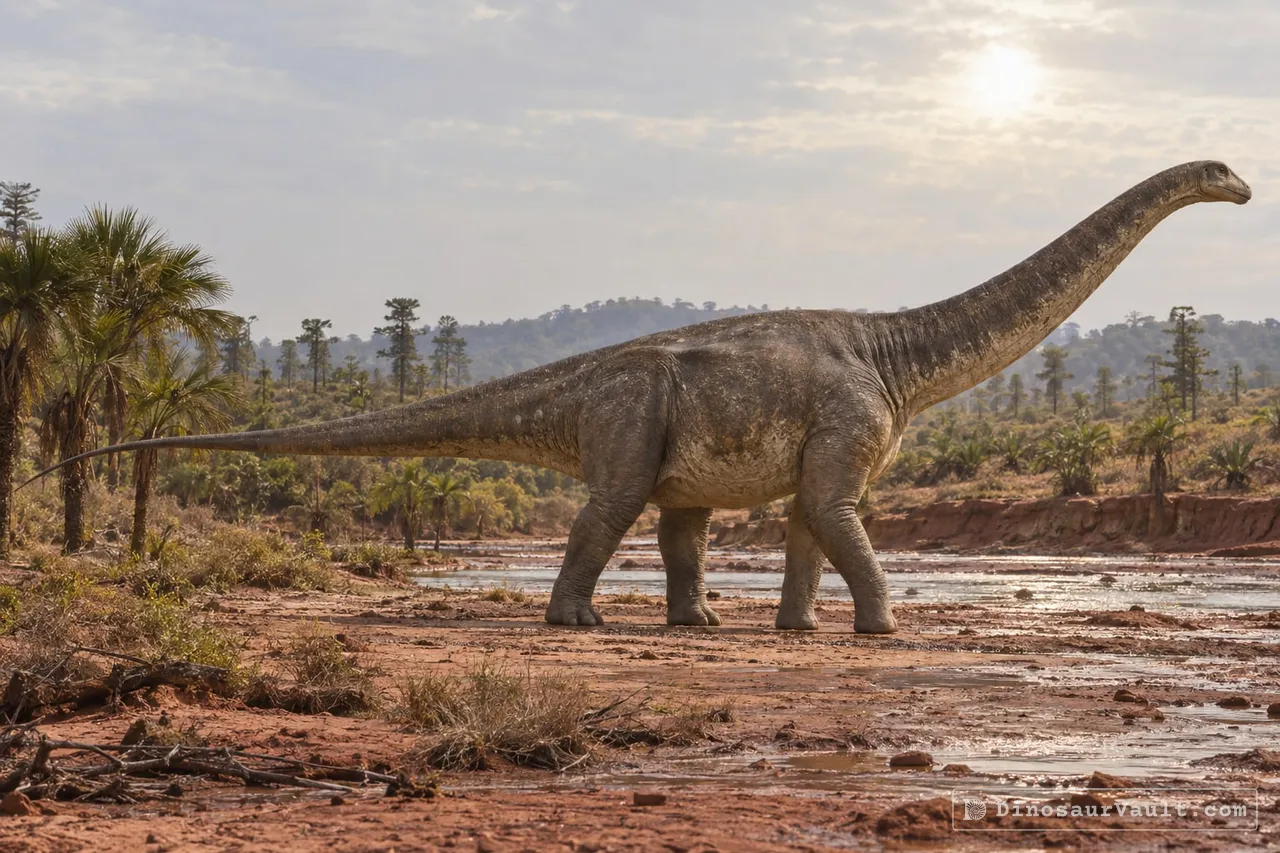
Gondwanatitan was a fairly small titanosaur, a long-necked plant eater. It was a close relative of Aeolosaurus. Its tail bones had spines that leaned forward, like those of its relatives.
Its world
It lived in the Late Cretaceous in what is now Brazil. Its bones come from the Adamantina Formation, where the titanosaur Maxakalisaurus also lived. Brazil was then part of Gondwana, the southern supercontinent.
How it was found
Kellner and Azevedo named Gondwanatitan in 1999.
Field gallery
More views of Gondwanatitan
Scenes reconstructed from the available fossil evidence.
1 of 2
Lived alongside
Found in the same rock formations


A rock formation can hold fossils laid down millions of years apart, so not every animal here met Gondwanatitan.
The evidence
The science behind Gondwanatitan
Which parts of the picture come from its own bones, and which come from its relatives.
From its own fossils
- An associated partial skeleton preserves neck, back, hip and tail bones, ribs, upper arm bones and shin bones.
- Some tail bones have heart-shaped joint surfaces and forward-leaning spines.
Borrowed from relatives
- Tapuiasaurus provides a comparison for the missing head.
- Rapetosaurus helps restore the missing hands, feet and other gaps in the skeleton.
Still unknown
- The exact shape of its skull and the proportions of its complete limbs.
- Its skin texture and color.
- How its body changed as it grew.
Often drawn wrong
- The heart-shaped surfaces were joints inside the tail, rather than ornaments on its skin.
Discovery timeline
- 1999Named itKellner & Azevedo
- 2006Its worldCandeiro et al.
- 2011Family treeSANTUCCI & DE ARRUDA-CAMPOS
Key papers
The research behind what we know of Gondwanatitan
Named it
Named Gondwanatitan from a partial skeleton with distinctive tail, upper arm and shin bones.
A new sauropod dinosaur (Titanosauria) from the Late Cretaceous of Brazil. Proceedings of the Second Gondwanan Dinosaur Symposium, National Science Museum Monographs 15: 111-142
No link available
Its world
Reviewed the animals of these rocks and supported separating Gondwanatitan from Aeolosaurus using differences in its tail, hips and upper arm.
Tetrapods from the Upper Cretaceous (Turonian–Maastrichtian) Bauru Group of Brazil: a reappraisal. Cretaceous Research 27: 923-946
Read the paper : Tetrapods from the Upper Cretaceous (Turonian–Maastrichtian) Bauru Group of Brazil: a reappraisal (opens in a new tab)Family tree
Compared related titanosaurs and supported Gondwanatitan as a separate genus within the same family branch as Aeolosaurus.
A new sauropod (Macronaria, Titanosauria) from the Adamantina Formation, Bauru Group, Upper Cretaceous of Brazil and the phylogenetic relationships of Aeolosaurini. Zootaxa 3085
Read the paper : A new sauropod (Macronaria, Titanosauria) from the Adamantina Formation, Bauru Group, Upper Cretaceous of Brazil and the phylogenetic relationships of Aeolosaurini (opens in a new tab)
Close relatives
Other members of Aeolosaurini


Sources: Wikidata