Mesetasaurus
Type species Mesetasaurus protector
- Lived
- 86 to 72 million years ago, Late Cretaceous
- Diet
- Herbivore
- Group
- Sauropods
- Found in
- Uruguay
- Named by
- Soto Núñez et al. 2026
Where its fossils were found
The evidence
Today

80 million years ago
Habitat
Rivers carried sand and mud through what is now Uruguay, with wind also moving sand locally. Uruguaysuchus, a crocodile relative, and the titanosaur Udelartitan also lived in this landscape.
Field notes
About Mesetasaurus
What it was like
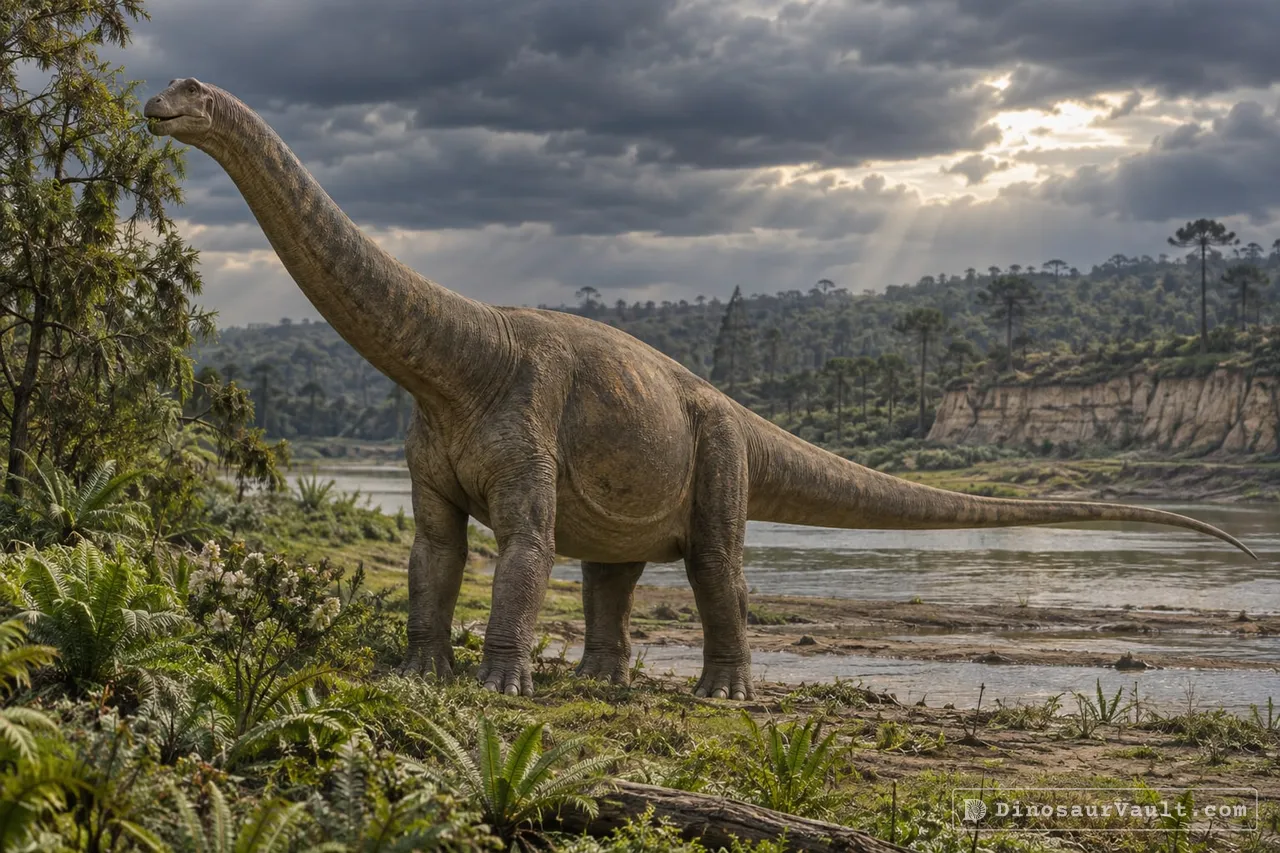
Mesetasaurus was a titanosaur, a long-necked plant eater related to Aeolosaurus. It is known from part of one skeleton.
Its world
It lived in the Late Cretaceous, in what is now Uruguay. It comes from the Guichón Formation, where the titanosaur Udelartitan was also found.
How it was found
Soto and colleagues named Mesetasaurus in 2026. The type species is Mesetasaurus protector.
Field gallery
More views of Mesetasaurus
Scenes reconstructed from the available fossil evidence.
Lived alongside
Found in the same rock formations

A rock formation can hold fossils laid down millions of years apart, so not every animal here met Mesetasaurus.
The evidence
The science behind Mesetasaurus
Which parts of the picture come from its own bones, and which come from its relatives.
From its own fossils
- The type material is a pair of anterior tail vertebrae with incomplete spines and side projections.
- The surviving spine bases are nearly vertical in the earlier vertebra and lean slightly forward in the later one.
- A distinctive blind pit lies near the lower rear joint surface of a tail vertebra.
Borrowed from relatives
- Tapuiasaurus provides a comparison for its missing head.
- Mnyamawamtuka provides comparisons for the missing trunk, limbs, hands and feet.
- Arrudatitan provides a comparison for missing neck and trunk bones.
Still unknown
- Its body size and the shape of its head.
- Its skin covering and color.
- Its exact position among the aeolosaurin titanosaurs, which the naming paper's analysis supports only weakly, and the full shape of its tail spines.
Discovery timeline
- 2011Family treeSANTUCCI & DE ARRUDA-CAMPOS
- 2024Same rocksSoto et al.
- 2026Named itSoto Núñez, Montenegro & Perea
Key papers
The research behind what we know of Mesetasaurus
Family tree
Compared the tail bones of Aeolosaurus and its relatives to define features of their shared branch of the titanosaur family tree.
A new sauropod (Macronaria, Titanosauria) from the Adamantina Formation, Bauru Group, Upper Cretaceous of Brazil and the phylogenetic relationships of Aeolosaurini. Zootaxa 3085
Read the paper : A new sauropod (Macronaria, Titanosauria) from the Adamantina Formation, Bauru Group, Upper Cretaceous of Brazil and the phylogenetic relationships of Aeolosaurini (opens in a new tab)Same rocks
Described Udelartitan from tail and limb bones, establishing another titanosaur lineage in the same formation.
Phylogenetic relationships of a new titanosaur (Dinosauria, Sauropoda) from the Upper Cretaceous of Uruguay. Cretaceous Research 160: 105894
Read the paper : Phylogenetic relationships of a new titanosaur (Dinosauria, Sauropoda) from the Upper Cretaceous of Uruguay (opens in a new tab)Named it
Named Mesetasaurus from tail vertebrae and identified an aeolosaurin lineage distinct from the other titanosaur known from these rocks.
A NEW AEOLOSAURINI (SAUROPODA, TITANOSAURIA) FROM THE UPPER CRETACEOUS OF URUGUAY. Ameghiniana
Read the paper : A NEW AEOLOSAURINI (SAUROPODA, TITANOSAURIA) FROM THE UPPER CRETACEOUS OF URUGUAY (opens in a new tab)
Close relatives
Other members of Aeolosaurini


Sources: Wikidata